Prevention Insights, Department of Applied Health Science, School of Public Health - Bloomington, Indiana University Bloomington, Bloomington, IN, United States.
Department of Population Health Sciences, Weill Cornell Medical College, New York, NY, United States.
J Med Internet Res. 2023 Mar 30;25:e45482. doi: 10.2196/45482.
Scientists often make cognitive claims (eg, the results of their work) and normative claims (eg, what should be done based on those results). Yet, these types of statements contain very different information and implications. This randomized controlled trial sought to characterize the granular effects of using normative language in science communication.
Our study examined whether viewing a social media post containing scientific claims about face masks for COVID-19 using both normative and cognitive language (intervention arm) would reduce perceptions of trust and credibility in science and scientists compared with an identical post using only cognitive language (control arm). We also examined whether effects were mediated by political orientation.
This was a 2-arm, parallel group, randomized controlled trial. We aimed to recruit 1500 US adults (age 18+) from the Prolific platform who were representative of the US population census by cross sections of age, race/ethnicity, and gender. Participants were randomly assigned to view 1 of 2 images of a social media post about face masks to prevent COVID-19. The control image described the results of a real study (cognitive language), and the intervention image was identical, but also included recommendations from the same study about what people should do based on the results (normative language). Primary outcomes were trust in science and scientists (21-item scale) and 4 individual items related to trust and credibility; 9 additional covariates (eg, sociodemographics, political orientation) were measured and included in analyses.
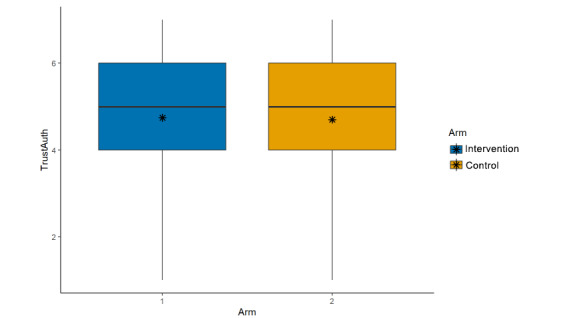
From September 4, 2022, to September 6, 2022, 1526 individuals completed the study. For the sample as a whole (eg, without interaction terms), there was no evidence that a single exposure to normative language affected perceptions of trust or credibility in science or scientists. When including the interaction term (study arm × political orientation), there was some evidence of differential effects, such that individuals with liberal political orientation were more likely to trust scientific information from the social media post's author if the post included normative language, and political conservatives were more likely to trust scientific information from the post's author if the post included only cognitive language (β=0.05, 95% CI 0.00 to 0.10; P=.04).
This study does not support the authors' original hypotheses that single exposures to normative language can reduce perceptions of trust or credibility in science or scientists for all people. However, the secondary preregistered analyses indicate the possibility that political orientation may differentially mediate the effect of normative and cognitive language from scientists on people's perceptions. We do not submit this paper as definitive evidence thereof but do believe that there is sufficient evidence to support additional research into this topic, which may have implications for effective scientific communication.
OSF Registries osf.io/kb3yh; https://osf.io/kb3yh.
INTERNATIONAL REGISTERED REPORT IDENTIFIER (IRRID): RR2-10.2196/41747.
科学家经常做出认知声明(例如,他们工作的结果)和规范声明(例如,基于这些结果应该做什么)。然而,这些类型的陈述包含非常不同的信息和含义。本随机对照试验旨在描述在科学传播中使用规范语言对认知产生的细微影响。
我们的研究考察了与仅使用认知语言的社交媒体帖子(对照组)相比,观看包含有关 COVID-19 口罩的科学声明并同时使用规范和认知语言的社交媒体帖子(干预组)是否会降低对科学和科学家的信任和可信度。我们还检查了这些效果是否通过政治取向来介导。
这是一项 2 臂、平行组、随机对照试验。我们的目标是从 Prolific 平台招募 1500 名美国成年人(18 岁以上),通过年龄、种族/族裔和性别等横截面代表美国人口普查。参与者被随机分配观看有关预防 COVID-19 的口罩的社交媒体帖子的 2 个图像之一。对照组的图像描述了一项真实研究的结果(认知语言),而干预组的图像是相同的,但也包括基于结果建议人们应该做什么的建议(规范语言)。主要结果是对科学和科学家的信任(21 项量表)和与信任和可信度相关的 4 项单项指标;还测量了 9 项其他协变量(例如,社会人口统计学、政治取向)并将其包含在分析中。
从 2022 年 9 月 4 日至 9 月 6 日,共有 1526 人完成了这项研究。对于整个样本(例如,没有交互项),没有证据表明单次接触规范语言会影响对科学或科学家的信任或可信度。当包含交互项(研究臂×政治取向)时,有一些证据表明存在差异效应,例如,具有自由政治取向的个体如果社交媒体帖子包含规范语言,则更有可能信任帖子作者的科学信息,而政治保守派如果帖子只包含认知语言,则更有可能信任帖子作者的科学信息(β=0.05,95%CI 0.00 至 0.10;P=.04)。
这项研究不支持作者最初的假设,即单次接触规范语言会降低所有人对科学或科学家的信任或可信度。然而,预先注册的次要分析表明,政治取向可能会以不同的方式调节科学家的规范语言和认知语言对人们看法的影响。我们不将这篇论文作为这方面的明确证据提交,但确实认为有足够的证据支持对这一主题进行更多研究,这可能对有效的科学传播产生影响。
OSF 注册表 osf.io/kb3yh;https://osf.io/kb3yh。
国际注册报告标识符(IRRID):RR2-10.2196/41747。