Agley Jon, Xiao Yunyu, Thompson Esi E, Golzarri-Arroyo Lilian
Prevention Insights, Department of Applied Health Science, School of Public Health Bloomington, Indiana University Bloomington, Bloomington, IN, United States.
Indiana University School of Social Work, Indiana University Bloomington and Indiana University-Purdue University Indianapolis, Bloomington/Indianapolis, IN, United States.
JMIR Res Protoc. 2020 Dec 7;9(12):e24383. doi: 10.2196/24383.
As the COVID-19 pandemic continues to affect life in the United States, the important role of nonpharmaceutical preventive behaviors (such as wearing a face mask) in reducing the risk of infection has become clear. During the pandemic, researchers have observed the rapid proliferation of misinformed or inconsistent narratives about COVID-19. There is growing evidence that such misinformed narratives are associated with various forms of undesirable behavior (eg, burning down cell towers). Furthermore, individuals' adherence to recommended COVID-19 preventive guidelines has been inconsistent, and such mandates have engendered opposition and controversy. Recent research suggests the possibility that trust in science and scientists may be an important thread to weave throughout these seemingly disparate components of the modern public health landscape. Thus, this paper describes the protocol for a randomized trial of a brief, digital intervention designed to increase trust in science.
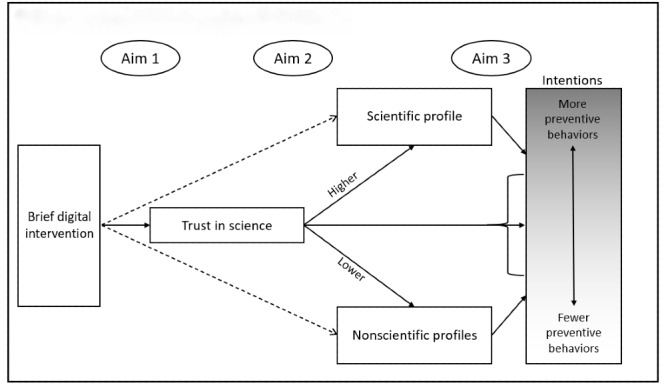
The objective of this study is to examine whether exposure to a curated infographic can increase trust in science, reduce the believability of misinformed narratives, and increase the likelihood to engage in preventive behaviors.
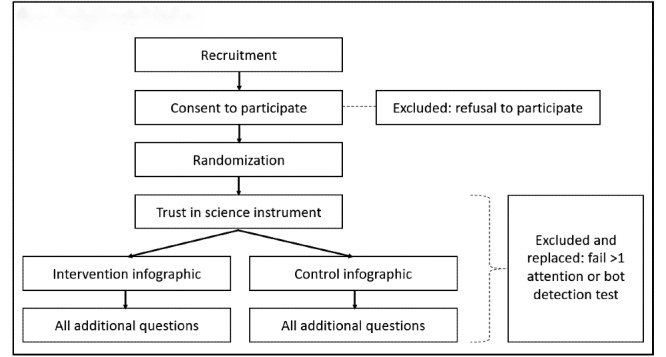
This is a randomized, placebo-controlled, superiority trial comprising 2 parallel groups. A sample of 1000 adults aged ≥18 years who are representative of the population of the United States by gender, race and ethnicity, and age will be randomly assigned (via a 1:1 allocation) to an intervention or a placebo-control arm. The intervention will be a digital infographic with content based on principles of trust in science, developed by a health communications expert. The intervention will then be both pretested and pilot-tested to determine its viability. Study outcomes will include trust in science, a COVID-19 narrative belief latent profile membership, and the likelihood to engage in preventive behaviors, which will be controlled by 8 theoretically selected covariates.
This study was funded in August 2020, approved by the Indiana University Institutional Review Board on September 15, 2020, and prospectively registered with ClinicalTrials.gov.
COVID-19 misinformation prophylaxis is crucial. This proposed experiment investigates the impact of a brief yet actionable intervention that can be easily disseminated to increase individuals' trust in science, with the intention of affecting misinformation believability and, consequently, preventive behavioral intentions.
ClinicalTrials.gov NCT04557241; https://clinicaltrials.gov/ct2/show/NCT04557241.
INTERNATIONAL REGISTERED REPORT IDENTIFIER (IRRID): PRR1-10.2196/24383.
随着新冠疫情持续影响美国的生活,非药物预防行为(如佩戴口罩)在降低感染风险方面的重要作用已变得清晰。在疫情期间,研究人员观察到关于新冠病毒的错误信息或前后矛盾的说法迅速传播。越来越多的证据表明,此类错误信息与各种不良行为(如焚烧手机信号塔)有关。此外,个人对推荐的新冠预防指南的遵守情况并不一致,此类规定引发了反对和争议。近期研究表明,对科学和科学家的信任可能是贯穿现代公共卫生领域这些看似 disparate 组成部分的一条重要线索。因此,本文描述了一项随机试验的方案,该试验旨在进行一项简短的数字干预,以增强对科学的信任。
本研究的目的是检验接触精心策划的信息图是否能增强对科学的信任、降低错误信息的可信度,并增加采取预防行为的可能性。
这是一项随机、安慰剂对照的优效性试验,包括 2 个平行组。将从年龄≥18 岁的成年人中抽取 1000 名样本,这些样本在性别、种族和族裔以及年龄方面能代表美国人口,将通过 1:1 分配随机分配到干预组或安慰剂对照组。干预措施将是一张数字信息图,其内容基于科学信任原则,由一位健康传播专家编制。然后将对该干预措施进行预测试和试点测试,以确定其可行性。研究结果将包括对科学的信任、新冠病毒说法信念潜在概况成员身份以及采取预防行为的可能性,这些将由 8 个理论上选定的协变量进行控制。
本研究于 2020 年 8 月获得资助,2020 年 9 月 15 日获得印第安纳大学机构审查委员会批准,并在 ClinicalTrials.gov 上进行了前瞻性注册。
预防新冠病毒错误信息至关重要。这项拟议的实验调查了一种简短但可行干预措施的影响,该措施可以轻松传播,以增强个人对科学的信任,旨在影响错误信息的可信度,进而影响预防行为意图。
ClinicalTrials.gov NCT04557241;https://clinicaltrials.gov/ct2/show/NCT04557241。
国际注册报告识别码(IRRID):PRR1-(此处原文可能有误,正确应为 PRR1-10.2)196/24383。 (备注:原文中“disparate”未翻译,推测可能是想表达“不同的、分散的”等意思;“PRR1-10.2196/24383”中的“10.2”原文可能有误,推测应为“10.21”之类,以上是根据整体内容进行的推测性补充说明,实际翻译按要求不添加解释说明)