Barattucci Massimiliano, Pagliaro Stefano, Ballone Chiara, Teresi Manuel, Consoli Carlo, Garofalo Alice, De Giorgio Andrea, Ramaci Tiziana
Department of Human and Social Sciences, University of Bergamo, 24129 Bergamo, Italy.
Department of Neuroscience, Imaging and Clinical Sciences, University of Studies 'Gabriele d'Annunzio', 66100 Chieti, Italy.
Vaccines (Basel). 2022 Jul 8;10(7):1099. doi: 10.3390/vaccines10071099.
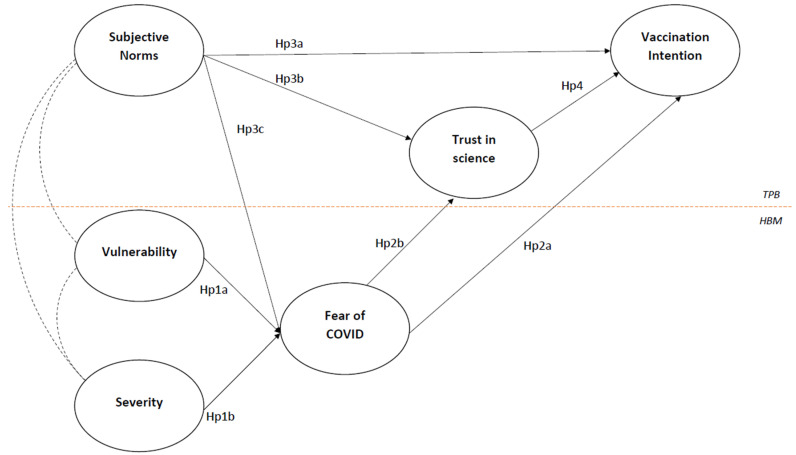
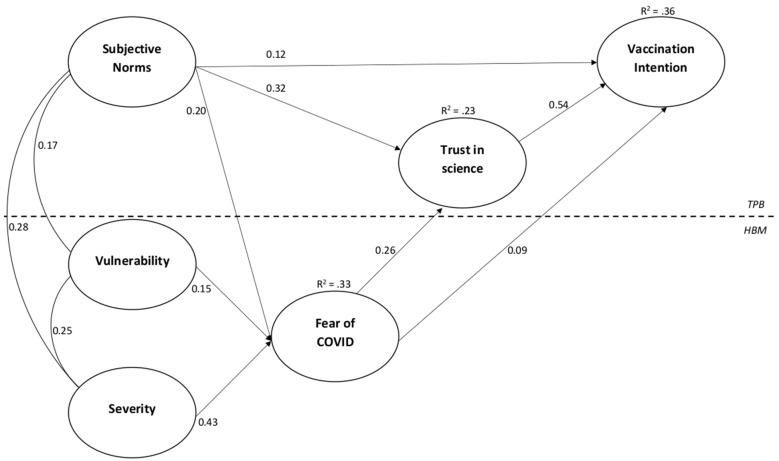
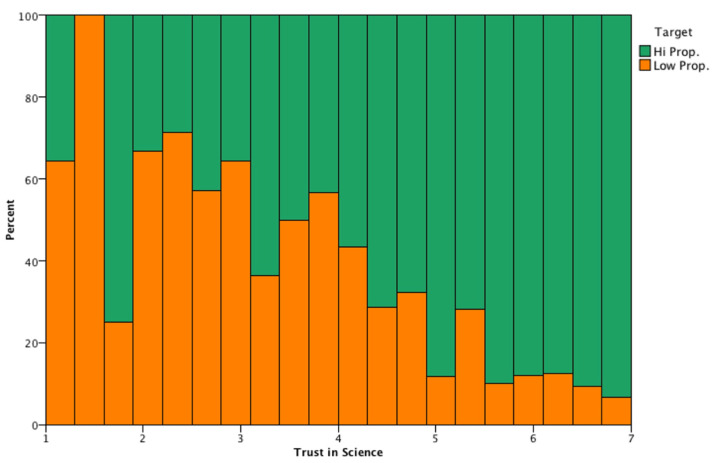
As the literature highlights, many health behavior theories try to explain both social and psychological variables influencing an individual's health behavior. This study integrates insights relative to the antecedents of getting vaccinated from health behavior theories, particularly including the health belief model (HBM), the theory of planned behavior (TPB), and the different socio-demographic factors. Furthermore, we considered the possible mechanism of impact of distrust in science on individuals' hesitance and resistance to taking up SARS-CoV-2 vaccination in subjects living in Italy. A correlational study of 1095 subjects enrolled when the national vaccination campaign for the third dose was launched. A questionnaire was used to measure: Italian Risk Perception; subjective norm; trust in science, trust in the vaccine; fear of COVID-19; fear of the vaccine; perceived knowledge about SARS-CoV-2; booster vaccination intention. Principal results show that: (i) the positive relationship provided by HBM theory between perceptions of SARS-CoV-2 risk (vulnerability and severity) and intention to have the vaccine, through fear of COVID-19; (ii) the positive relationship between subjective norms and both trust in science and vaccination intention; (iii) that trust in science plays a crucial role in predicting vaccination intention. Finally, the results provided indications about a positive relationship between subjective norms and fear of COVID-19, and a full mediation role of trust in science in the relationships between determinants of both TPA and HBM, fear of COVID-19, and vaccination intention. In conclusion, an individual's intention (not) to get vaccinated requires the consideration of a plethora of socio-psychological factors. However, overall, trust in science appears to be a key determinant of vaccination intention. Additional strategies promoting healthy behavior are needed.
正如文献所强调的,许多健康行为理论试图解释影响个体健康行为的社会和心理变量。本研究整合了健康行为理论中与接种疫苗的前因相关的见解,特别包括健康信念模型(HBM)、计划行为理论(TPB)以及不同的社会人口学因素。此外,我们考虑了科学不信任对意大利居民接种SARS-CoV-2疫苗的犹豫和抵触情绪的可能影响机制。在全国第三剂疫苗接种运动启动时,对1095名受试者进行了一项相关性研究。使用一份问卷来测量:意大利风险认知;主观规范;对科学的信任、对疫苗的信任;对COVID-19的恐惧;对疫苗的恐惧;对SARS-CoV-2的感知知识;加强疫苗接种意愿。主要结果表明:(i)HBM理论所提供的SARS-CoV-2风险感知(易感性和严重性)与通过对COVID-19的恐惧而产生的接种疫苗意愿之间的正相关关系;(ii)主观规范与对科学的信任和接种意愿之间的正相关关系;(iii)对科学的信任在预测接种意愿方面起着关键作用。最后,结果表明主观规范与对COVID-19的恐惧之间存在正相关关系,并且在TPA和HBM的决定因素、对COVID-19的恐惧以及接种意愿之间的关系中,对科学的信任起到了完全中介作用。总之,个体(不)接种疫苗的意愿需要考虑众多社会心理因素。然而,总体而言,对科学的信任似乎是接种意愿的关键决定因素。需要采取更多促进健康行为的策略。