• 文献检索
  • 文档翻译
  • 深度研究
  • 学术资讯
  • Suppr Zotero 插件Zotero 插件
  • 邀请有礼
  • 套餐&价格
  • 历史记录
应用&插件
Suppr Zotero 插件Zotero 插件浏览器插件Mac 客户端Windows 客户端微信小程序
定价
高级版会员购买积分包购买API积分包
服务
文献检索文档翻译深度研究API 文档MCP 服务
关于我们
关于 Suppr公司介绍联系我们用户协议隐私条款
关注我们

Suppr 超能文献

核心技术专利:CN118964589B侵权必究
粤ICP备2023148730 号-1Suppr @ 2026

文献检索

告别复杂PubMed语法,用中文像聊天一样搜索,搜遍4000万医学文献。AI智能推荐,让科研检索更轻松。

立即免费搜索

文件翻译

保留排版,准确专业,支持PDF/Word/PPT等文件格式,支持 12+语言互译。

免费翻译文档

深度研究

AI帮你快速写综述,25分钟生成高质量综述,智能提取关键信息,辅助科研写作。

立即免费体验

针对心肌梗死后的心脏组织修复的神经免疫调节策略:从体内临床前研究到临床试验的治疗方法综述。

Targeting neuro-immune systems to achieve cardiac tissue repair following myocardial infarction: A review of therapeutic approaches from in-vivo preclinical to clinical studies.

机构信息

Bristol Heart Institute and Translational Biomedical Research Centre, Faculty of Health Science, University of Bristol, Bristol, UK.

Bristol Heart Institute and Translational Biomedical Research Centre, Faculty of Health Science, University of Bristol, Bristol, UK.

出版信息

Pharmacol Ther. 2023 May;245:108397. doi: 10.1016/j.pharmthera.2023.108397. Epub 2023 Mar 28.

DOI:10.1016/j.pharmthera.2023.108397
PMID:36996910
原文链接:https://pmc.ncbi.nlm.nih.gov/articles/PMC7616359/
Abstract

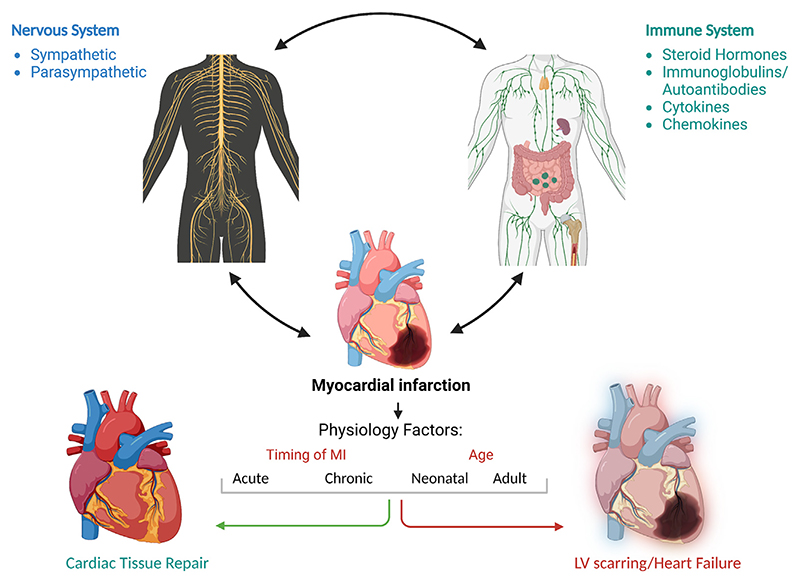
Myocardial healing following myocardial infarction (MI) toward either functional tissue repair or excessive scarring/heart failure, may depend on a complex interplay between nervous and immune system responses, myocardial ischemia/reperfusion injury factors, as well as genetic and epidemiological factors. Hence, enhancing cardiac repair post MI may require a more patient-specific approach targeting this complex interplay and not just the heart, bearing in mind that the dysregulation or modulation of just one of these systems or some of their mechanisms may determine the outcome either toward functional repair or toward heart failure. In this review we have elected to focus on existing preclinical and clinical in-vivo studies aimed at testing novel therapeutic approaches targeting the nervous and immune systems to trigger myocardial healing toward functional tissue repair. To this end, we have only selected clinical and preclinical in-vivo studies reporting on novel treatments targeting neuro-immune systems to ultimately treat MI. Next, we have grouped and reported treatments under each neuro-immune system. Finally, for each treatment we have assessed and reported the results of each clinical/preclinical study and then discussed their results collectively. This structured approach has been followed for each treatment discussed. To keep this review focused, we have deliberately omitted to cover other important and related research areas such as myocardial ischemia/reperfusion injury, cell and gene therapies as well as any ex-vivo and in-vitro studies. The review indicates that some of the treatments targeting the neuro-immune/inflammatory systems appear to induce beneficial effects remotely on the healing heart post MI, warranting further validation. These remote effects on the heart also indicates the presence of an overarching synergic response occurring across the nervous and immune systems in response to acute MI, which appear to influence cardiac tissue repair in different ways depending on age and timing of treatment delivery following MI. The cumulative evidence arising from this review allows also to make informed considerations on safe as opposed to detrimental treatments, and within the safe treatments to ascertain those associated with conflicting or supporting preclinical data, and those warranting further validation.

摘要

心肌梗死后(MI)心肌的修复方向是功能性组织修复还是过度瘢痕/心力衰竭,可能取决于神经系统和免疫系统反应、心肌缺血/再灌注损伤因素以及遗传和流行病学因素之间的复杂相互作用。因此,增强 MI 后心脏修复可能需要一种更针对这种复杂相互作用的个体化方法,而不仅仅是针对心脏,因为这些系统中的一个或其中一些机制的失调或调节可能会决定修复方向是朝向功能性修复还是心力衰竭。在这篇综述中,我们选择关注旨在测试针对神经系统和免疫系统的新型治疗方法的现有临床前和体内临床研究,以触发向功能性组织修复的心肌愈合。为此,我们仅选择了报告针对神经-免疫系统的新型治疗方法以最终治疗 MI 的临床前和体内临床研究。接下来,我们根据每个神经-免疫系统对治疗方法进行分组和报告。最后,对于每种治疗方法,我们评估并报告了每项临床/临床前研究的结果,然后集体讨论了它们的结果。我们遵循了这种结构化的方法来讨论每种治疗方法。为了使本综述重点突出,我们故意省略了涵盖其他重要且相关的研究领域,如心肌缺血/再灌注损伤、细胞和基因治疗以及任何离体和体外研究。该综述表明,一些针对神经-免疫/炎症系统的治疗方法似乎在 MI 后对愈合的心脏产生有益的远程影响,这需要进一步验证。这些对心脏的远程影响也表明,在急性 MI 后,神经系统和免疫系统之间存在一种广泛的协同反应,这种反应似乎以不同的方式影响心脏组织修复,这取决于治疗的年龄和 MI 后治疗的时间。本综述得出的综合证据还允许对安全治疗与有害治疗进行明智的考虑,并在安全治疗中确定那些与相互矛盾或支持的临床前数据相关的治疗方法,以及那些需要进一步验证的治疗方法。
https://cdn.ncbi.nlm.nih.gov/pmc/blobs/63fa/7616359/d593ba0c8c04/EMS197856-f001.jpg

相似文献

1
Targeting neuro-immune systems to achieve cardiac tissue repair following myocardial infarction: A review of therapeutic approaches from in-vivo preclinical to clinical studies.针对心肌梗死后的心脏组织修复的神经免疫调节策略:从体内临床前研究到临床试验的治疗方法综述。
Pharmacol Ther. 2023 May;245:108397. doi: 10.1016/j.pharmthera.2023.108397. Epub 2023 Mar 28.
2
Impact of Reperfusion on Temporal Immune Cell Dynamics After Myocardial Infarction.再灌注对心肌梗死后时间免疫细胞动力学的影响。
J Am Heart Assoc. 2023 Feb 21;12(4):e027600. doi: 10.1161/JAHA.122.027600. Epub 2023 Feb 15.
3
Clinical aspects of left ventricular diastolic function assessed by Doppler echocardiography following acute myocardial infarction.急性心肌梗死后经多普勒超声心动图评估左心室舒张功能的临床方面
Dan Med Bull. 2001 Nov;48(4):199-210.
4
Acute myocardial infarction in rats.大鼠急性心肌梗死
J Vis Exp. 2011 Feb 16(48):2464. doi: 10.3791/2464.
5
The therapeutic potential of hepatocyte growth factor for myocardial infarction and heart failure.肝细胞生长因子对心肌梗死和心力衰竭的治疗潜力。
Curr Pharm Des. 2004;10(20):2525-33. doi: 10.2174/1381612043383863.
6
Damage-Associated Molecular Patterns in Myocardial Infarction and Heart Transplantation: The Road to Translational Success.心肌梗死和心脏移植中的损伤相关分子模式:通往转化成功的道路。
Front Immunol. 2020 Dec 8;11:599511. doi: 10.3389/fimmu.2020.599511. eCollection 2020.
7
Immunomodulatory interventions in myocardial infarction and heart failure: a systematic review of clinical trials and meta-analysis of IL-1 inhibition.免疫调节干预心肌梗死和心力衰竭:临床试验系统评价和白细胞介素-1 抑制的荟萃分析。
Cardiovasc Res. 2018 Sep 1;114(11):1445-1461. doi: 10.1093/cvr/cvy145.
8
Lipoxygenase inhibitor ML351 dysregulated an innate inflammatory response leading to impaired cardiac repair in acute heart failure.脂氧合酶抑制剂 ML351 失调固有炎症反应,导致急性心力衰竭中心脏修复受损。
Biomed Pharmacother. 2021 Jul;139:111574. doi: 10.1016/j.biopha.2021.111574. Epub 2021 Apr 13.
9
The effect of immune cell-derived exosomes in the cardiac tissue repair after myocardial infarction: Molecular mechanisms and pre-clinical evidence.免疫细胞来源的细胞外囊泡在心肌梗死后心肌组织修复中的作用:分子机制和临床前证据。
J Cell Mol Med. 2021 Jul;25(14):6500-6510. doi: 10.1111/jcmm.16686. Epub 2021 Jun 5.
10
Malonate given at reperfusion prevents post-myocardial infarction heart failure by decreasing ischemia/reperfusion injury.在再灌注时给予丙二酸盐可通过减少缺血/再灌注损伤来预防心肌梗死后心力衰竭。
Basic Res Cardiol. 2024 Aug;119(4):691-697. doi: 10.1007/s00395-024-01063-z. Epub 2024 Jun 12.

引用本文的文献

1
Intramyocardial immunomodulation with human CD16 monocytes to treat myocardial infarction in pig: a blind randomized preclinical trial.用人CD16单核细胞进行心肌内免疫调节治疗猪心肌梗死:一项盲法随机临床前试验。
Front Cardiovasc Med. 2024 Aug 7;11:1427023. doi: 10.3389/fcvm.2024.1427023. eCollection 2024.

本文引用的文献

1
Abrogation of CC Chemokine Receptor 9 Ameliorates Ventricular Electrical Remodeling in Mice After Myocardial Infarction.CC趋化因子受体9的缺失改善心肌梗死后小鼠的心室电重构。
Front Cardiovasc Med. 2021 Oct 12;8:716219. doi: 10.3389/fcvm.2021.716219. eCollection 2021.
2
Immune cell β-adrenergic receptors contribute to the development of heart failure.免疫细胞的β-肾上腺素能受体有助于心力衰竭的发展。
Am J Physiol Heart Circ Physiol. 2021 Oct 1;321(4):H633-H649. doi: 10.1152/ajpheart.00243.2021. Epub 2021 Aug 20.
3
Fibrosis after Myocardial Infarction: An Overview on Cellular Processes, Molecular Pathways, Clinical Evaluation and Prognostic Value.
心肌梗死后纤维化:细胞过程、分子途径、临床评估和预后价值概述。
Med Sci (Basel). 2021 Mar 1;9(1):16. doi: 10.3390/medsci9010016.
4
Celecoxib alleviates pathological cardiac hypertrophy and fibrosis via M1-like macrophage infiltration in neonatal mice.塞来昔布通过在新生小鼠中诱导类似M1型巨噬细胞浸润来减轻病理性心脏肥大和纤维化。
iScience. 2021 Feb 25;24(3):102233. doi: 10.1016/j.isci.2021.102233. eCollection 2021 Mar 19.
5
Chemokine CCL5 promotes robust optic nerve regeneration and mediates many of the effects of CNTF gene therapy.趋化因子 CCL5 促进强有力的视神经再生,并介导 CNTF 基因治疗的许多作用。
Proc Natl Acad Sci U S A. 2021 Mar 2;118(9). doi: 10.1073/pnas.2017282118.
6
Immunomodulation for optimal cardiac regeneration: insights from comparative analyses.优化心脏再生的免疫调节:比较分析的见解
NPJ Regen Med. 2021 Feb 15;6(1):8. doi: 10.1038/s41536-021-00118-2.
7
Cholinergic modulation of the immune system - A novel therapeutic target for myocardial inflammation.胆碱能免疫系统调节——心肌炎症治疗的新靶点。
Int Immunopharmacol. 2021 Apr;93:107391. doi: 10.1016/j.intimp.2021.107391. Epub 2021 Feb 4.
8
Strategies for immune regulation in iPS cell-based cardiac regenerative medicine.基于诱导多能干细胞的心脏再生医学中的免疫调节策略。
Inflamm Regen. 2020 Sep 29;40:36. doi: 10.1186/s41232-020-00145-4. eCollection 2020.
9
The Chemokine Receptor CXCR4 in Cell Proliferation and Tissue Regeneration.趋化因子受体 CXCR4 在细胞增殖和组织再生中的作用。
Front Immunol. 2020 Aug 28;11:2109. doi: 10.3389/fimmu.2020.02109. eCollection 2020.
10
Functions of the CXCL12 Receptor ACKR3/CXCR7-What Has Been Perceived and What Has Been Overlooked.ACKR3/CXCR7 趋化因子受体的功能:被感知与被忽视的。
Mol Pharmacol. 2020 Nov;98(5):577-585. doi: 10.1124/molpharm.120.000056. Epub 2020 Sep 3.