Department of Cardiology, Guangdong Provincial People's Hospital (Guangdong Academy of Medical Sciences), Southern Medical University, Guangzhou, 510080, China.
Shantou University Medical College, Shantou, China.
Cardiovasc Diabetol. 2023 Mar 31;22(1):76. doi: 10.1186/s12933-023-01799-3.
Previous studies have shown that the stress hyperglycemia ratio (SHR), a parameter of relative stress-induced hyperglycemia, is an excellent predictive factor for all-cause mortality and major adverse cardiovascular events (MACEs) among patients with ST-segment elevation myocardial infarction (STEMI). However, its association with pulmonary infection in patients with STEMI during hospitalization remains unclear.
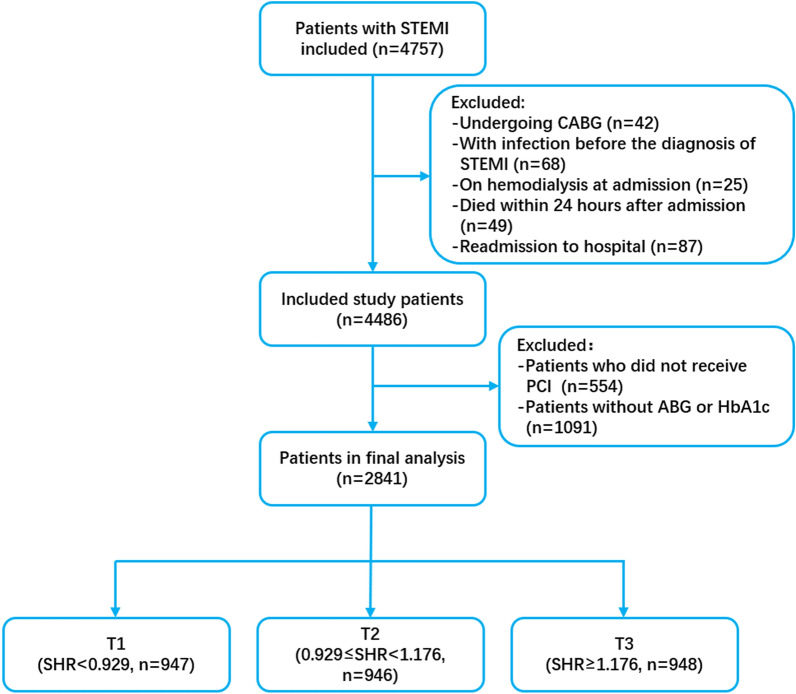
Patients with STEMI undergoing percutaneous coronary intervention (PCI) were consecutively enrolled from 2010 to 2020. The primary endpoint was the occurrence of pulmonary infection during hospitalization, and the secondary endpoint was in-hospital MACEs, composed of all-cause mortality, stroke, target vessel revascularization, or recurrent myocardial infarction.
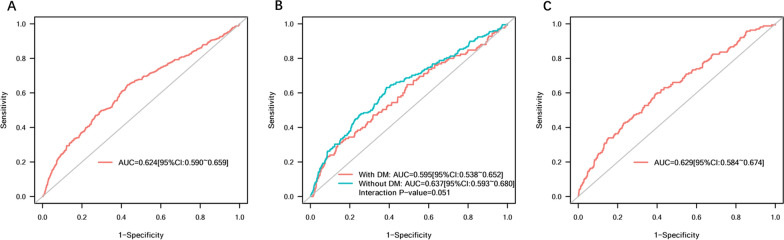
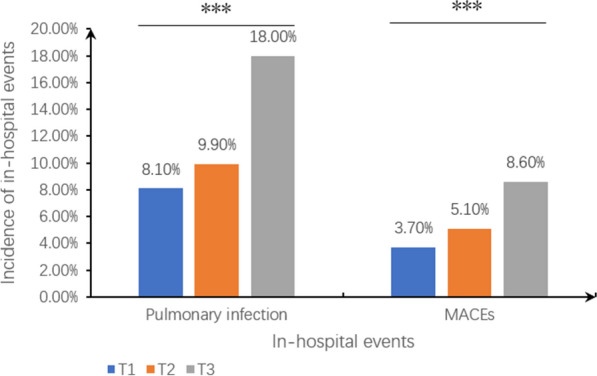
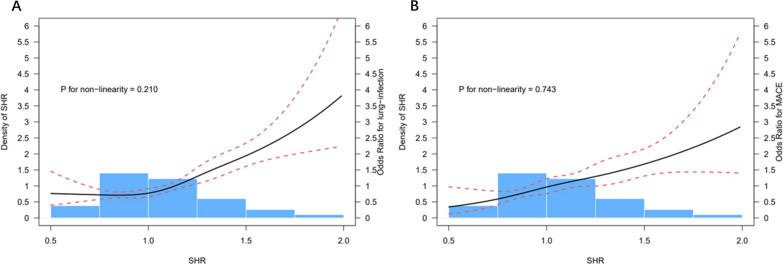
A total of 2,841 patients were finally included, with 323 (11.4%) developing pulmonary infection and 165 (5.8%) developing in-hospital MACEs. The patients were divided into three groups according to SHR tertiles. A higher SHR was associated with a higher rate of pulmonary infection during hospitalization (8.1%, 9.9%, and 18.0%, P < 0.001) and in-hospital MACEs (3.7%, 5.1%, and 8.6%, P < 0.001). Multivariate logistic regression analysis demonstrated that SHR was significantly associated with the risk of pulmonary infection during hospitalization (odds ratio [OR] = 1.46, 95% confidence interval [CI] 1.06-2.02, P = 0.021) and in-hospital MACEs (OR = 1.67, 95% CI 1.17-2.39, P = 0.005) after adjusting for potential confounding factors. The cubic spline models demonstrated no significant non-linear relationship between SHR and pulmonary infection (P = 0.210) and MACEs (P = 0.743). In receiver operating characteristic curve, the best cutoff value of SHR for pulmonary infection was 1.073.
The SHR is independently associated with the risk of pulmonary infection during hospitalization and in-hospital MACEs for patients with STEMI undergoing PCI.
先前的研究表明,应激性高血糖比值(SHR)是一种相对应激诱导性高血糖的参数,是 ST 段抬高型心肌梗死(STEMI)患者全因死亡率和主要不良心血管事件(MACEs)的极佳预测因素。然而,其与 STEMI 患者住院期间肺部感染的关系尚不清楚。
连续纳入 2010 年至 2020 年接受经皮冠状动脉介入治疗(PCI)的 STEMI 患者。主要终点为住院期间发生肺部感染,次要终点为住院期间 MACEs,包括全因死亡率、卒中和血运重建或复发性心肌梗死。
最终共纳入 2841 例患者,323 例(11.4%)发生肺部感染,165 例(5.8%)发生住院期间 MACEs。根据 SHR 三分位将患者分为三组。较高的 SHR 与住院期间肺部感染的发生率(8.1%、9.9%和 18.0%,P<0.001)和住院期间 MACEs(3.7%、5.1%和 8.6%,P<0.001)呈正相关。多变量逻辑回归分析表明,SHR 与住院期间肺部感染的风险显著相关(比值比[OR] 1.46,95%置信区间[CI] 1.06-2.02,P=0.021)和住院期间 MACEs(OR 1.67,95% CI 1.17-2.39,P=0.005),调整了潜在混杂因素后。三次样条模型显示 SHR 与肺部感染(P=0.210)和 MACEs(P=0.743)之间无显著非线性关系。在接受者操作特征曲线中,SHR 对肺部感染的最佳截断值为 1.073。
SHR 与接受 PCI 的 STEMI 患者住院期间肺部感染和住院期间 MACEs 的风险独立相关。