Department of Intensive Care, Erasme University Hospital, Université Libre de Bruxelles, Route de Lennik, 808, 1070, Brussels, Belgium.
Anesthesia and Neurointensive Care Unit, IRCCS Istituto Delle Scienze Neurologiche di Bologna, Via Altura, 3, Bologna, Italy.
Crit Care. 2023 Mar 31;27(1):130. doi: 10.1186/s13054-023-04409-6.
Altered levels of cerebrospinal fluid (CSF) glucose and lactate concentrations are associated with poor outcomes in acute brain injury patients. However, no data on changes in such metabolites consequently to therapeutic interventions are available. The aim of the study was to assess CSF glucose-to-lactate ratio (CGLR) changes related to therapies aimed at reducing intracranial pressure (ICP).
A multicentric prospective cohort study was conducted in 12 intensive care units (ICUs) from September 2017 to March 2022. Adult (> 18 years) patients admitted after an acute brain injury were included if an external ventricular drain (EVD) for intracranial pressure (ICP) monitoring was inserted within 24 h of admission. During the first 48-72 h from admission, CGLR was measured before and 2 h after any intervention aiming to reduce ICP ("intervention"). Patients with normal ICP were also sampled at the same time points and served as the "control" group.
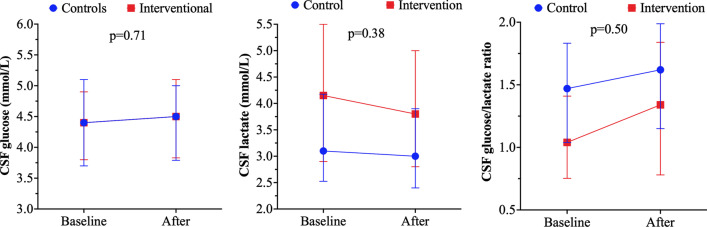
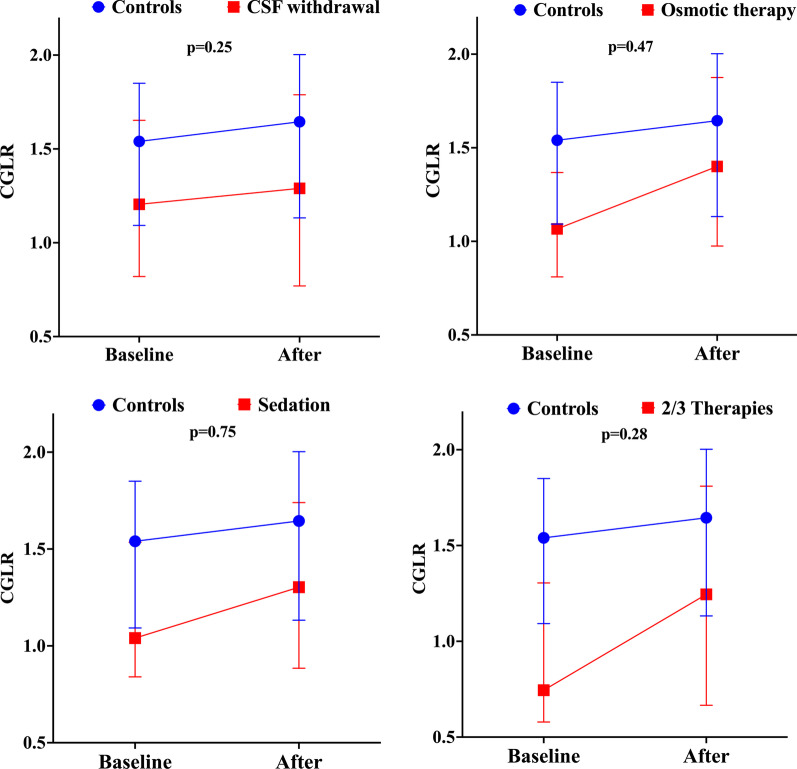
A total of 219 patients were included. In the intervention group (n = 115, 53%), ICP significantly decreased and CPP increased. After 2 h from the intervention, CGLR rose in both the intervention and control groups, although the magnitude was higher in the intervention than in the control group (20.2% vs 1.6%; p = 0.001). In a linear regression model adjusted for several confounders, therapies to manage ICP were independently associated with changes in CGLR. There was a weak inverse correlation between changes in ICP and CGRL in the intervention group.
In this study, CGLR significantly changed over time, regardless of the study group. However, these effects were more significant in those patients receiving interventions to reduce ICP.
脑脊液(CSF)中葡萄糖和乳酸浓度的改变与急性脑损伤患者的不良预后相关。然而,目前尚无关于这些代谢物在治疗干预后变化的数据。本研究旨在评估与降低颅内压(ICP)的治疗相关的 CSF 葡萄糖-乳酸比值(CGLR)的变化。
这是一项于 2017 年 9 月至 2022 年 3 月在 12 个重症监护病房(ICU)进行的多中心前瞻性队列研究。纳入标准为入院后 24 小时内插入脑室外引流管(EVD)以监测 ICP 的成年(>18 岁)急性脑损伤患者。在入院后 48-72 小时内,在任何旨在降低 ICP 的干预措施前后(“干预”)测量 CGLR。ICP 正常的患者也在同一时间点采样,作为“对照组”。
共纳入 219 例患者。在干预组(n=115,53%)中,ICP 显著降低,CPP 升高。干预后 2 小时,干预组和对照组的 CGLR 均升高,但干预组的升高幅度高于对照组(20.2%比 1.6%;p=0.001)。在调整了多个混杂因素的线性回归模型中,治疗 ICP 的方法与 CGLR 的变化独立相关。在干预组中,ICP 的变化与 CGLR 呈弱负相关。
在这项研究中,无论研究组如何,CGLR 随时间显著变化。然而,在接受降低 ICP 干预的患者中,这些变化更为显著。