Nham Fong H, Patel Ishan, Zalikha Abdul K, El-Othmani Mouhanad M
DMC Orthopaedics & Sports Medicine, 3990 John R Street, Detroit, MI, 48201, USA.
Department of Orthopaedic Surgery, Columbia University Medical Center, 622 W 168Th Street, New York, NY, 10032, USA.
Arthroplasty. 2023 Apr 2;5(1):18. doi: 10.1186/s42836-023-00175-6.
Primary total knee arthroplasty (TKA) is a preferred treatment for end-stage knee osteoarthritis. In the setting of a failed TKA, revision total knee arthroplasty (rTKA) acts as a salvage procedure and carries a higher risk compared to primary TKA. Given increased interest in postoperative outcomes from these procedures, a thorough understanding of the demographics, comorbidities, and inpatient outcomes is warranted. This study aimed to report the epidemiological data of demographics, comorbidity profiles and outcomes of patients undergoing TKA and rTKA.
A retrospective review of NIS registry discharge data from 2006 to 2015 third quarter was performed. This study included adults aged 40 and older who underwent TKA or rTKA. A total of 5,901,057 TKA patients and 465,968 rTKA patients were included in this study. Simple descriptive statistics were used to present variables on demographics, medical comorbidities, and postoperative complications.
A total of 5,901,057 TKA and 465,968 rTKA discharges were included in this study, with an average age of 66.30 and 66.56 years, and the major payor being Medicare, accounting for 55.34% and 59.88% of TKA and rTKA cases, respectively. Infection (24.62%) was the most frequent reason for rTKA, and was followed by mechanical complications (18.62%) and dislocation (7.67%). The most common medical comorbidities for both groups were hypertension, obesity, and diabetes. All types of inpatient complications were reported in 22.21% TKA and 28.78% of rTKA cases. Postoperative anemia was the most common complication in both groups (20.34% vs. 25.05%).
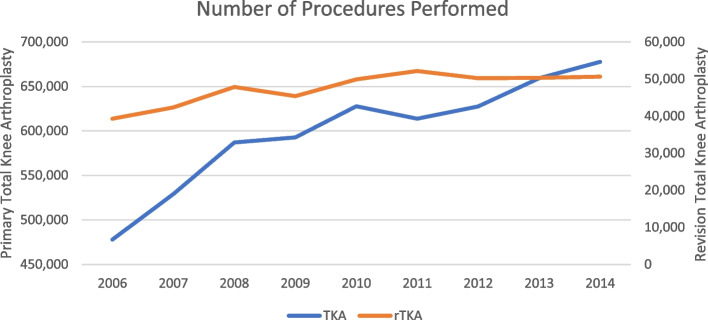
Our data demonstrated a 41.9% increase in patients receiving TKA and 28.8% increase in rTKA from the years 2006 to 2014. The data showed a 22.21% and a 28.78% "complication" rate with TKA and rTKA, with postoperative anemia being the most common complication. The top 3 medical comorbidities were hypertension, obesity, and diabetes for both groups and with increased focus on perioperative optimization, future analyses into preoperative medical optimization, and improved primary arthroplasty protocol may result in improved postoperative outcomes.
初次全膝关节置换术(TKA)是终末期膝骨关节炎的首选治疗方法。在初次全膝关节置换术失败的情况下,翻修全膝关节置换术(rTKA)作为一种挽救性手术,与初次全膝关节置换术相比风险更高。鉴于人们对这些手术的术后结果越来越感兴趣,有必要全面了解患者的人口统计学特征、合并症和住院结局。本研究旨在报告接受初次全膝关节置换术和翻修全膝关节置换术患者的人口统计学、合并症概况及结局的流行病学数据。
对2006年至2015年第三季度的国家住院患者样本(NIS)登记出院数据进行回顾性分析。本研究纳入了年龄在40岁及以上接受初次全膝关节置换术或翻修全膝关节置换术的成年人。本研究共纳入5901057例初次全膝关节置换术患者和465968例翻修全膝关节置换术患者。采用简单描述性统计方法呈现人口统计学、医疗合并症和术后并发症等变量。
本研究共纳入5901057例初次全膝关节置换术和465968例翻修全膝关节置换术出院病例,平均年龄分别为66.30岁和66.56岁,主要支付方为医疗保险,分别占初次全膝关节置换术和翻修全膝关节置换术病例的55.34%和59.88%。感染(24.62%)是翻修全膝关节置换术最常见的原因,其次是机械并发症(18.62%)和脱位(7.67%)。两组最常见的医疗合并症均为高血压、肥胖和糖尿病。22.21%的初次全膝关节置换术病例和28.78%的翻修全膝关节置换术病例报告了所有类型的住院并发症。术后贫血是两组最常见的并发症(20.34%对25.05%)。
我们的数据显示,2006年至2014年期间,接受初次全膝关节置换术的患者增加了41.9%,接受翻修全膝关节置换术的患者增加了28.8%。数据显示,初次全膝关节置换术和翻修全膝关节置换术的“并发症”发生率分别为22.21%和28.78%,术后贫血是最常见的并发症。两组最常见的三种医疗合并症均为高血压、肥胖和糖尿病,随着对围手术期优化的关注度增加,未来对术前医疗优化的分析以及改进初次关节置换方案可能会改善术后结局。