Department of Orthopaedic Surgery, Yueyang Second People's Hospital, Yueyang, China.
Department of Orthopaedic Surgery, Yueyang Hospital Affiliated to Hunan Normal University, Yueyang, China.
Orthop Surg. 2019 Oct;11(5):755-761. doi: 10.1111/os.12535.
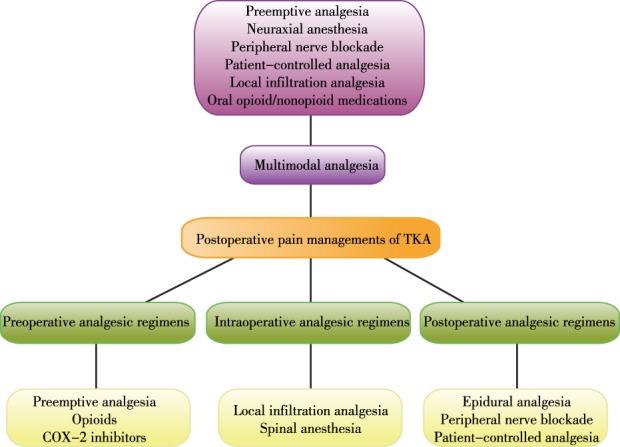
Total knee arthroplasty (TKA) is one of the most common surgeries performed to relieve joint pain in patients with end-stage osteoarthritis or rheumatic arthritis of the knee. However, TKA is followed by moderate to severe postoperative pain that affects postoperative rehabilitation, patient satisfaction, and overall outcomes. Historically, opioids have been widely used for perioperative pain management of TKA. However, opioids are associated with undesirable adverse effects, such as nausea, respiratory depression, and retention of urine, which limit their application in daily clinical practice. The aim of this review was to discuss the current postoperative pain management regimens for TKA. Our review of the literature demonstrated that multimodal analgesia is considered the optimal regimen for perioperative pain management of TKA and improves clinical outcomes and patient satisfaction, through a combination of several types of medications and delivery routes, including preemptive analgesia, neuraxial anesthesia, peripheral nerve blockade, patient-controlled analgesia and local infiltration analgesia, and oral opioid/nonopioid medications. Multimodal analgesia provides superior pain relief, promotes recovery of the knee, and reduces opioid consumption and related adverse effects in patients undergoing TKA.
全膝关节置换术(TKA)是缓解晚期骨关节炎或膝关节风湿性关节炎患者关节疼痛最常用的手术之一。然而,TKA 术后会出现中度至重度疼痛,这会影响术后康复、患者满意度和整体效果。历史上,阿片类药物被广泛用于 TKA 的围手术期疼痛管理。然而,阿片类药物会引起恶心、呼吸抑制和尿潴留等不良副作用,限制了它们在日常临床实践中的应用。本文旨在讨论 TKA 的术后疼痛管理方案。我们对文献的回顾表明,多模式镇痛被认为是 TKA 围手术期疼痛管理的最佳方案,通过多种药物和给药途径的联合,包括预防性镇痛、椎管内麻醉、外周神经阻滞、患者自控镇痛和局部浸润镇痛以及口服阿片类药物/非阿片类药物,改善了临床结果和患者满意度。多模式镇痛可提供更好的疼痛缓解,促进膝关节恢复,并减少 TKA 患者的阿片类药物用量和相关不良反应。