Department of Computer Science and Software Engineering, Miami University, 205W Benton Hall, High St, Oxford, OH, 45056, USA.
National Center for Injury Prevention and Control, Centers for Disease Control and Prevention (CDC), Atlanta, GA, USA.
BMC Public Health. 2023 Apr 1;23(1):627. doi: 10.1186/s12889-023-15320-8.
Suicide is currently the second leading cause of death among adolescents ages 10-14, and third leading cause of death among adolescents ages 15-19 in the United States (U.S). Although we have numerous U.S. based surveillance systems and survey data sources, the coverage offered by these data with regard to the complexity of youth suicide had yet to be examined. The recent release of a comprehensive systems map for adolescent suicide provides an opportunity to contrast the content of surveillance systems and surveys with the mechanisms listed in the map.
To inform existing data collection efforts and advance future research on the risk and protective factors relevant to adolescent suicide.
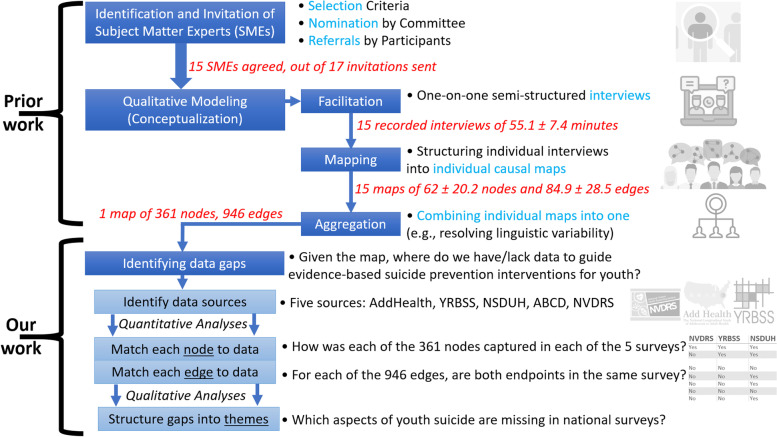
We examined data from U.S. based surveillance systems and nationally-representative surveys that included (1) observations for an adolescent population and (2) questions or indicators in the data that identified suicidal ideation or suicide attempt. Using thematic analysis, we evaluated the codebooks and data dictionaries for each source to match questions or indicators to suicide-related risk and protective factors identified through a recently published suicide systems map. We used descriptive analysis to summarize where data were available or missing and categorized data gaps by social-ecological level.
Approximately 1-of-5 of the suicide-related risk and protective factors identified in the systems map had no supporting data, in any of the considered data sources. All sources cover less than half the factors, except the Adolescent Brain Cognitive Development Study (ABCD), which covers nearly 70% of factors.
Examining gaps in suicide research can help focus future data collection efforts in suicide prevention. Our analysis precisely identified where data is missing and also revealed that missing data affects some aspects of suicide research (e.g., distal factors at the community and societal level) more than others (e.g., proximal factors about individual characteristics). In sum, our analysis highlights limitations in current suicide-related data availability and provides new opportunities to identify and expand current data collection efforts.
自杀是目前美国 10-14 岁青少年死亡的第二大原因,也是 15-19 岁青少年死亡的第三大原因。尽管我们有许多基于美国的监测系统和调查数据来源,但这些数据在青少年自杀的复杂性方面的覆盖范围尚未得到检验。最近发布的一份青少年自杀综合系统图提供了一个机会,可以将监测系统和调查的内容与该地图列出的机制进行对比。
为现有的数据收集工作提供信息,并推进与青少年自杀相关的风险和保护因素的未来研究。
我们检查了来自美国的监测系统和全国代表性调查的数据,这些数据包括:(1)青少年人群的观察结果,(2)数据中识别自杀意念或自杀企图的问题或指标。我们使用主题分析,评估了每个来源的代码本和数据字典,将问题或指标与通过最近发表的自杀系统图确定的与自杀相关的风险和保护因素进行匹配。我们使用描述性分析总结了数据的可用性或缺失情况,并按社会生态水平对数据差距进行分类。
在系统图中确定的与自杀相关的风险和保护因素中,大约有 1/5 没有任何支持数据,在考虑的任何数据源中都没有。除了青少年大脑认知发展研究(ABCD)之外,所有来源都涵盖了不到一半的因素,而 ABCD 则涵盖了近 70%的因素。
检查自杀研究中的差距可以帮助集中未来预防自杀的数据收集工作。我们的分析准确地确定了数据缺失的地方,同时也揭示了缺失数据对某些方面的自杀研究(例如社区和社会层面的远端因素)的影响大于其他方面(例如个人特征的近端因素)。总之,我们的分析强调了当前与自杀相关的数据可用性的局限性,并提供了新的机会来识别和扩大当前的数据收集工作。