Centre for Muscle and Joint Health, Department of Sports Science and Clinical Biomechanics, University of Southern Denmark, 55 Campusvej, Odense, 5230, Denmark.
Schroeder Arthritis Institute, Krembil Research Institute, University Health Network, Toronto, Canada.
BMC Musculoskelet Disord. 2023 Apr 1;24(1):250. doi: 10.1186/s12891-023-06356-3.
Previous studies have found that lumbar spinal stenosis (LSS) often co-occurs with knee or hip OA and can impact treatment response. However, it is unclear what participant characteristics may be helpful in identifying individuals with these co-occurring conditions. The aim of this cross-sectional study was to explore characteristics associated with comorbid symptoms of lumbar spinal stenosis (LSS) in people with knee or hip osteoarthritis (OA) enrolled in a primary care education and exercise program.
Sociodemographic, clinical characteristics, health status measures, and a self-report questionnaire on the presence of LSS symptoms was collected at baseline from the Good Life with osteoArthritis in Denmark primary care program for knee and hip OA. Cross-sectional associations between characteristics and the presence of comorbid LSS symptoms were assessed separately in participants with primary complaint of knee and hip OA, using domain-specific logistic models and a logistic model including all characteristics.
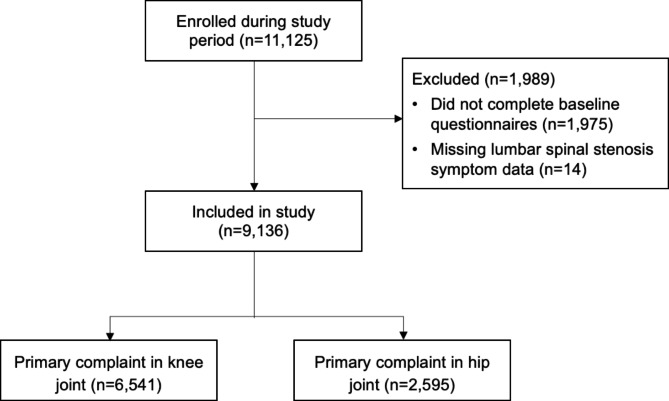
A total of 6,541 participants with a primary complaint of knee OA and 2,595 participants with a primary complaint of hip OA were included, of which 40% and 50% reported comorbid LSS symptoms, respectively. LSS symptoms were associated with similar characteristics in knee and hip OA. Sick leave was the only sociodemographic variable consistently associated with LSS symptoms. For clinical characteristics, back pain, longer symptom duration and bilateral or comorbid knee or hip symptoms were also consistently associated. Health status measures were not consistently related to LSS symptoms.
Comorbid LSS symptoms in people with knee or hip OA undergoing a primary care treatment program of group-based education and exercise were common and associated with a similar set of characteristics. These characteristics may help to identify people with co-occurring LSS and knee or hip OA, which can be used to help guide clinical decision-making.
先前的研究发现,腰椎管狭窄症(LSS)常与膝或髋骨关节炎(OA)同时发生,并可能影响治疗反应。然而,目前尚不清楚哪些参与者的特征有助于识别同时患有这些疾病的个体。本横断面研究的目的是探讨与接受初级保健教育和运动项目的膝或髋骨关节炎患者同时存在的腰椎管狭窄症(LSS)相关的特征。
从丹麦膝关节和髋关节骨关节炎初级保健计划的 Good Life with osteoArthritis 中收集了基线时的社会人口统计学、临床特征、健康状况指标以及关于 LSS 症状存在的自我报告问卷。分别使用特定于域的逻辑模型和包括所有特征的逻辑模型,评估了以膝关节或髋关节为主要主诉的参与者中特征与并存 LSS 症状之间的横断面关联。
共纳入了 6541 名膝关节 OA 主要主诉患者和 2595 名髋关节 OA 主要主诉患者,其中 40%和 50%分别报告存在并存的 LSS 症状。LSS 症状与膝关节和髋关节 OA 中相似的特征相关。病假是唯一与 LSS 症状始终相关的社会人口统计学变量。对于临床特征,背痛、更长的症状持续时间以及双侧或并存的膝关节或髋关节症状也始终与 LSS 症状相关。健康状况指标与 LSS 症状无一致相关性。
在接受以小组为基础的教育和运动的初级保健治疗计划的膝或髋骨关节炎患者中,并存的 LSS 症状很常见,且与一组相似的特征相关。这些特征可能有助于识别同时患有 LSS 和膝或髋 OA 的患者,这可以帮助指导临床决策。