Institute of Inflammation and Ageing, MRC-ARUK Centre for Musculoskeletal Ageing Research, University of Birmingham, Birmingham, UK.
Department of Pharmacy and Pharmacology, University of Bath, Claverton Down, Bath, UK.
Clin Transl Med. 2023 Apr;13(4):e1232. doi: 10.1002/ctm2.1232.
Osteoarthritis (OA), a multifaceted condition, poses a significant challenge for the successful clinical development of therapeutics due to heterogeneity. However, classifying molecular endotypes of OA pathogenesis could provide invaluable phenotype-directed routes for stratifying subgroups of patients for targeted therapeutics, leading to greater chances of success in trials. This study establishes endotypes in OA soft joint tissue driven by obesity in both load-bearing and non-load bearing joints.
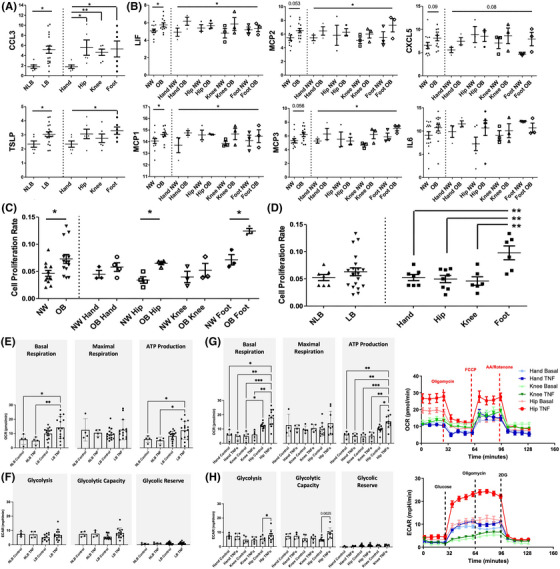
Hand, hip, knee and foot joint synovial tissue was obtained from OA patients (n = 32) classified as obese (BMI > 30) or normal weight (BMI 18.5-24.9). Isolated fibroblasts (OA SF) were assayed by Olink proteomic panel, seahorse metabolic flux assay, Illumina's NextSeq 500 bulk and Chromium 10X single cell RNA-sequencing, validated by Luminex and immunofluorescence.
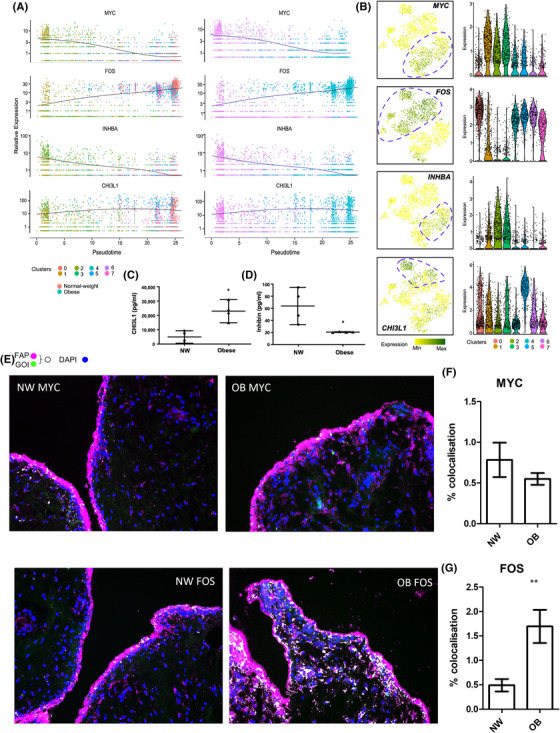
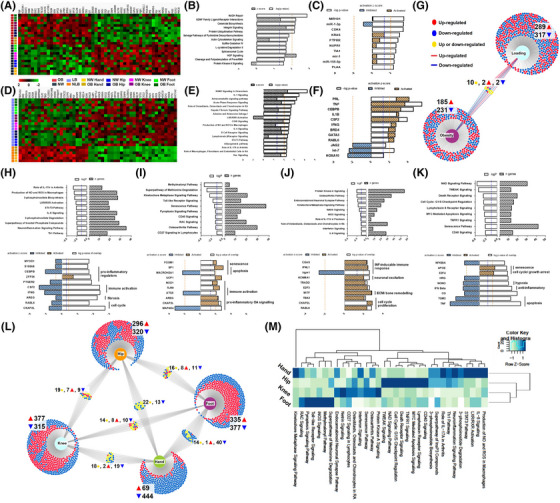
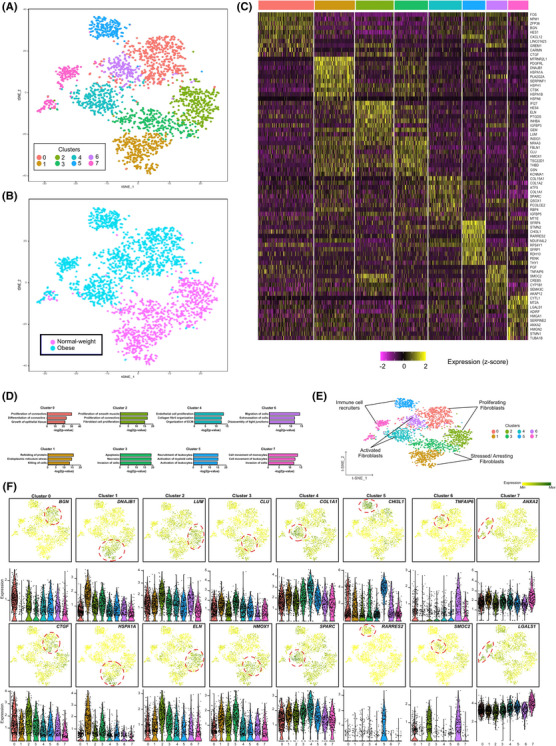
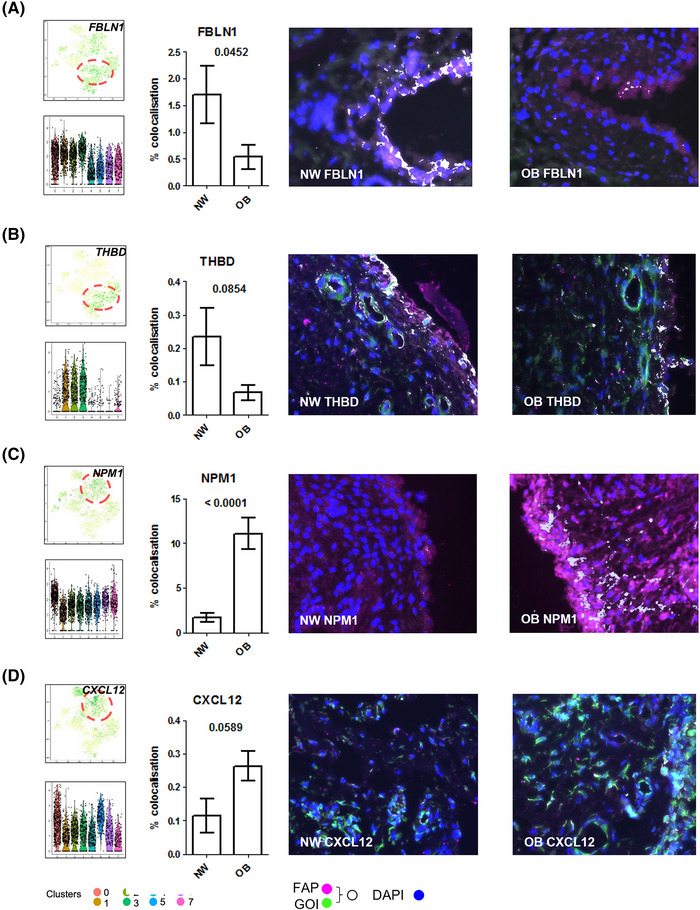
Targeted proteomic, metabolic and transcriptomic analysis found the inflammatory landscape of OA SFs are independently impacted by obesity, joint loading and anatomical site with significant heterogeneity between obese and normal weight patients, confirmed by bulk RNAseq. Further investigation by single cell RNAseq identified four functional molecular endotypes including obesity specific subsets defined by an inflammatory endotype related to immune cell regulation, fibroblast activation and inflammatory signaling, with up-regulated CXCL12, CFD and CHI3L1 expression. Luminex confirmed elevated chitase3-like-1(229.5 vs. 49.5 ng/ml, p < .05) and inhibin (20.6 vs. 63.8 pg/ml, p < .05) in obese and normal weight OA SFs, respectively. Lastly, we find SF subsets in obese patients spatially localise in sublining and lining layers of OA synovium and can be distinguished by differential expression of the transcriptional regulators MYC and FOS.
These findings demonstrate the significance of obesity in changing the inflammatory landscape of synovial fibroblasts in both load bearing and non-load bearing joints. Describing multiple heterogeneous OA SF populations characterised by specific molecular endotypes, which drive heterogeneity in OA disease pathogenesis. These molecular endotypes may provide a route for the stratification of patients in clinical trials, providing a rational for the therapeutic targeting of specific SF subsets in specific patient populations with arthritic conditions.
骨关节炎(OA)是一种多方面的疾病,由于异质性,对治疗药物的成功临床开发构成了重大挑战。然而,对 OA 发病机制的分子内表型进行分类可为患者进行靶向治疗的亚组分层提供宝贵的表型导向途径,从而增加临床试验成功的机会。本研究建立了由负重和非负重关节肥胖驱动的 OA 软关节组织的内表型。
从 OA 患者(n=32)中获得手部、髋部、膝部和足部关节滑膜组织,这些患者分为肥胖(BMI>30)或正常体重(BMI 18.5-24.9)。通过 Olink 蛋白质组面板、 Seahorse 代谢通量测定、Illumina 的 NextSeq 500 批量和 Chromium 10X 单细胞 RNA-seq 对分离的成纤维细胞(OA SF)进行检测,并通过 Luminex 和免疫荧光进行验证。
靶向蛋白质组学、代谢和转录组学分析发现,OA SF 的炎症景观独立受到肥胖、关节负荷和解剖部位的影响,肥胖患者和正常体重患者之间存在显著的异质性,这通过批量 RNAseq 得到了证实。通过单细胞 RNA-seq 的进一步研究确定了四个功能分子内表型,包括与免疫细胞调节、成纤维细胞激活和炎症信号相关的炎症内表型所定义的肥胖特异性亚群,上调的 CXCL12、CFD 和 CHI3L1 表达。Luminex 分别证实肥胖和正常体重 OA SF 中 chitase3-like-1(229.5 vs. 49.5ng/ml,p<0.05)和抑制素(20.6 vs. 63.8pg/ml,p<0.05)表达升高。最后,我们发现肥胖患者的 SF 亚群在 OA 滑膜的亚衬里层和衬里层中空间定位,并可通过转录调节因子 MYC 和 FOS 的差异表达来区分。
这些发现表明肥胖在改变负重和非负重关节滑膜成纤维细胞的炎症景观方面具有重要意义。描述了多个具有特定分子内表型的异质 OA SF 群体,这些内表型驱动 OA 发病机制的异质性。这些分子内表型可能为临床试验中的患者分层提供途径,为具有关节炎的特定患者群体中特定 SF 亚群的治疗靶向提供合理依据。