Eleftheriotis Gerasimos, Tsounis Efthymios P, Aggeletopoulou Ioanna, Dousdampanis Periklis, Triantos Christos, Mouzaki Athanasia, Marangos Markos, Assimakopoulos Stelios F
Division of Infectious Diseases, Department of Internal Medicine, Medical School, University of Patras, Patras, Greece.
Division of Gastroenterology, Department of Internal Medicine, University Hospital of Patras, Patras, Greece.
Front Immunol. 2023 Mar 15;14:1129190. doi: 10.3389/fimmu.2023.1129190. eCollection 2023.
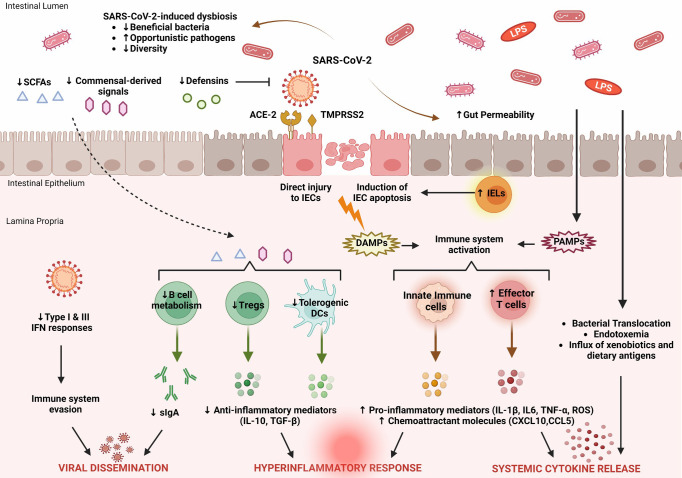
Although coronavirus disease 2019 (COVID-19) is primarily associated with mild respiratory symptoms, a subset of patients may develop more complicated disease with systemic complications and multiple organ injury. The gastrointestinal tract may be directly infected by SARS-CoV-2 or secondarily affected by viremia and the release of inflammatory mediators that cause viral entry from the respiratory epithelium. Impaired intestinal barrier function in SARS-CoV-2 infection is a key factor leading to excessive microbial and endotoxin translocation, which triggers a strong systemic immune response and leads to the development of viral sepsis syndrome with severe sequelae. Multiple components of the gut immune system are affected, resulting in a diminished or dysfunctional gut immunological barrier. Antiviral peptides, inflammatory mediators, immune cell chemotaxis, and secretory immunoglobulins are important parameters that are negatively affected in SARS-CoV-2 infection. Mucosal CD4+ and CD8+ T cells, Th17 cells, neutrophils, dendritic cells, and macrophages are activated, and the number of regulatory T cells decreases, promoting an overactivated immune response with increased expression of type I and III interferons and other proinflammatory cytokines. The changes in the immunologic barrier could be promoted in part by a dysbiotic gut microbiota, through commensal-derived signals and metabolites. On the other hand, the proinflammatory intestinal environment could further compromise the integrity of the intestinal epithelium by promoting enterocyte apoptosis and disruption of tight junctions. This review summarizes the changes in the gut immunological barrier during SARS-CoV-2 infection and their prognostic potential.
尽管2019冠状病毒病(COVID-19)主要与轻度呼吸道症状相关,但一部分患者可能会发展为更复杂的疾病,出现全身并发症和多器官损伤。胃肠道可能直接被严重急性呼吸综合征冠状病毒2(SARS-CoV-2)感染,或继发于病毒血症以及炎症介质的释放,这些炎症介质会导致病毒从呼吸道上皮进入。SARS-CoV-2感染中肠道屏障功能受损是导致微生物和内毒素过度移位的关键因素,这会引发强烈的全身免疫反应,并导致伴有严重后遗症的病毒脓毒症综合征的发生。肠道免疫系统的多个组成部分受到影响,导致肠道免疫屏障减弱或功能失调。抗病毒肽、炎症介质、免疫细胞趋化性和分泌型免疫球蛋白是在SARS-CoV-2感染中受到负面影响的重要参数。黏膜CD4+和CD8+ T细胞、Th17细胞、中性粒细胞、树突状细胞和巨噬细胞被激活,调节性T细胞数量减少,从而促进免疫反应过度激活,导致I型和III型干扰素以及其他促炎细胞因子的表达增加。肠道微生物群失调可能通过共生菌衍生的信号和代谢产物在一定程度上促进免疫屏障的变化。另一方面,促炎的肠道环境可能通过促进肠上皮细胞凋亡和紧密连接的破坏,进一步损害肠上皮的完整性。本综述总结了SARS-CoV-2感染期间肠道免疫屏障的变化及其预后潜力。