de Melo Roberta Crevelário, da Silva Letícia Aparecida Lopes Bezerra, Toma Tereza Setsuko, de Araújo Bruna Carolina, Luquine Cézar Donizetti, Milhomens Lais de Moura, Melo Daiane Sousa, de Bortoli Maritsa Carla, Barreto Jorge Otávio Maia
Secretaria de Estado de Saúde Instituto de Saúde Núcleo de Evidências São Paulo (SP) Brasil Secretaria de Estado de Saúde, Instituto de Saúde, Núcleo de Evidências, São Paulo (SP), Brasil.
Fundação Oswaldo Cruz Brasília (DF) Brasil Fundação Oswaldo Cruz, Brasília (DF) Brasil.
Rev Panam Salud Publica. 2023 Mar 31;47:e47. doi: 10.26633/RPSP.2023.47. eCollection 2023.
To synthesize the evidence about the effects of telehealth interventions provided through smart-phone apps and text messages on the behavior of adults regarding healthy food consumption.
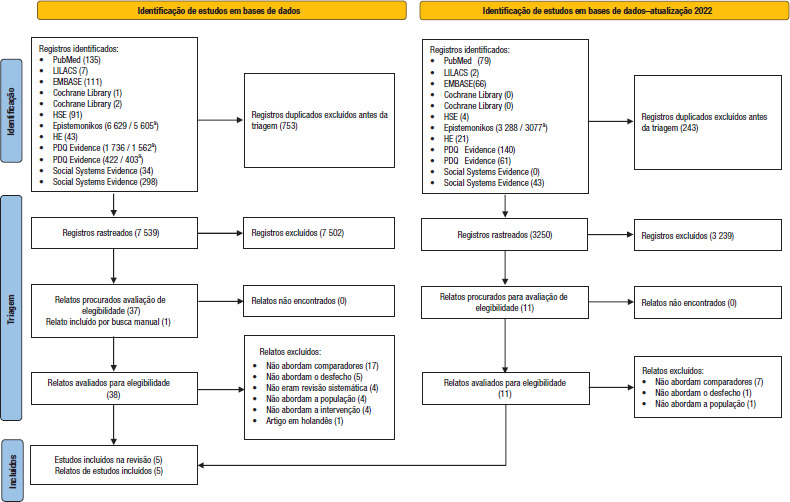
A rapid systematic review of the literature was performed through searches in nine electronic databases to identify systematic reviews published in English, Portuguese, and Spanish that evaluated telehealth strategies compared to face-to-face interventions to improve dietary intake in the adult population (18 to 59 years old). Searches were performed in November 2020 and updated in April 2022. The included systematic reviews were assessed for methodological quality using the AMSTAR 2 tool.
Five systematic reviews were included. Methodological quality was moderate in one review and critically low in four. There was a dearth of studies comparing the use of telehealth strategies with face-to-face interventions for the promotion of healthy eating in adults. The most consistent results refer to an increase in the consumption of fruits and vegetables with the use of an app or text messages, in addition to improvement in the dietary habits of people with diabetes or glucose intolerance with the use of text messages.
Positive effects were observed on healthy eating outcomes for most interventions using mobile apps or text messages; however, the findings refer to a few clinical trials with small samples that were analyzed in the systematic reviews covered in the present rapid review, most of which had low methodological quality. Thus, the current knowledge gap warrants the performance of further methodologically robust studies.
综合关于通过智能手机应用程序和短信提供的远程医疗干预措施对成年人健康食品消费行为影响的证据。
通过在九个电子数据库中进行检索,对文献进行快速系统综述,以识别以英文、葡萄牙文和西班牙文发表的系统综述,这些综述评估了与面对面干预相比的远程医疗策略,以改善成年人群(18至59岁)的饮食摄入。检索于2020年11月进行,并于2022年4月更新。使用AMSTAR 2工具对纳入的系统综述进行方法学质量评估。
纳入了五项系统综述。一项综述的方法学质量中等,四项综述的方法学质量极低。缺乏比较远程医疗策略与面对面干预措施以促进成年人健康饮食的研究。最一致的结果是,使用应用程序或短信可增加水果和蔬菜的消费量,此外,使用短信可改善糖尿病或葡萄糖不耐受患者的饮食习惯。
对于大多数使用移动应用程序或短信的干预措施,在健康饮食结果方面观察到了积极影响;然而,这些发现来自少数在本快速综述所涵盖的系统综述中分析的小样本临床试验,其中大多数的方法学质量较低。因此,当前的知识空白需要进行进一步方法学严谨的研究。