Gan Shu-Lin, Long Yu-Qin, Wang Qin-Yun, Feng Chang-Dong, Lai Chen-Xu, Liu Chun-Tong, Ding Yun-Ying, Liu Hong, Peng Ke, Ji Fu-Hai
Department of Anesthesiology, First Affiliated Hospital of Soochow University, Suzhou, Jiangsu, China.
Institute of Anesthesiology, Soochow University, Suzhou, Jiangsu, China.
Front Psychiatry. 2023 Mar 15;14:1128406. doi: 10.3389/fpsyt.2023.1128406. eCollection 2023.
Depressive symptoms are common among patients with lung cancer. We aimed to assess the effects of esketamine on postoperative depressive symptoms after thoracoscopic lung cancer surgery.
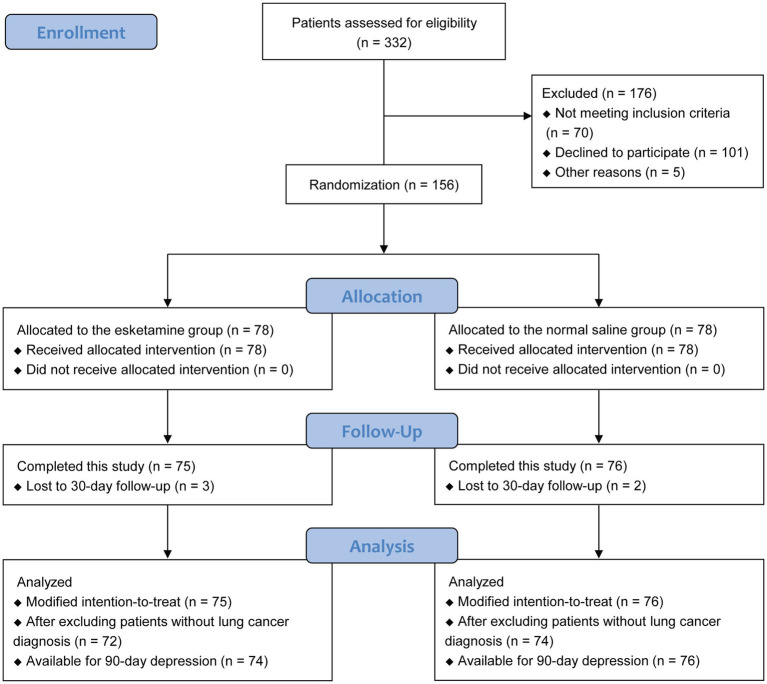
In this randomized, double-blind, placebo-controlled trial, 156 patients undergoing thoracoscopic lung cancer surgery were randomly allocated in a 1:1 ratio to receive intravenous esketamine (intraoperatively and in patient-controlled analgesia until 48 h postoperatively) or normal saline placebo. The primary outcome was the proportion of patients with depressive symptoms at 1 month postoperatively, assessed using the Beck Depression Inventory-II (BDI-II). Secondary outcomes included depressive symptoms at 48 h postoperatively, hospital discharge and 3 months postoperatively, BDI-II scores, anxious symptoms, Beck Anxiety Inventory scores, Quality of Recovery-15 (QoR-15) scores, and 1- and 3-month mortality.
A total of 151 patients (75 in the esketamine group and 76 in the normal saline group) completed the 1-month follow-up. The esketamine group had a significantly lower incidence of depressive symptoms at 1 month compared to the normal saline group (1.3% vs. 11.8%; risk difference = -10.5, 95%CI = -19.6% to -0.49%; = 0.018). After excluding patients without lung cancer diagnosis, the incidence of depressive symptoms was also lower in the esketamine group (1.4% vs. 12.2%; risk difference = -10.8, 95%CI = -20.2% to -0.52%; = 0.018). The secondary outcomes were similar between groups, except that the esketamine group had higher QoR-15 scores at 1 month postoperatively (median difference = 2; 95%CI = 0 to 5; = 0.048). The independent risk factors for depressive symptoms were hypertension (odds ratio = 6.75, 95%CI = 1.13 to 40.31; = 0.036) and preoperative anxious symptoms (odds ratio = 23.83, 95%CI = 3.41 to 166.33; = 0.001).
Perioperative administration of esketamine reduced the incidence of depressive symptoms at 1 month after thoracoscopic lung cancer surgery. History of hypertension and preoperative anxious symptoms were independent risk factors for depressive symptoms. Chinese Clinical Trial Registry http://www.chictr.org.cn, Identifier (ChiCTR2100046194).
抑郁症状在肺癌患者中很常见。我们旨在评估艾司氯胺酮对胸腔镜肺癌手术后术后抑郁症状的影响。
在这项随机、双盲、安慰剂对照试验中,156例接受胸腔镜肺癌手术的患者按1:1比例随机分配,接受静脉注射艾司氯胺酮(术中及患者自控镇痛,直至术后48小时)或生理盐水安慰剂。主要结局是术后1个月有抑郁症状的患者比例,采用贝克抑郁量表第二版(BDI-II)进行评估。次要结局包括术后48小时、出院时和术后3个月的抑郁症状、BDI-II评分、焦虑症状、贝克焦虑量表评分、恢复质量-15(QoR-15)评分以及1个月和3个月时的死亡率。
共有151例患者(艾司氯胺酮组75例,生理盐水组76例)完成了1个月的随访。与生理盐水组相比,艾司氯胺酮组术后1个月抑郁症状的发生率显著更低(1.3%对11.8%;风险差异=-10.5,95%CI=-19.6%至-0.49%;P=0.018)。排除未确诊为肺癌的患者后,艾司氯胺酮组抑郁症状的发生率也更低(1.4%对12.2%;风险差异=-10.8,95%CI=-20.2%至-0.52%;P=0.018)。除艾司氯胺酮组术后1个月的QoR-15评分更高外(中位数差异=2;95%CI=0至5;P=0.048),两组的次要结局相似。抑郁症状的独立危险因素是高血压(比值比=6.75,95%CI=1.13至40.31;P=0.036)和术前焦虑症状(比值比=23.83,95%CI=3.41至166.33;P=0.001)。
胸腔镜肺癌手术围手术期给予艾司氯胺酮可降低术后1个月抑郁症状的发生率。高血压病史和术前焦虑症状是抑郁症状的独立危险因素。中国临床试验注册中心http://www.chictr.org.cn,标识符(ChiCTR2100046194)。