Zhao Jialian, Le Zhenkai, Chu Lihua, Gao Yi, Zhang Manqing, Fan Jiabin, Ma Daqing, Hu Yaoqin, Lai Dengming
Department of Anesthesiology, Children's Hospital, Zhejiang University School of Medicine, National Clinical Research Center for Child Health, Hangzhou, China.
Department of Neonatal Surgery, Children's Hospital, Zhejiang University School of Medicine, National Clinical Research Center for Child Health, Hangzhou, China.
Front Pediatr. 2023 Mar 15;11:1113627. doi: 10.3389/fped.2023.1113627. eCollection 2023.
The incidence of intraoperative hypothermia remains high in pediatric patients during anesthesia and surgery even though core body temperature monitoring and warming systems have been greatly improved in recent years. We analyzed the risk factors and outcomes of intraoperative hypothermia in neonates and infants undergoing general anesthesia and surgery.
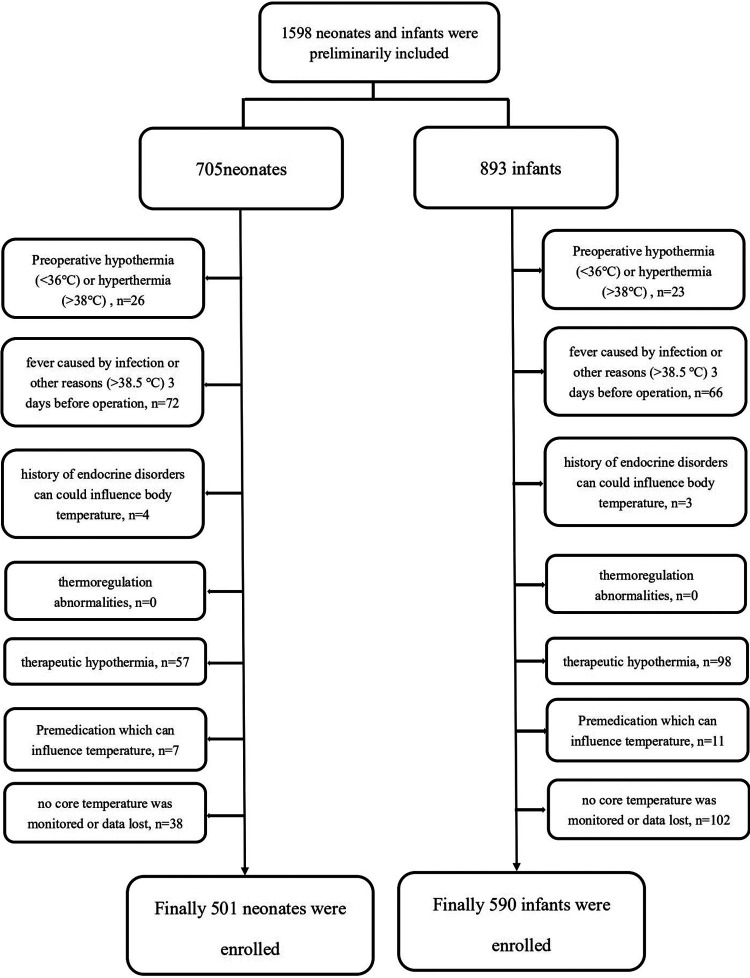
The data on the incidence of intraoperative hypothermia, other clinical characteristics, and outcomes from electronic records of 1,091 patients (501 neonates and 590 infants between 28 days and 1 year old), who received general anesthesia and surgery, were harvested and analyzed. Intraoperative hypothermia was defined as a core temperature below 36°C during surgery.
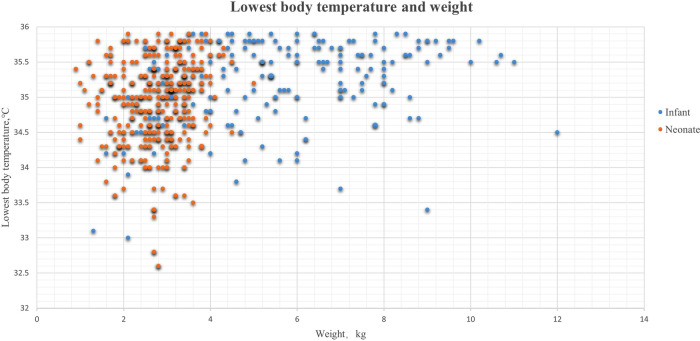
The incidence of intraoperative hypothermia in neonates was 82.83%, which was extremely higher than in infants (38.31%, < 0.001)-the same as the lowest body temperature (35.05 ± 0.69°C vs. 35.40 ± 0.68°C, < 0.001) and the hypothermia duration (86.6 ± 44.5 min vs. 75.0 ± 52.4 min, < 0.001). Intraoperative hypothermia was associated with prolonged PACU, ICU, hospital stay, postoperative bleeding, and transfusion in either age group. Intraoperative hypothermia in infants was also related to prolonged postoperative extubation time and surgical site infection. After univariate and multivariate analyses, the age (OR = 0.902, < 0.001), weight (OR = 0.480, = 0.013), prematurity (OR = 2.793, = 0.036), surgery time of more than 60 min (OR = 3.743, < 0.001), prewarming (OR = 0.081, < 0.001), received >20 mL/kg fluid (OR = 2.938, = 0.004), and emergency surgery (OR = 2.142, = 0.019) were associated with hypothermia in neonates. Similar to neonates, age (OR = 0.991, < 0.001), weight (OR = 0.783, = 0.019), surgery time >60 min (OR = 2.140, = 0.017), pre-warming (OR = 0.017, < 0.001), and receive >20 mL/kg fluid (OR = 3.074, = 0.001) were relevant factors to intraoperative hypothermia in infants along with the ASA grade (OR = 4.135, < 0.001).
The incidence of intraoperative hypothermia was still high, especially in neonates, with a few detrimental complications. Neonates and infants each have their different risk factors associated with intraoperative hypothermia, but younger age, lower weight, longer surgery time, received more fluid, and no prewarming management were the common risk factors.
尽管近年来核心体温监测和保暖系统有了很大改进,但小儿患者在麻醉和手术期间术中低体温的发生率仍然很高。我们分析了接受全身麻醉和手术的新生儿和婴儿术中低体温的危险因素及结局。
收集并分析了1091例接受全身麻醉和手术患者(501例新生儿和590例28天至1岁婴儿)的电子记录中关于术中低体温发生率、其他临床特征及结局的数据。术中低体温定义为手术期间核心温度低于36°C。
新生儿术中低体温发生率为82.83%,远高于婴儿(38.