Institute of Medical Genetics, University of Zürich, Schlieren-Zurich, 8952, Switzerland.
Institute of Biochemistry, Friedrich-Alexander-Universität Erlangen-Nürnberg (FAU), Erlangen, 91054, Germany.
Eur J Hum Genet. 2023 Jul;31(7):784-792. doi: 10.1038/s41431-023-01320-0. Epub 2023 Apr 4.
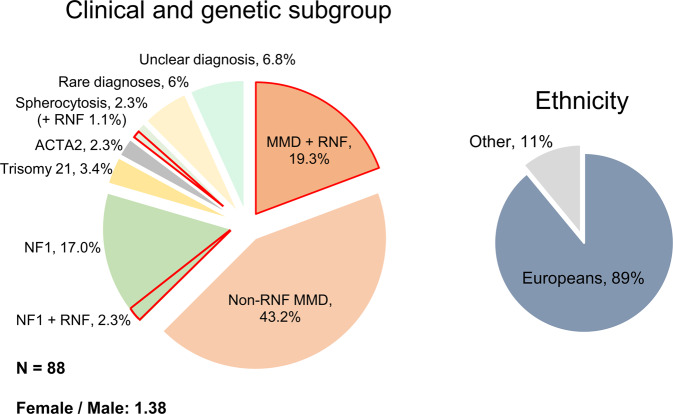
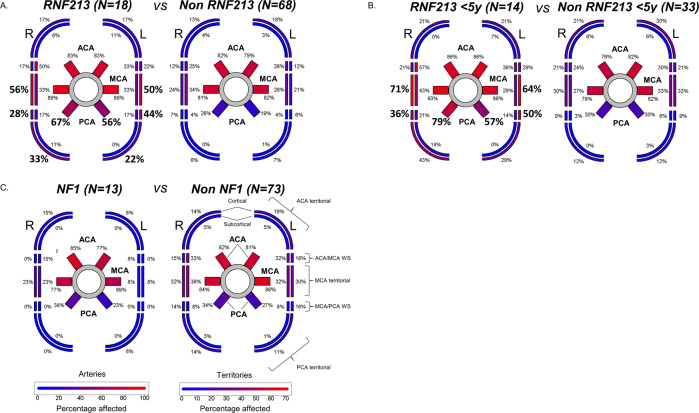
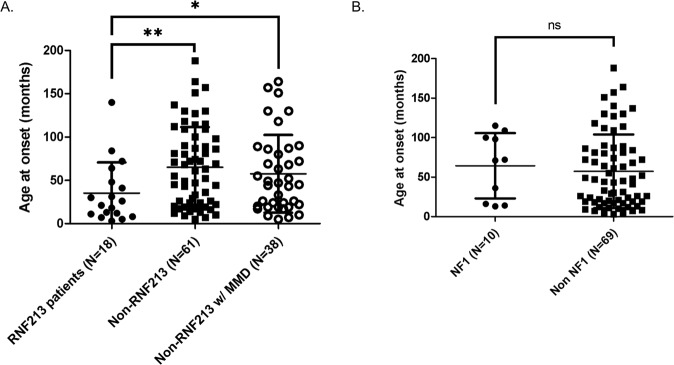
Pediatric Moyamoya Angiopathy (MMA) is a progressive intracranial occlusive arteriopathy that represents a leading cause of transient ischemic attacks and strokes in childhood. Despite this, up to now no large, exclusively pediatric MMA cohort has been subjected to systematic genetic investigation. In this study, we performed molecular karyotyping, exome sequencing and automated structural assessment of missense variants on a series of 88 pediatric MMA patients and correlated genetic, angiographic and clinical (stroke burden) findings. The two largest subgroups in our cohort consisted of RNF213 and neurofibromatosis type 1 (NF1) patients. While deleterious RNF213 variants were associated with a severe MMA clinical course with early symptom onset, frequent posterior cerebral artery involvement and higher stroke rates in multiple territories, NF1 patients had a similar infarct burden compared to non-NF1 individuals and were often diagnosed incidentally during routine MRIs. Additionally, we found that MMA-associated RNF213 variants have lower predicted functional impact compared to those associated with aortic disease. We also raise the question of MMA as a feature of recurrent as well as rare chromosomal imbalances and further support the possible association of MMA with STAT3 deficiency. In conclusion, we provide a comprehensive characterization at the genetic and clinical level of a large exclusively pediatric MMA population. Due to the clinical differences found across genetic subgroups, we propose genetic testing for risk stratification as part of the routine assessment of pediatric MMA patients.
小儿烟雾病(MMA)是一种进行性颅内闭塞性动脉病,是儿童短暂性脑缺血发作和中风的主要原因。尽管如此,迄今为止,还没有对专门的大型儿科 MMA 队列进行系统的遗传研究。在这项研究中,我们对 88 名儿科 MMA 患者进行了分子核型分析、外显子组测序和错义变异的自动结构评估,并将遗传、血管造影和临床(中风负担)发现进行了关联。我们队列中的两个最大亚组由 RNF213 和神经纤维瘤病 1 型(NF1)患者组成。虽然有害的 RNF213 变异与严重的 MMA 临床病程相关,其具有早期症状发作、频繁的大脑后动脉受累和多个部位更高的中风率,但 NF1 患者的梗塞负担与非 NF1 个体相似,并且通常在常规 MRI 检查中偶然发现。此外,我们发现与 MMA 相关的 RNF213 变异的预测功能影响低于与主动脉疾病相关的变异。我们还提出了 MMA 作为复发性和罕见染色体不平衡特征的问题,并进一步支持 MMA 与 STAT3 缺乏的可能关联。总之,我们在遗传和临床水平上对大型专门儿科 MMA 人群进行了全面描述。由于在遗传亚组中发现了临床差异,我们建议进行遗传测试以进行风险分层,作为儿科 MMA 患者常规评估的一部分。