De Block Andreas, Dewitte Siegfried, Hens Kristien
Centre for Logic and Philosophy of Science, Kardinaal Mercierplein 2 - box 3200, 3000, Leuven, Belgium.
Department of Marketing, Leuven, Naamsestraat 69 - box 3545, 3000, Leuven, Belgium.
New Ideas Psychol. 2023 Apr;69:None. doi: 10.1016/j.newideapsych.2023.101008.
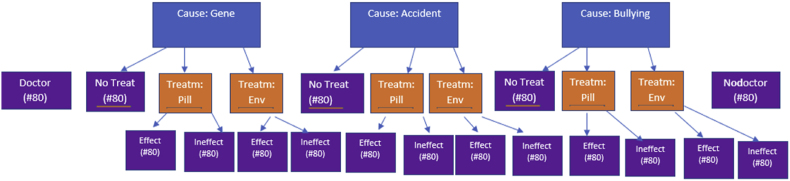
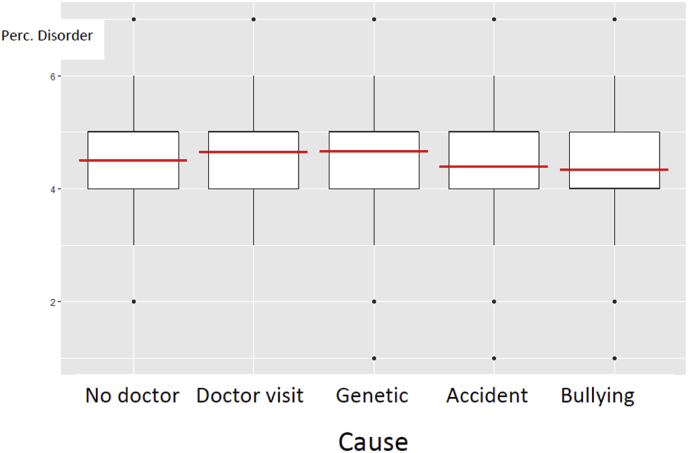
Are attention issues disorders or not? Philosophers of medicine have tried to address this question by looking for properties that distinguish disorders from non-disorders. Such properties include deviation of a statistical norm, a loss of function or experienced suffering. However, attempts at such conceptual analysis have not led to a consensus on the necessary and sufficient conditions for the application of the concept of disorder. Recently, philosophers have proposed an experimental approach to investigate in which circumstances people think a specific concept is applicable. Here we present a quantitative vignette study investigating whether disorder attribution depends on the perceived cause and the perceived type of treatment for an attention problem. The results of our study indicate that the attribution of a disorder decreased when the attention problem was understood as caused by bullying (social environmental cause) or by an accident (non-social environmental cause) rather than a genetic cause. When prescribed a pill, attention problems were considered a disorder to a larger extent than when the child was prescribed an environmental treatment. Our study also suggests that whereas successful environmental treatments will not necessarily decrease the disorder attribution, successful pharmacological treatments will decrease the likelihood that a person is thought to still suffer from a disorder after receiving the treatment.
注意力问题究竟是不是疾病?医学哲学家们试图通过寻找能区分疾病与非疾病的特征来回答这个问题。这些特征包括偏离统计规范、功能丧失或经历痛苦。然而,此类概念分析的尝试并未就疾病概念应用的必要和充分条件达成共识。最近,哲学家们提出了一种实验方法来研究在哪些情况下人们认为某个特定概念适用。在此,我们展示一项定量的情景描述研究,探究疾病归因是否取决于对注意力问题的感知原因和感知治疗类型。我们的研究结果表明,当注意力问题被认为是由欺凌(社会环境原因)或事故(非社会环境原因)而非基因原因导致时,疾病归因会减少。当开了药时,注意力问题比孩子接受环境治疗时更被认为是一种疾病。我们的研究还表明,虽然成功的环境治疗不一定会减少疾病归因,但成功的药物治疗会降低人们在接受治疗后仍被认为患有疾病的可能性。