Department of Clinical Epidemiology, Leiden University Medical Center, Leiden, The Netherlands.
Department of Medical Microbiology and Department of Internal Medicine, Leiden University Medical Center, Leiden, The Netherlands.
Blood Adv. 2023 Aug 8;7(15):4072-4079. doi: 10.1182/bloodadvances.2022009577.
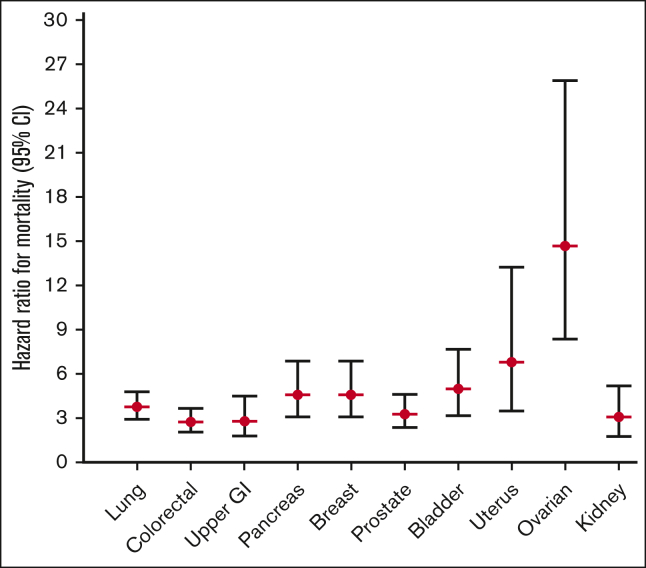
Patients with cancer have an increased risk of developing venous thromboembolism (VTE), and this combination is reported to result in poorer survival compared with cancer alone. This study aimed to investigate the impact of VTE on the survival of patients with cancer in a general population. The Scandinavian Thrombosis and Cancer (STAC) cohort, a population-based cohort including 144 952 participants without previous VTE or cancer, was used. During follow-up, cancer and VTE incidences were registered. "Cancer-related VTE" was defined as VTE diagnosed in patients with overt or occult cancer. The survival of participants without cancer and/or VTE ("disease-free") was compared with the survival of participants with cancer and cancer-related VTE. Cox regression models with cancer and VTE as time-varying exposures were performed to calculate hazard ratios for death. Subanalyses were performed across cancer types and stages and VTE type (deep vein thrombosis or pulmonary embolism). During follow-up (mean, 11.7 years), 14 621 participants developed cancer, and 2444 developed VTE, of which 1241 were cancer-related. The mortality rates (per 100 person years) for disease-free participants, VTE only, cancer only, and cancer-related VTE were 0.63, 5.0, 9.2, and 45.3, respectively. Compared with patients with cancer only, the risk of death for patients with cancer-related VTE was increased 3.4-fold. Within all cancer types, the occurrence of VTE increased the mortality risk 2.8- to 14.7-fold. In a general population, patients with cancer with VTE had a 3.4-fold higher mortality risk than patients with cancer without VTE, independent of cancer type.
癌症患者发生静脉血栓栓塞症(VTE)的风险增加,据报道,这种合并症的患者生存情况较单纯癌症患者更差。本研究旨在调查 VTE 对一般人群中癌症患者生存的影响。研究使用了基于人群的斯堪的纳维亚血栓和癌症(STAC)队列,该队列共纳入了 144952 名无既往 VTE 或癌症的参与者。在随访期间,登记了癌症和 VTE 的发病情况。“与癌症相关的 VTE”定义为在有显性或隐匿性癌症的患者中诊断出的 VTE。无癌症和/或 VTE(“无疾病”)的参与者的生存情况与有癌症和癌症相关 VTE 的参与者的生存情况进行了比较。使用 Cox 回归模型,将癌症和 VTE 作为时变暴露因素,计算死亡的风险比。进行了癌症类型和分期以及 VTE 类型(深静脉血栓形成或肺栓塞)的亚组分析。在随访期间(平均 11.7 年),14621 名参与者发生了癌症,2444 名参与者发生了 VTE,其中 1241 名与癌症相关。无疾病参与者、仅 VTE、仅癌症和与癌症相关的 VTE 的死亡率(每 100 人年)分别为 0.63、5.0、9.2 和 45.3。与仅患有癌症的患者相比,与癌症相关的 VTE 患者的死亡风险增加了 3.4 倍。在所有癌症类型中,VTE 的发生使死亡率风险增加了 2.8 至 14.7 倍。在一般人群中,患有癌症合并 VTE 的患者的死亡风险比无 VTE 的癌症患者高 3.4 倍,与癌症类型无关。