Division of Sleep Medicine, Department of Psychiatry and Behavioral Sciences, Stanford University School of Medicine, Stanford, CA, USA.
Department of Orthodontics, Arthur A. Dugoni School of Dentistry at the University of the Pacific, San Francisco, CA, USA.
Sleep. 2023 Aug 14;46(8). doi: 10.1093/sleep/zsad095.
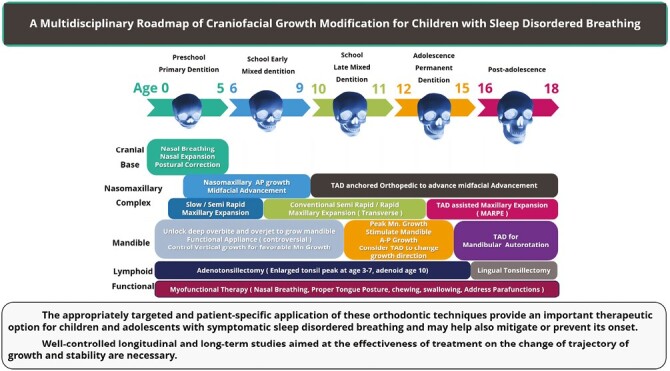
Craniofacial modification by orthodontic techniques is increasingly incorporated into the multidisciplinary management of sleep-disordered breathing in children and adolescents. With increasing application of orthodontics to this clinical population it is important for healthcare providers, families, and patients to understand the wide range of available treatments. Orthodontists can guide craniofacial growth depending on age; therefore, it is important to work with other providers for a team-based approach to sleep-disordered breathing. From infancy to adulthood the dentition and craniofacial complex change with growth patterns that can be intercepted and targeted at critical time points. This article proposes a clinical guideline for application of multidisciplinary care with emphasis on dentofacial interventions that target variable growth patterns. We also highlight how these guidelines serve as a roadmap for the key questions that will influence future research directions. Ultimately the appropriate application of these orthodontic techniques will not only provide an important therapeutic option for children and adolescents with symptomatic sleep-disordered breathing but may help also mitigate or prevent its onset.
颅面畸形通过正畸技术进行矫正,已逐渐被纳入儿童和青少年睡眠呼吸障碍的多学科管理中。随着正畸技术在这一临床人群中的应用越来越广泛,医疗保健提供者、家庭和患者都需要了解广泛的可用治疗方法。正畸医生可以根据年龄来引导颅面生长;因此,重要的是与其他提供者合作,采用基于团队的方法来治疗睡眠呼吸障碍。从婴儿期到成年期,牙齿和颅面复合体随着生长模式的变化而变化,这些生长模式可以在关键时间点被拦截和针对。本文提出了多学科护理的临床指导方针,重点是针对可变生长模式的牙颌面干预措施。我们还强调了这些指南如何作为影响未来研究方向的关键问题的路线图。最终,这些正畸技术的适当应用不仅将为有症状的睡眠呼吸障碍的儿童和青少年提供重要的治疗选择,而且可能有助于减轻或预防其发病。