International Health Program (PROSICS), Direcció Territorial de Malalties Infeccioses Metropolitana Nord, Institut Català de la Salut, Badalona, Spain.
Fight and Infectious Diseases Foundation, Badalona, Spain.
PLoS Negl Trop Dis. 2023 Apr 4;17(4):e0011221. doi: 10.1371/journal.pntd.0011221. eCollection 2023 Apr.
Imported schistosomiasis is an emerging issue in European countries as a result of growing global migration from schistosomiasis-endemic countries, mainly in sub-Saharan Africa. Undetected infection may lead to serious long-term complications with an associated high cost for public healthcare systems especially among long-term migrants.
To evaluate from a health economics perspective the introduction of schistosomiasis screening programs in non-endemic countries with high prevalence of long-term migrants.
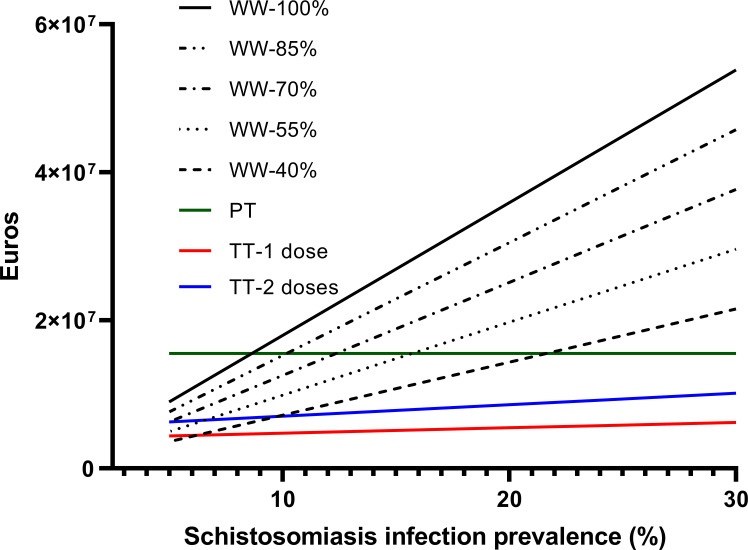
We calculated the costs associated with three approaches-presumptive treatment, test-and-treat and watchful waiting-under different scenarios of prevalence, treatment efficacy and the cost of care resulting from long-term morbidity. Costs were estimated for our study area, in which there are reported to reside 74,000 individuals who have been exposed to the infection. Additionally, we methodically reviewed the potential factors that could affect the cost/benefit ratio of a schistosomiasis screening program and need therefore to be ascertained.
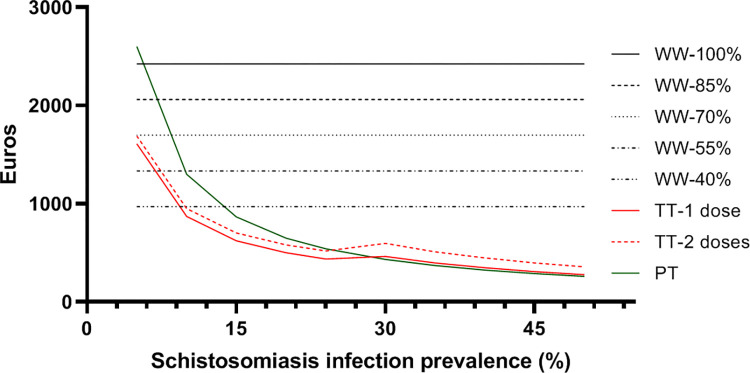
Assuming a 24% prevalence of schistosomiasis in the exposed population and 100% treatment efficacy, the estimated associated cost per infected person of a watchful waiting strategy would be €2,424, that of a presumptive treatment strategy would be €970 and that of a test-and-treat strategy would be €360. The difference in averted costs between test-and-treat and watchful waiting strategies ranges from nearly €60 million in scenarios of high prevalence and treatment efficacy, to a neutral costs ratio when these parameters are halved. However, there are important gaps in our understanding of issues such as the efficacy of treatment in infected long-term residents, the natural history of schistosomiasis in long-term migrants and the feasibility of screening programs.
Our results support the roll-out of a schistosomiasis screening program based on a test-and-treat strategy from a health economics perspective under the most likely projected scenarios, but important knowledge gaps should be addressed for a more accurate estimations among long-term migrants.
由于来自血吸虫病流行国家的全球移民不断增加,输入性血吸虫病已成为欧洲国家的一个新问题,这些国家主要在撒哈拉以南非洲地区。未被发现的感染可能导致严重的长期并发症,并给公共卫生系统带来高昂的费用,特别是对于长期移民。
从卫生经济学角度评估在高长期移民流行率的非流行国家引入血吸虫病筛查计划。
我们根据不同的流行率、治疗效果和长期发病导致的护理成本情景,计算了三种方法-推测性治疗、检测和治疗以及观察等待-相关的成本。成本是根据我们的研究地区估算的,据报道该地区有 74000 名接触过感染的人居住。此外,我们系统地审查了可能影响血吸虫病筛查计划的成本效益比并因此需要确定的潜在因素。
假设暴露人群中血吸虫病的流行率为 24%,治疗效果为 100%,那么观察等待策略下每个感染者的估计相关成本为 2424 欧元,推测性治疗策略下为 970 欧元,检测和治疗策略下为 360 欧元。在高流行率和治疗效果的情景下,检测和治疗策略与观察等待策略之间的避免成本差异从近 6000 万欧元不等,而当这些参数减半时,成本比接近中性。然而,我们对一些问题的理解还存在重要差距,例如感染的长期居民的治疗效果、长期移民的血吸虫病自然史以及筛查计划的可行性。
从卫生经济学的角度来看,我们的结果支持根据最有可能的预测情景推出基于检测和治疗策略的血吸虫病筛查计划,但应解决长期移民中更准确估计的重要知识差距。