Warwick Medical School, University of Warwick, Coventry, UK
Warwick Medical School, University of Warwick, Coventry, UK.
BMJ Open. 2023 Apr 4;13(4):e067429. doi: 10.1136/bmjopen-2022-067429.
The aim of this systematic overview of reviews was to synthesise available evidence on inequalities in infectious disease based on three dimensions of inequalities; inclusion health groups, protected characteristics and socioeconomic inequalities.
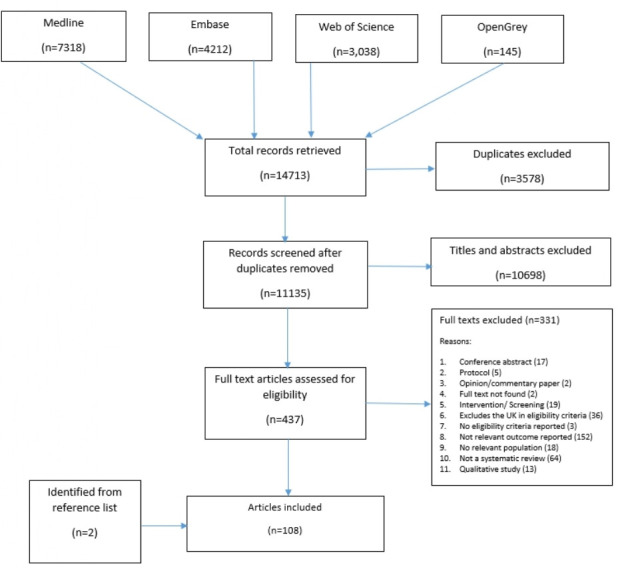
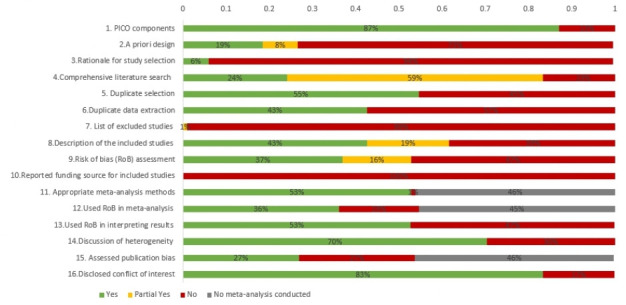
We searched MEDLINE, Embase, Web of Science and OpenGrey databases in November 2021. We included reviews published from the year 2000 which examined inequalities in the incidence, prevalence or consequences of infectious diseases based on the dimensions of interest. Our search focused on tuberculosis, HIV, sexually transmitted infections, hepatitis C, vaccination and antimicrobial resistance. However, we also included eligible reviews of any other infectious diseases. We appraised the quality of reviews using the Assessment of Multiple Systematic Reviews V.2 (AMSTAR2) checklist. We conducted a narrative data synthesis.
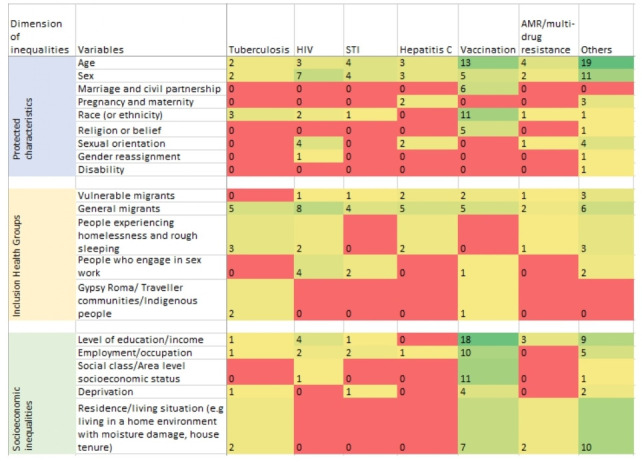
We included 108 reviews in our synthesis covering all the dimensions of inequalities for most of the infectious disease topics of interest, however the quality and volume of review evidence and consistency of their findings varied. The existing literature reviews provide strong evidence that people in inclusion health groups and lower socioeconomic status are consistently at higher risk of infectious diseases, antimicrobial resistance and incomplete/delayed vaccination. In the protected characteristics dimension, ethnicity, and sexual orientation are important factors contributing to inequalities across the various infectious disease topics included in this overview of reviews.
We identified many reviews that provide evidence of various types of health inequalities in different infectious diseases, vaccination, and antimicrobial resistance. We also highlight areas where reviews may be lacking. The commonalities in the associations and their directions suggest it might be worth targeting interventions for some high risk-groups that may have benefits across multiple infectious disease outcomes rather than operating purely in infectious disease siloes.
本系统综述旨在综合现有关于传染病不平等的证据,基于不平等的三个维度:包容性健康群体、保护特征和社会经济不平等。
我们于 2021 年 11 月检索了 MEDLINE、Embase、Web of Science 和 OpenGrey 数据库。我们纳入了自 2000 年以来发表的审查,这些审查根据感兴趣的维度检查了传染病发病率、患病率或后果的不平等。我们的搜索重点是结核病、艾滋病毒、性传播感染、丙型肝炎、疫苗接种和抗微生物药物耐药性。但是,我们还纳入了任何其他传染病的合格审查。我们使用评估多个系统审查 V.2(AMSTAR2)清单评估了审查的质量。我们进行了叙述性数据综合。
我们的综合分析纳入了 108 篇审查,涵盖了大多数感兴趣的传染病主题的所有不平等维度,但审查证据的质量和数量及其发现的一致性存在差异。现有文献综述提供了强有力的证据,表明包容性健康群体和社会经济地位较低的人始终面临更高的传染病、抗微生物药物耐药性和不完全/延迟疫苗接种风险。在保护特征维度,族裔和性取向是影响本综述中包含的各种传染病主题不平等的重要因素。
我们确定了许多审查,这些审查提供了不同传染病、疫苗接种和抗微生物药物耐药性方面各种健康不平等的证据。我们还强调了审查可能存在的不足之处。这些关联及其方向的相似性表明,针对某些高风险群体的干预措施可能具有益处,而不仅仅是在传染病隔离中运作,这些干预措施可能具有益处,这些干预措施可能跨越多种传染病结果。