Walker Josephine G, Ivanova Elena, Jamil Muhammad S, Ong Jason J, Easterbrook Philippa, Fajardo Emmanuel, Johnson Cheryl Case, Luhmann Niklas, Terris-Prestholt Fern, Vickerman Peter, Shilton Sonjelle
Population Health Sciences, Bristol Medical School, University of Bristol, Bristol, United Kingdom.
FIND, The Global Alliance for Diagnostics, Geneva, Switzerland.
PLOS Glob Public Health. 2023 Apr 5;3(4):e0001667. doi: 10.1371/journal.pgph.0001667. eCollection 2023.
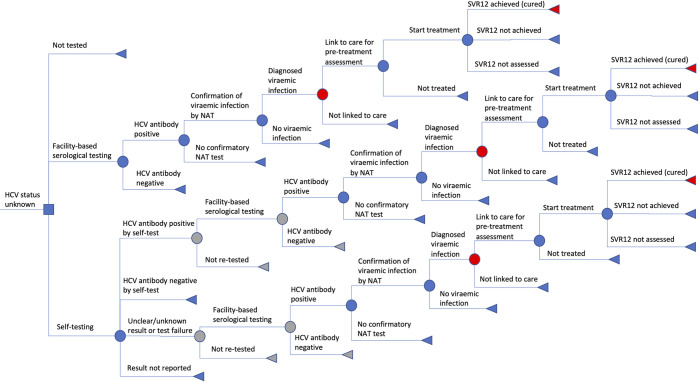
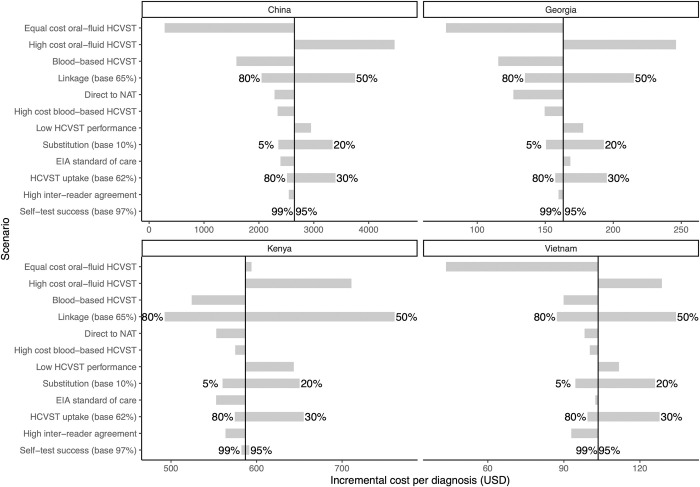
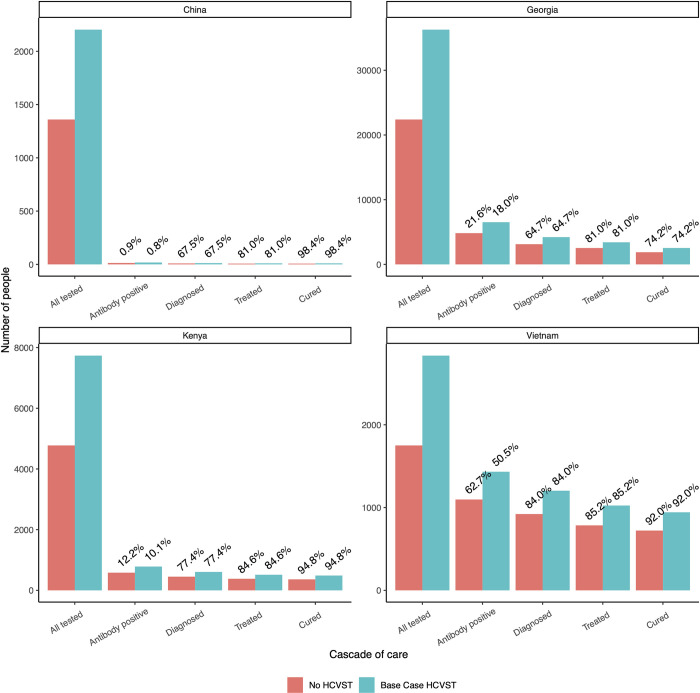
Globally, there are approximately 58 million people with chronic hepatitis C virus infection (HCV) but only 20% have been diagnosed. HCV self-testing (HCVST) could reach those who have never been tested and increase uptake of HCV testing services. We compared cost per HCV viraemic diagnosis or cure for HCVST versus facility-based HCV testing services. We used a decision analysis model with a one-year time horizon to examine the key drivers of economic cost per diagnosis or cure following the introduction of HCVST in China (men who have sex with men), Georgia (men 40-49 years), Viet Nam (people who inject drugs, PWID), and Kenya (PWID). HCV antibody (HCVAb) prevalence ranged from 1%-60% across settings. Model parameters in each setting were informed by HCV testing and treatment programmes, HIV self-testing programmes, and expert opinion. In the base case, we assume a reactive HCVST is followed by a facility-based rapid diagnostic test (RDT) and then nucleic acid testing (NAT). We assumed oral-fluid HCVST costs of $5.63/unit ($0.87-$21.43 for facility-based RDT), 62% increase in testing following HCVST introduction, 65% linkage following HCVST, and 10% replacement of facility-based testing with HCVST based on HIV studies. Parameters were varied in sensitivity analysis. Cost per HCV viraemic diagnosis without HCVST ranged from $35 2019 US dollars (Viet Nam) to $361 (Kenya). With HCVST, diagnosis increased resulting in incremental cost per diagnosis of $104 in Viet Nam, $163 in Georgia, $587 in Kenya, and $2,647 in China. Differences were driven by HCVAb prevalence. Switching to blood-based HCVST ($2.25/test), increasing uptake of HCVST and linkage to facility-based care and NAT testing, or proceeding directly to NAT testing following HCVST, reduced the cost per diagnosis. The baseline incremental cost per cure was lowest in Georgia ($1,418), similar in Viet Nam ($2,033), and Kenya ($2,566), and highest in China ($4,956). HCVST increased the number of people tested, diagnosed, and cured, but at higher cost. Introducing HCVST is more cost-effective in populations with high prevalence.
全球约有5800万人感染慢性丙型肝炎病毒(HCV),但仅有20%的感染者得到诊断。HCV自我检测(HCVST)能够覆盖从未接受检测的人群,并提高HCV检测服务的利用率。我们比较了HCVST与基于医疗机构的HCV检测服务每确诊或治愈一例HCV病毒血症患者的成本。我们使用了一个为期一年的决策分析模型,以研究在中国(男男性行为者)、格鲁吉亚(40 - 49岁男性)、越南(注射吸毒者,PWID)和肯尼亚(PWID)引入HCVST后,每确诊或治愈一例患者经济成本的关键驱动因素。各地区HCV抗体(HCVAb)流行率在1%至60%之间。每个地区的模型参数依据HCV检测和治疗项目、HIV自我检测项目以及专家意见确定。在基础案例中,我们假设HCVST呈反应性,随后进行基于医疗机构的快速诊断检测(RDT),然后进行核酸检测(NAT)。我们假设口腔液HCVST成本为每单位5.63美元(基于医疗机构的RDT成本为0.87 - 21.43美元),引入HCVST后检测量增加62%,HCVST后转诊率为65%,并且根据HIV研究,基于医疗机构的检测中有10%被HCVST取代。在敏感性分析中对参数进行了调整。未采用HCVST时,每确诊一例HCV病毒血症患者的成本在越南为35美元(2019年美元)至肯尼亚的361美元之间。采用HCVST后,确诊人数增加,导致越南每确诊一例的增量成本为104美元,格鲁吉亚为163美元,肯尼亚为587美元,中国为2647美元。差异由HCVAb流行率驱动。改用基于血液的HCVST(每次检测2.25美元)、提高HCVST的利用率以及与基于医疗机构的护理和NAT检测的转诊率,或者在HCVST后直接进行NAT检测,可降低每确诊一例的成本。每治愈一例的基线增量成本在格鲁吉亚最低(1418美元),在越南(2033美元)和肯尼亚(2566美元)相近,在中国最高(4956美元)。HCVST增加了检测、确诊和治愈的人数,但成本更高。在高流行率人群中引入HCVST更具成本效益。