Max von Pettenkofer-Institute, Chair for Medical Microbiology and Hygiene, Ludwig Maximilian University (LMU), Munich, Germany.
Deutsches Zentrum für Infektionsforschung, partner site Munich, Germany.
PLoS Pathog. 2023 Apr 5;19(4):e1011306. doi: 10.1371/journal.ppat.1011306. eCollection 2023 Apr.
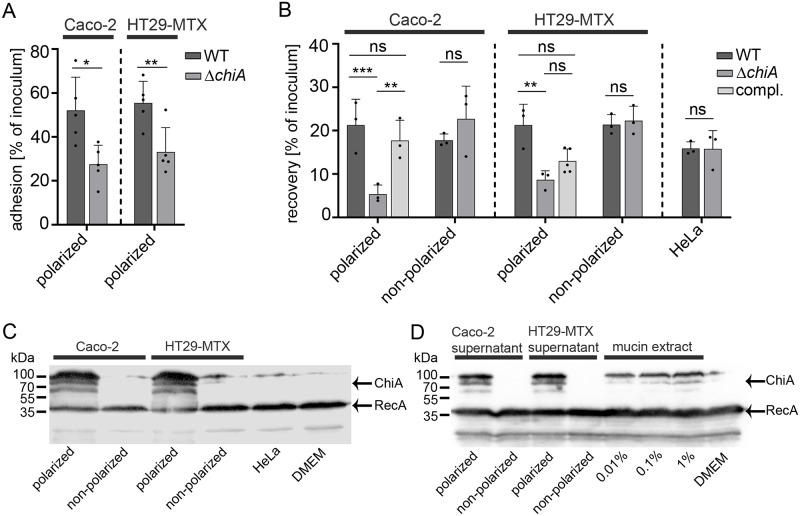
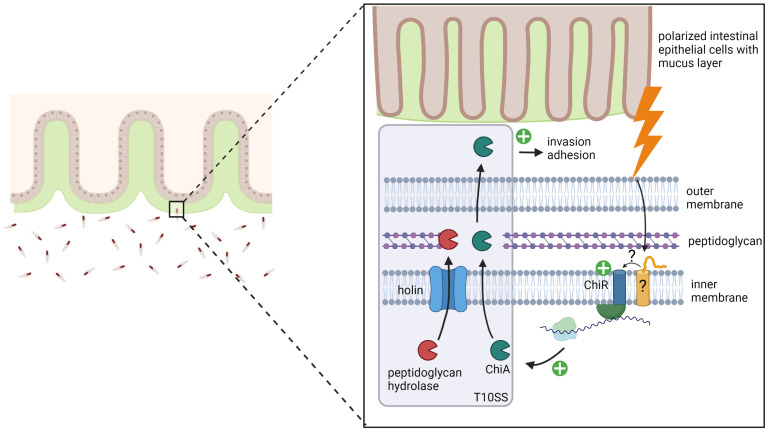
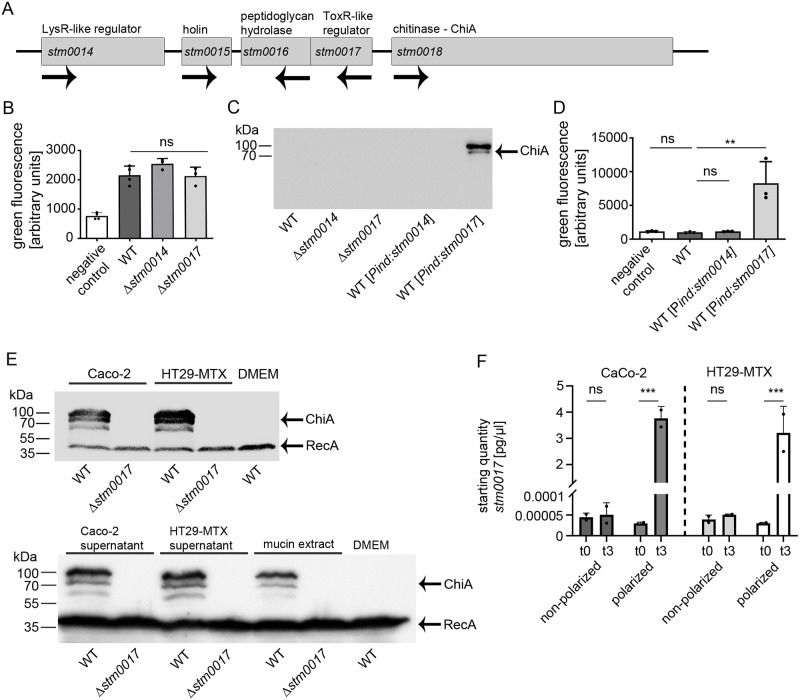
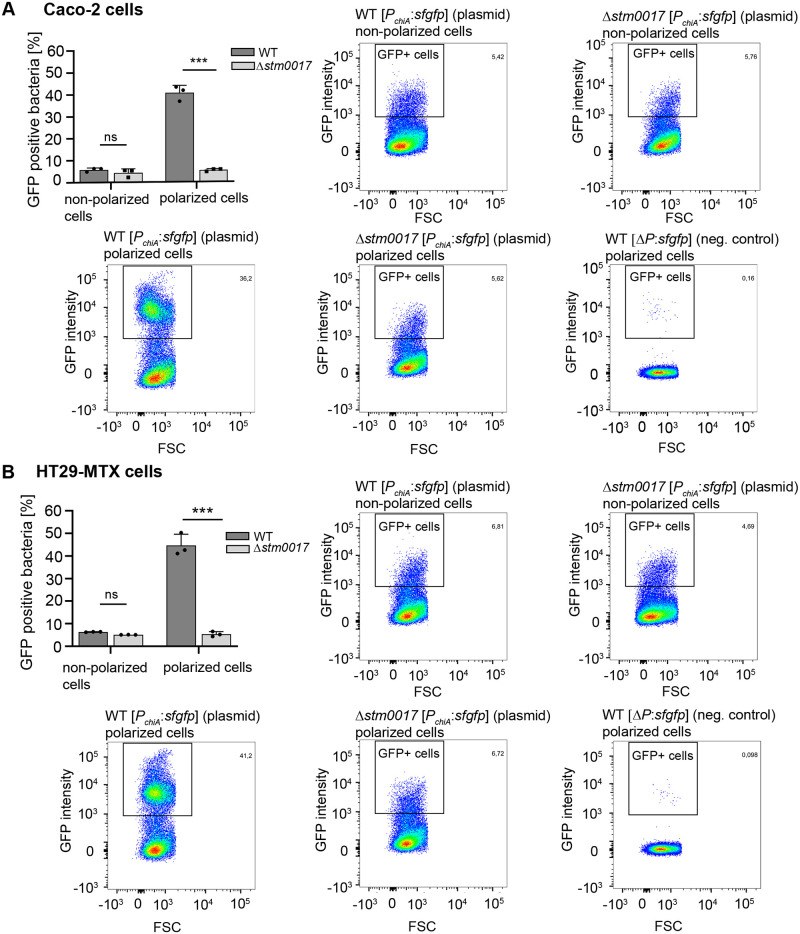
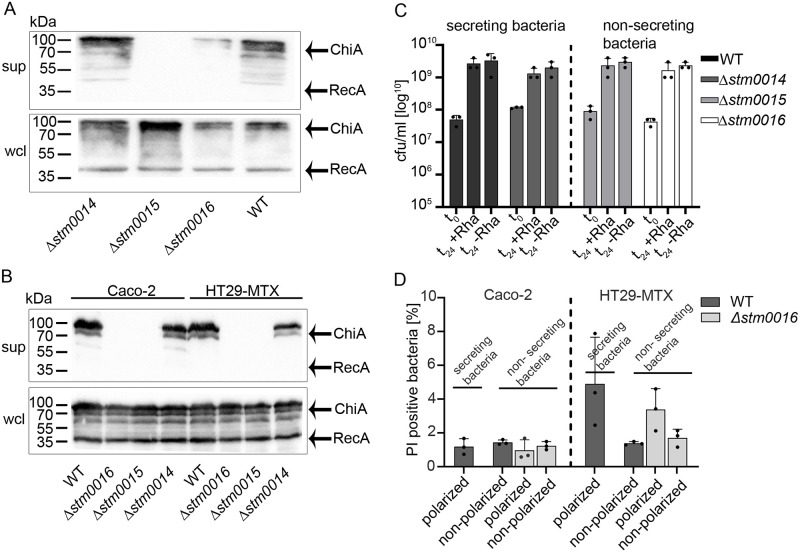
As a facultative intracellular pathogen, Salmonella enterica serovar Typhimurium is one of the leading causes of food-borne diseases in humans. With the ingestion of fecal contaminated food or water, S. Typhimurium reaches the intestine. Here, the pathogen efficiently invades intestinal epithelial cells of the mucosal epithelium by the use of multiple virulence factors. Recently, chitinases have been described as emerging virulence factors of S. Typhimurium that contribute to the attachment and invasion of the intestinal epithelium, prevent immune activation, and modulate the host glycome. Here we find that the deletion of chiA leads to diminished adhesion and invasion of polarized intestinal epithelial cells (IEC) compared to wild-type S. Typhimurium. Interestingly, no apparent impact on interaction was detected when using non-polarized IEC or HeLa epithelial cells. In concordance, we demonstrate that chiA gene and ChiA protein expression was solely induced when bacteria gain contact with polarized IEC. The induction of chiA transcripts needs the specific activity of transcriptional regulator ChiR, which is co-localized with chiA in the chitinase operon. Moreover, we established that after chiA is induced, a major portion of the bacterial population expresses chiA, analyzed by flow cytometry. Once expressed, we found ChiA in the bacterial supernatants using Western blot analyses. ChiA secretion was completely abolished when accessory genes within the chitinase operon encoding for a holin and a peptidoglycan hydrolase were deleted. Holins, peptidoglycan hydrolases, and large extracellular enzymes in close proximity have been described as components of the bacterial holin/peptidoglycan hydrolase-dependent protein secretion system or Type 10 Secretion System. Overall, our results confirm that chitinase A is an important virulence factor, tightly regulated by ChiR, that promotes adhesion and invasion upon contact with polarized IEC and is likely secreted by a Type 10 Secretion System (T10SS).
作为一种兼性细胞内病原体,鼠伤寒沙门氏菌是人类食源性疾病的主要病原体之一。通过摄入受粪便污染的食物或水,鼠伤寒沙门氏菌到达肠道。在这里,病原体通过多种毒力因子有效地入侵黏膜上皮的肠上皮细胞。最近,几丁质酶被描述为鼠伤寒沙门氏菌的新兴毒力因子,有助于附着和入侵肠上皮细胞,防止免疫激活,并调节宿主糖组。在这里,我们发现与野生型鼠伤寒沙门氏菌相比,chiA 缺失导致粘附和侵袭极化肠上皮细胞(IEC)的能力降低。有趣的是,当使用非极化 IEC 或 HeLa 上皮细胞时,没有检测到对相互作用的明显影响。一致地,我们证明当细菌与极化 IEC 接触时,chiA 基因和 ChiA 蛋白表达仅被诱导。chiA 转录物的诱导需要转录调节因子 ChiR 的特异性活性,ChiR 与几丁质酶操纵子中的 chiA 共定位。此外,我们建立了在 chiA 被诱导后,通过流式细胞术分析,细菌群体的主要部分表达 chiA。一旦表达,我们使用 Western blot 分析在细菌上清液中发现 ChiA。当几丁质酶操纵子中编码一个孔蛋白和一个肽聚糖水解酶的辅助基因缺失时,ChiA 分泌完全被阻断。孔蛋白、肽聚糖水解酶和紧密接近的大细胞外酶已被描述为细菌孔蛋白/肽聚糖水解酶依赖性蛋白分泌系统或 10 型分泌系统的组成部分。总体而言,我们的结果证实,几丁质酶 A 是一种重要的毒力因子,受 ChiR 严格调控,当与极化 IEC 接触时促进粘附和侵袭,并且可能通过 10 型分泌系统(T10SS)分泌。