Genome Dynamics Laboratory, National Institute of Genetics, Mishima, Shizuoka 411-8540, Japan.
Laboratory for Developmental Dynamics, Center for Biosystems Dynamics Research (BDR), RIKEN, Kobe, Hyogo 650-0047, Japan.
Sci Adv. 2023 Apr 5;9(14):eadf1488. doi: 10.1126/sciadv.adf1488.
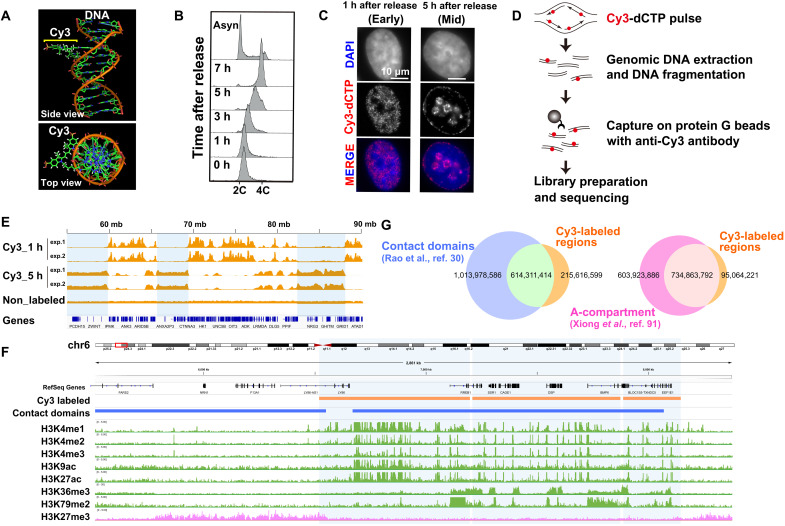
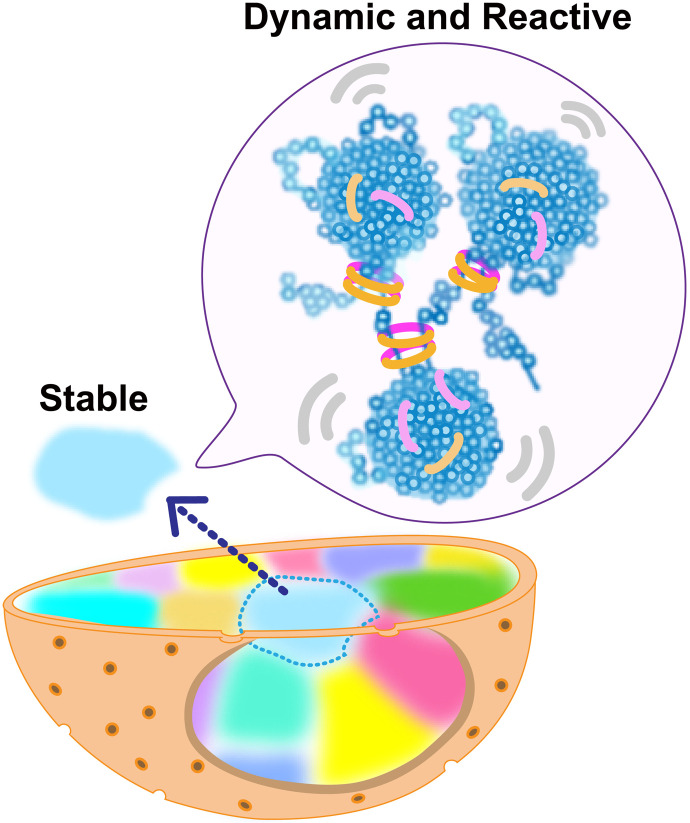
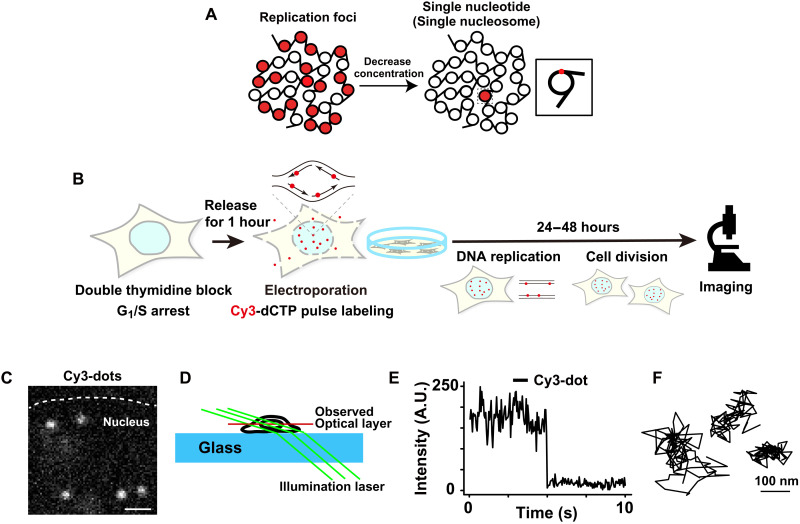
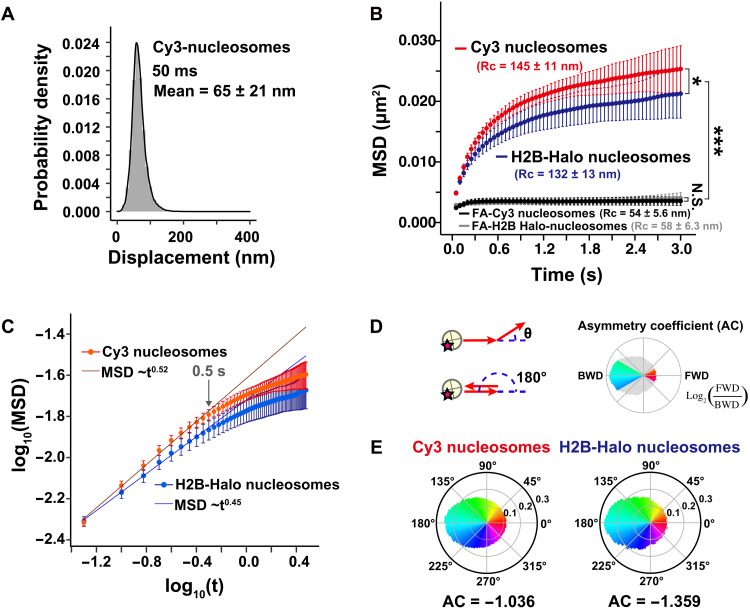
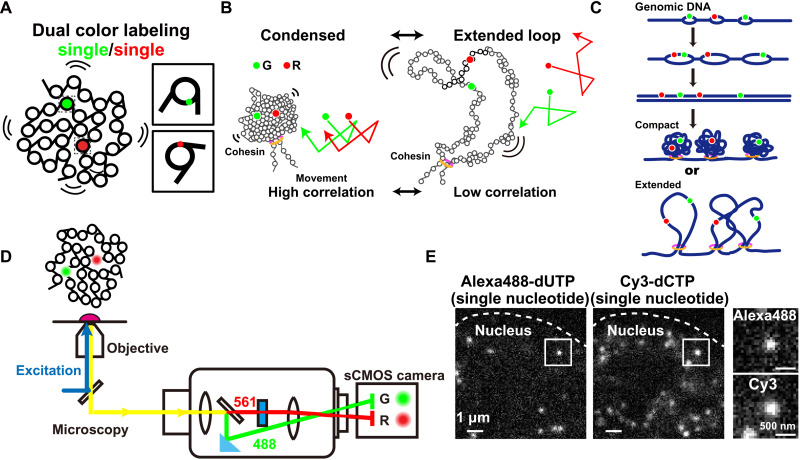
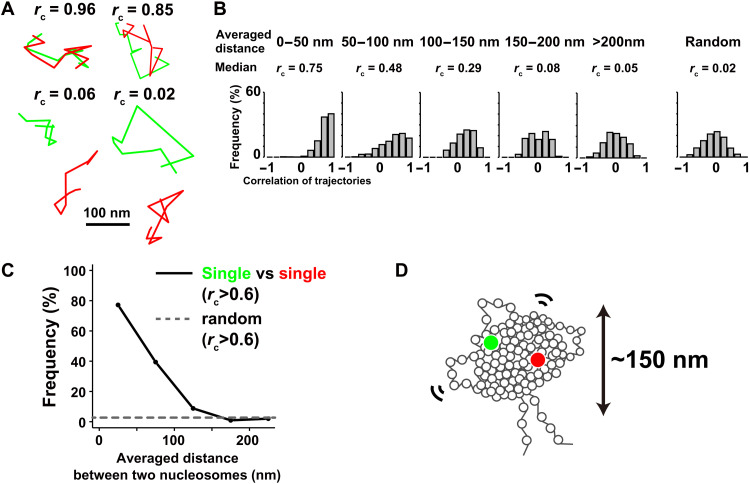
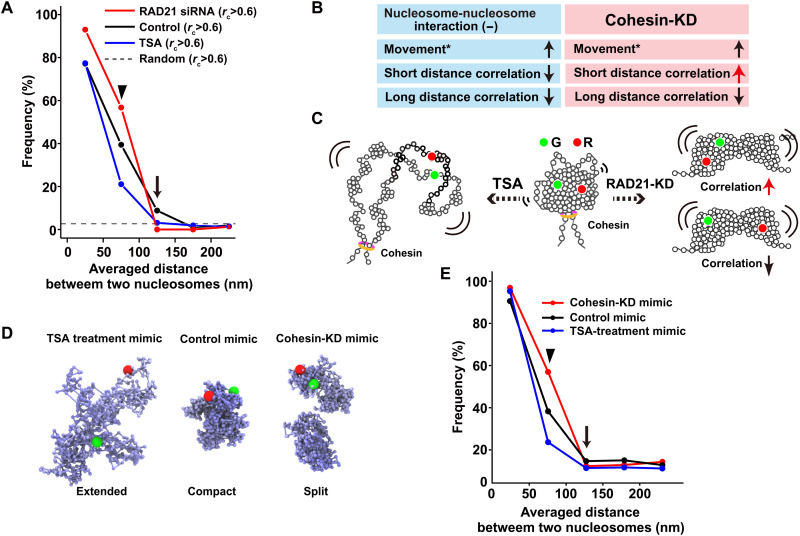
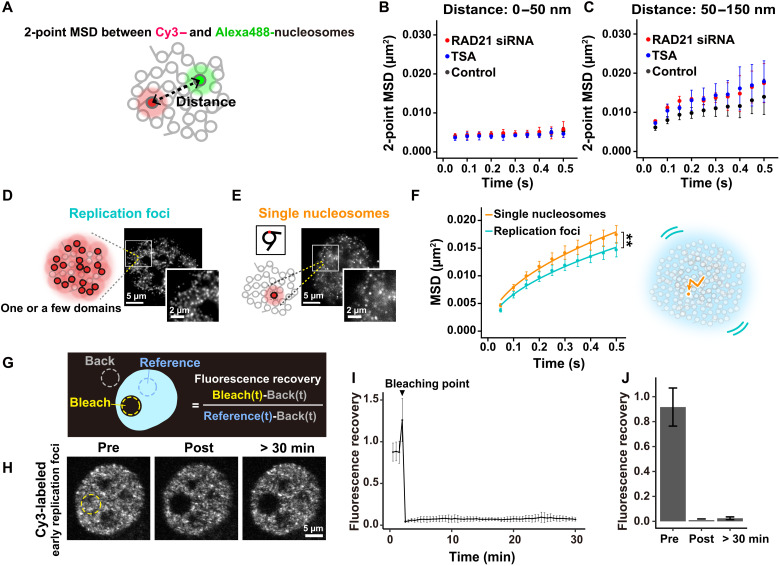
In eukaryotes, higher-order chromatin organization is spatiotemporally regulated as domains, for various cellular functions. However, their physical nature in living cells remains unclear (e.g., condensed domains or extended fiber loops; liquid-like or solid-like). Using novel approaches combining genomics, single-nucleosome imaging, and computational modeling, we investigated the physical organization and behavior of early DNA replicated regions in human cells, which correspond to Hi-C contact domains with active chromatin marks. Motion correlation analysis of two neighbor nucleosomes shows that nucleosomes form physically condensed domains with 150-nm diameters, even in active chromatin regions. The mean-square displacement analysis between two neighbor nucleosomes demonstrates that nucleosomes behave like a liquid in the condensed domain on the ~150 nm/0.5 s spatiotemporal scale, which facilitates chromatin accessibility. Beyond the micrometers/minutes scale, chromatin seems solid-like, which may contribute to maintaining genome integrity. Our study reveals the viscoelastic principle of the chromatin polymer; chromatin is locally dynamic and reactive but globally stable.
在真核生物中,更高阶的染色质组织作为各种细胞功能的域,在时空上受到调节。然而,它们在活细胞中的物理性质仍然不清楚(例如,凝聚的域或扩展的纤维环;液态或固态)。我们使用结合基因组学、单核小体成像和计算建模的新方法,研究了人类细胞中早期 DNA 复制区域的物理组织和行为,这些区域对应于具有活跃染色质标记的 Hi-C 接触域。两个相邻核小体的运动相关分析表明,核小体即使在活跃染色质区域也形成具有约 150nm 直径的物理凝聚域。两个相邻核小体之间的均方位移分析表明,核小体在凝聚域中表现得像液体,在约 150nm/0.5s 的时空尺度上,这有利于染色质可及性。在微米/分钟的尺度之外,染色质似乎是固态的,这可能有助于维持基因组的完整性。我们的研究揭示了染色质聚合物的粘弹性原理;染色质在局部是动态和反应性的,但在全局是稳定的。