Department of Epidemiology and Biostatistics, School of Public Health, Peking University, Beijing, China.
School of Public Health, Key Lab of Public Health Safety of the Ministry of Education, NHC 12 Key Lab of Health Technology Assessment, IRDR ICoE on Risk Interconnectivity and 13 Governance on Weather or Climate Extremes Impact and Public Health, Fudan University, Shanghai, China.
Lancet Planet Health. 2023 Apr;7(4):e304-e312. doi: 10.1016/S2542-5196(23)00047-5.
Increased physical activity is associated with a reduced risk of cardiovascular disease, but outdoor physical activity can be accompanied by increased inhalation of fine particulate matter (PM). The extent to which long-term exposure to PM can offset the cardiovascular benefits of physical activity is unknown. We aimed to evaluate whether the associations between active commuting or farming activity and incident risks of cerebrovascular disease and ischaemic heart disease were consistent between populations with different ambient PM exposures.
We did a prospective cohort study using data from people aged 30-79 years without cardiovascular disease at baseline from the China Kadoorie Biobank (CKB). Active commuting and farming activity were assessed at baseline using questionnaires. A high-resolution (1 × 1 km) satellite-based model was used to estimate annual average PM exposure during the study period. Participants were stratified according to PM exposure (54 μg/m or greater vs less than 54 μg/m). Hazard ratios (HRs) and 95% CIs for incident cerebrovascular disease and ischaemic heart disease by active commuting and farming activity were estimated using Cox proportional hazard models. Effect modifications by PM exposure were tested by likelihood ratio tests. Analyses were restricted to the period from Jan 1, 2005, to Dec 31, 2017.
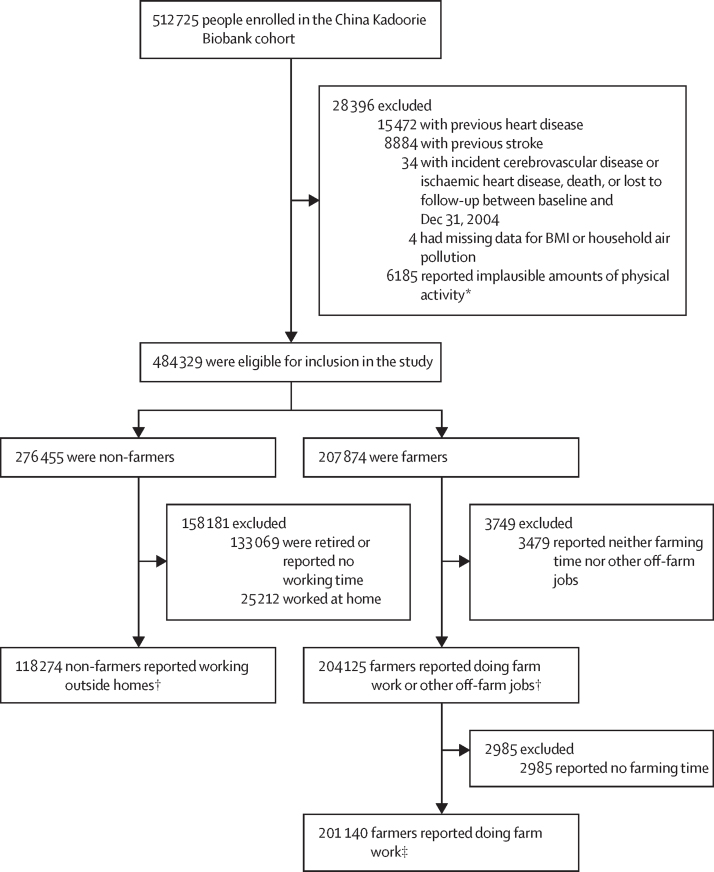
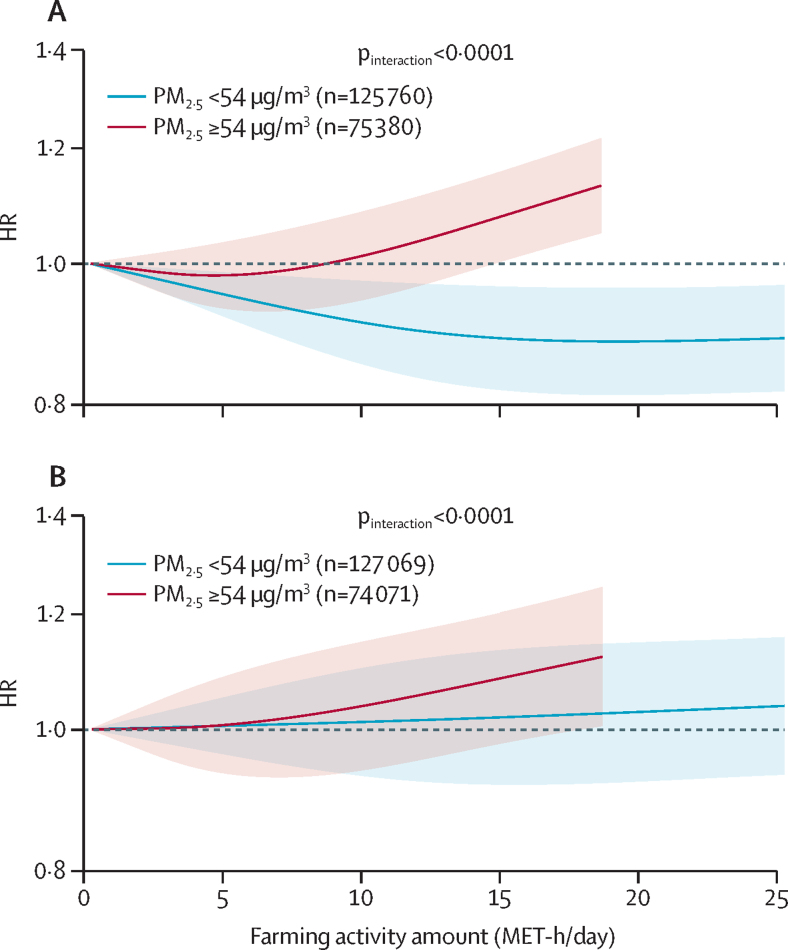
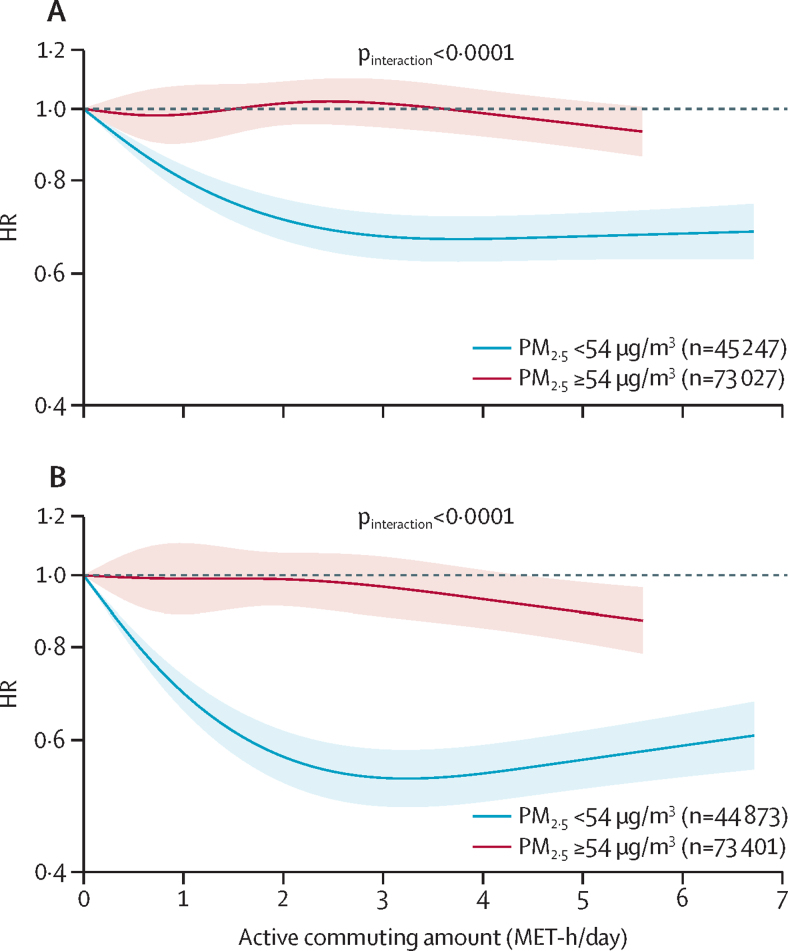
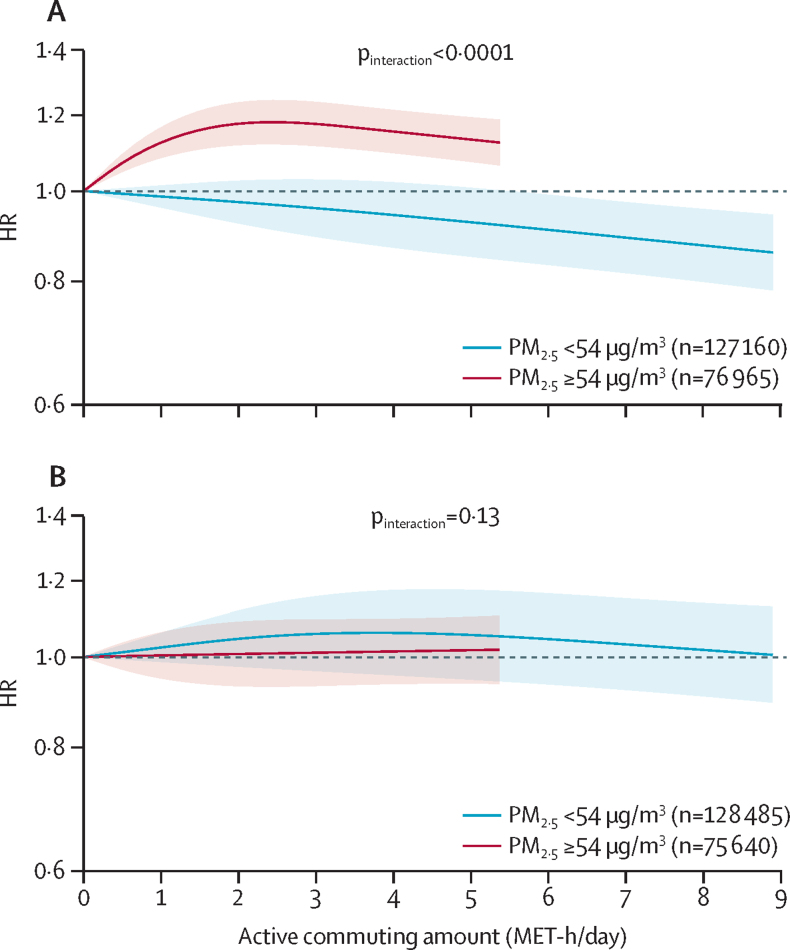
Between June 25, 2004, and July 15, 2008, 512 725 people were enrolled in the CKB cohort. 322 399 eligible participants completed the baseline survey and were included in the analysis of active commuting (118 274 non-farmers and 204 125 farmers). Among 204 125 farmers, 2985 reported no farming time and 201 140 were included in the farming activity analysis. During a median follow-up of 11 years, 39 514 cerebrovascular disease cases and 22 313 ischaemic heart disease cases were newly identified. Among non-farmers with exposure to annual average PM concentrations of less than 54 μg/m, increased active commuting was associated with lower risks of cerebrovascular disease (highest active commuting vs lowest active commuting HR 0·70, 95% CI 0·65-0·76) and ischaemic heart disease (0·60, 0·54-0·66). However, among non-farmers with exposure to annual average PM concentrations of 54 μg/m or greater, there was no association between active commuting and cerebrovascular disease or ischaemic heart disease. Among farmers with exposure to annual average PM concentrations of less than 54 μg/m, increased active commuting (highest active commuting vs lowest active commuting HR 0·77, 95% CI 0·63-0·93) and increased farming activity (highest activity vs lowest activity HR 0·85, 95% CI 0·79-0·92) were both associated with a lower cerebrovascular disease risk. However, among farmers with exposure to annual average PM concentrations of 54 μg/m or greater, increases in active commuting (highest active commuting vs lowest active commuting HR 1·12, 95% CI 1·05-1·19) and farming activity (highest activity vs lowest activity HR 1·18, 95% CI 1·09-1·28) were associated with an elevated cerebrovascular disease risk. The above associations differed significantly between PM strata (all interaction p values <0·0001).
For participants with long-term exposure to higher ambient PM concentrations, the cardiovascular benefits of active commuting and farming activity were significantly attenuated. Higher levels of active commuting and farming activity even increased the cerebrovascular disease risk among farmers with exposure to annual average PM concentrations of 54 μg/m or greater.
National Natural Science Foundation of China, National Key Research and Development Program of China, Kadoorie Charitable Foundation, UK Wellcome Trust.
增加身体活动与降低心血管疾病风险相关,但户外身体活动可能伴随着细颗粒物(PM)吸入量的增加。长期暴露于 PM 对身体活动的心血管益处的影响程度尚不清楚。我们旨在评估在不同环境 PM 暴露人群中,积极通勤或农业活动与脑血管疾病和缺血性心脏病事件风险之间的关联是否一致。
我们使用中国慢性病前瞻性研究(CKB)中基线时无心血管疾病的 30-79 岁人群的数据进行了一项前瞻性队列研究。使用问卷在基线时评估积极通勤和农业活动。使用基于高分辨率(1 × 1 km)卫星的模型来估计研究期间的年平均 PM 暴露。根据 PM 暴露(54 μg/m 或更高 vs 低于 54 μg/m)对参与者进行分层。使用 Cox 比例风险模型估计积极通勤和农业活动与脑血管疾病和缺血性心脏病事件的发生风险比(HR)和 95%置信区间。通过似然比检验检验 PM 暴露的效应修饰。分析仅限于 2005 年 1 月 1 日至 2017 年 12 月 31 日期间。
在 2004 年 6 月 25 日至 2008 年 7 月 15 日之间,有 512 725 人参加了 CKB 队列。512 725 人中,有 322 399 人完成了基线调查,并纳入了积极通勤的分析(118 274 名非农民和 204 125 名农民)。在 204 125 名农民中,有 2985 人报告没有务农时间,201 140 人纳入了农业活动分析。在中位随访 11 年期间,新确诊了 39 514 例脑血管疾病病例和 22 313 例缺血性心脏病病例。在暴露于年平均 PM 浓度低于 54 μg/m 的非农民中,增加积极通勤与降低脑血管疾病风险相关(最高积极通勤与最低积极通勤 HR 0·70,95%CI 0·65-0·76)和缺血性心脏病(0·60,0·54-0·66)。然而,在暴露于年平均 PM 浓度为 54 μg/m 或更高的非农民中,积极通勤与脑血管疾病或缺血性心脏病之间没有关联。在暴露于年平均 PM 浓度低于 54 μg/m 的农民中,增加积极通勤(最高积极通勤与最低积极通勤 HR 0·77,95%CI 0·63-0·93)和增加农业活动(最高活动与最低活动 HR 0·85,95%CI 0·79-0·92)都与较低的脑血管疾病风险相关。然而,在暴露于年平均 PM 浓度为 54 μg/m 或更高的农民中,增加积极通勤(最高积极通勤与最低积极通勤 HR 1·12,95%CI 1·05-1·19)和农业活动(最高活动与最低活动 HR 1·18,95%CI 1·09-1·28)与脑血管疾病风险升高相关。这些关联在 PM 分层之间差异显著(所有交互 p 值均<0·0001)。
对于长期暴露于较高环境 PM 浓度的参与者,积极通勤和农业活动的心血管益处明显减弱。在暴露于年平均 PM 浓度为 54 μg/m 或更高的农民中,较高水平的积极通勤和农业活动甚至增加了脑血管疾病的风险。
国家自然科学基金,国家重点研发计划,中国控烟协会,英国惠康信托基金会。