Xia Xi, Meng Xia, Liu Cong, Guo Yi, Li Xinyue, Niu Yue, Lam Kin Bong Hubert, Wright Neil, Kartsonaki Christiana, Chen Yiping, Yang Ling, Du Huaidong, Yu Canqing, Sun Dianjianyi, Lv Jun, Chen Junshi, Yang Xiaoming, Gao Ruqin, Wu Shaowei, Kan Haidong, Chan Ka Hung, Li Liming, Chen Zhengming
Department of Occupational and Environmental Health, School of Public Health, Xi'an Jiaotong University Health Science Center, Xi'an, China; Key Laboratory of Environment and Genes Related to Diseases, Ministry of Education, Xi'an, China; Clinical Trial Service Unit and Epidemiological Studies Unit, Nuffield Department of Population Health, University of Oxford, Oxford, UK; School of Public Health, Shaanxi University of Chinese Medicine, Xi'an, China.
School of Public Health, Key Laboratory of Public Health Safety of the Ministry of Education and NHC Key Laboratory of Health Technology Assessment, Fudan University, Shanghai, China.
Lancet Public Health. 2024 Dec;9(12):e1047-e1058. doi: 10.1016/S2468-2667(24)00264-0.
Little evidence is available on the long-term health effects of nitrogen dioxide (NO) in low-income and middle-income populations. We investigated the associations of long-term NO exposure with the incidence of a wide spectrum of disease outcomes, based on data from the China Kadoorie Biobank.
This prospective cohort study involved 512 724 Chinese adults aged 30-79 years recruited from ten areas of China during 2004-08. Time-varying Cox regression models yielded adjusted hazard ratios (HRs) for the associations of long-term NO exposure with aggregated disease incidence endpoints classified by 14 ICD-10 chapters, and incidences of 12 specific diseases selected from three key ICD-10 chapters (cardiovascular, respiratory, and musculoskeletal diseases) found to be robustly associated with NO in the analyses of aggregated endpoints. All models were stratified by age-at-risk (in 1-year scale), study area, and sex, and were adjusted for education, household income, smoking status, alcohol intake, cooking fuel type, heating fuel type, self-reported health status, BMI, physical activity level, temperature, and relative humidity.
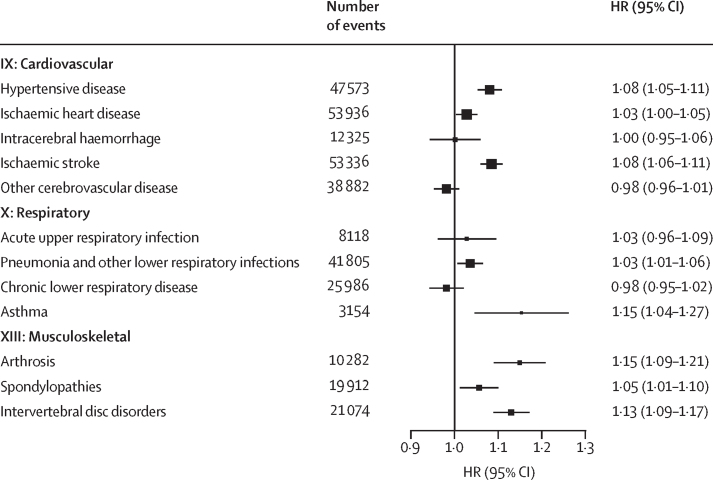
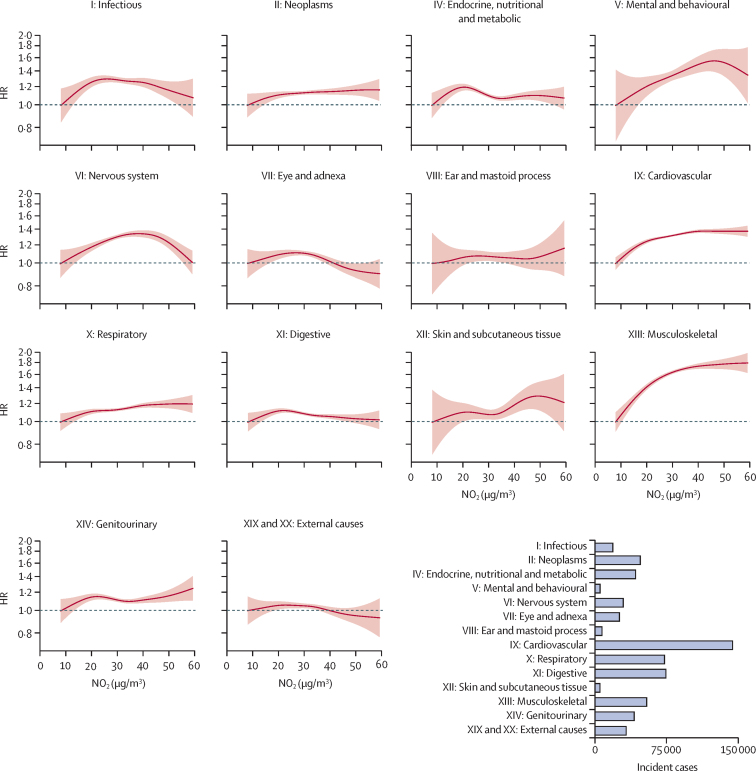
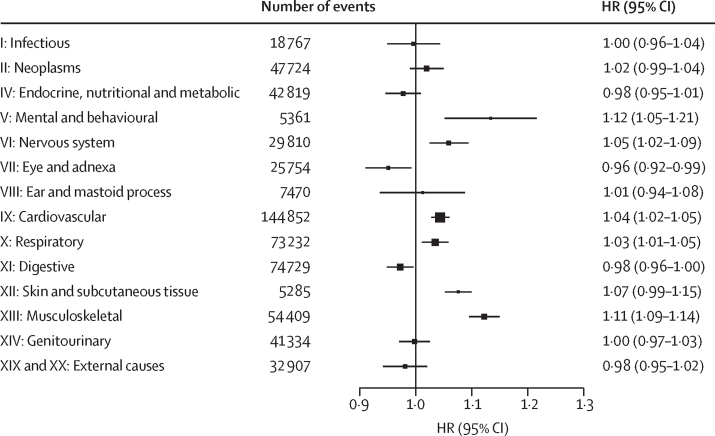
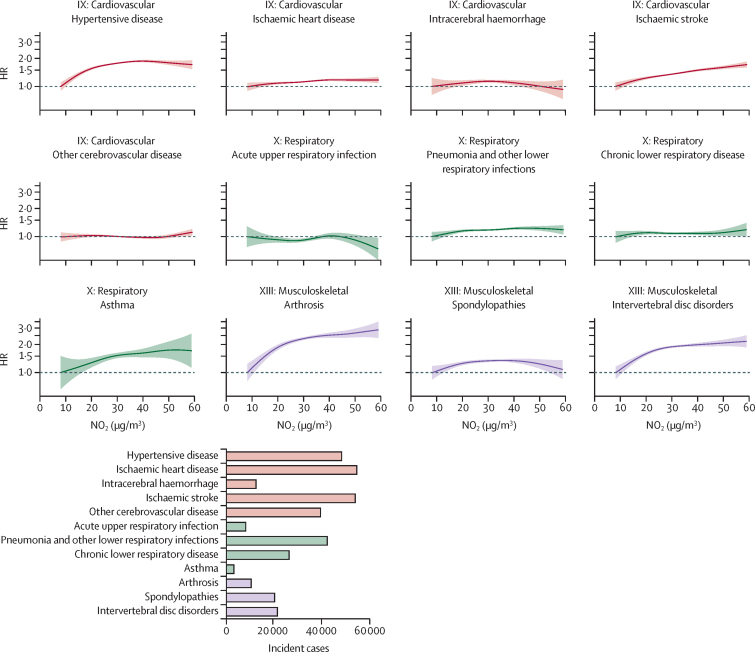
The analysis of 512 709 participants (mean baseline age 52·0 years [SD 10·7]; 59·0% female and 41·0% male) included approximately 6·5 million person-years of follow-up. Between 5285 and 144 852 incident events were recorded for each of the 14 aggregated endpoints. Each 10 μg/m higher annual average NO exposure was associated with higher risks of chapter-specific endpoints, especially cardiovascular (n=144 852; HR 1·04 [95% CI 1·02-1·05]), respiratory (n=73 232; 1·03 [1·01-1·05]), musculoskeletal (n=54 409; 1·11 [1·09-1·14]), and mental and behavioural (n=5361; 1·12 [1·05-1·21]) disorders. Further in-depth analyses on specific diseases found significant positive supra-linear associations with hypertensive disease (1·08 [1·05-1·11]), lower respiratory tract infection (1·03 [1·01-1·06]), arthrosis (1·15 [1·09-1·21]), intervertebral disc disorders (1·13 [1·09-1·17]), and spondylopathies (1·05 [1·01-1·10]), and linear associations with ischaemic heart disease (1·03 [1·00-1·05]), ischaemic stroke (1·08 [1·06-1·11]), and asthma (1·15 [1·04-1·27]), whereas intracerebral haemorrhage (1·00 [0·95-1·06]), other cerebrovascular disease (0·98 [0·96-1·01]), acute upper respiratory infection (1·03 [0·96-1·09]), and chronic lower respiratory disease (0·98 [0·95-1·02]) showed no significant association. NO exposure showed robust null association with external causes (n=32 907; 0·98 [0·95-1·02]) as a negative control.
In China, long-term NO exposure was associated with a range of diseases, particularly cardiovascular, respiratory, and musculoskeletal diseases. These associations underscore the pressing need to implement the recently tightened WHO air quality guidelines.
Wellcome Trust, UK Medical Research Council, Cancer Research UK, British Heart Foundation, National Natural Science Foundation of China, National Key Research and Development Program of China, Sino-British Fellowship Trust, and Kadoorie Charitable Foundation.
关于低收入和中等收入人群中二氧化氮(NO₂)对长期健康影响的证据较少。我们基于中国嘉道理生物银行的数据,研究了长期暴露于NO₂与多种疾病结局发生率之间的关联。
这项前瞻性队列研究纳入了2004年至2008年期间从中国十个地区招募的512724名年龄在30 - 79岁的中国成年人。时变Cox回归模型得出了长期暴露于NO₂与按国际疾病分类第十版(ICD - 10)的14个章节分类的综合疾病发病终点以及从三个关键ICD - 10章节(心血管、呼吸和肌肉骨骼疾病)中选出的12种特定疾病的发病率之间关联的调整后风险比(HR)。在汇总终点分析中发现这些疾病与NO₂有密切关联。所有模型均按风险年龄(以1年为单位)、研究地区和性别进行分层,并对教育程度、家庭收入、吸烟状况、饮酒量、烹饪燃料类型、取暖燃料类型、自我报告的健康状况、体重指数(BMI)、身体活动水平、温度和相对湿度进行了调整。
对512709名参与者(平均基线年龄52.0岁[标准差10.7];女性占59.0%,男性占41.0%)的分析包括约650万人年的随访。14个综合终点中的每一个都记录了5285至144852例发病事件。每年平均NO₂暴露每升高10μg/m³,与特定章节终点的风险增加相关,尤其是心血管疾病(n = 144852;HR 1.04[95%置信区间1.02 - 1.05])、呼吸系统疾病(n = 73232;1.03[1.01 - 1.05])、肌肉骨骼疾病(n = 54409;1.11[1.09 - 1.14])以及精神和行为障碍(n = 5361;1.12[1.05 - 1.21])。对特定疾病的进一步深入分析发现,与高血压疾病(1.08[1.05 - 1.11])、下呼吸道感染(1.03[1.01 - 1.06])、关节病(1.15[1.09 - 1.21])、椎间盘疾病(1.13[1.09 - 1.17])和脊椎病(1.05[1.01 - 1.10])存在显著的正超线性关联,与缺血性心脏病(1.03[1.00 - 1.05])、缺血性中风(1.08[1.06 - 1.11])和哮喘(1.15[1.04 - 1.27])存在线性关联,而脑出血(1.00[0.95 - 1.06])、其他脑血管疾病(0.98[0.96 - 1.01])、急性上呼吸道感染(1.03[0.96 - 1.09])和慢性下呼吸道疾病(0.98[0.95 - 1.02])未显示出显著关联。作为阴性对照,NO₂暴露与外部原因导致的疾病(n = 32907;0.98[0.95 - 1.02])无显著关联。
在中国,长期暴露于NO₂与一系列疾病相关,尤其是心血管、呼吸和肌肉骨骼疾病。这些关联凸显了迫切需要实施最近收紧的世界卫生组织空气质量指南。
英国惠康信托基金会、英国医学研究理事会、英国癌症研究基金会、英国心脏基金会、中国国家自然科学基金、中国国家重点研发计划、中英奖学金信托基金和嘉道理慈善基金会。