Department of Internal Medicine and Nephrology, University Hospital of Münster, Medical Clinic D, Munster, Germany.
Research Group Regulatory Mechanisms of Inflammation, Institute of Medical Biochemistry, Centre for Molecular Biology of Inflammation, University of Muenster, Muenster, Germany.
J Am Soc Nephrol. 2023 Jul 1;34(7):1191-1206. doi: 10.1681/ASN.0000000000000126. Epub 2023 Apr 5.
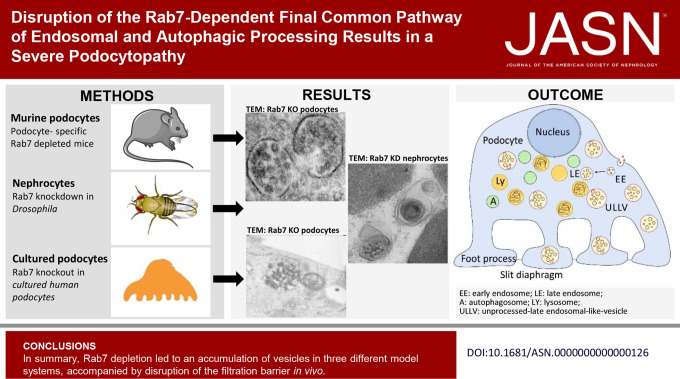
Endocytosis, recycling, and degradation of proteins are essential functions of mammalian cells, especially for terminally differentiated cells with limited regeneration rates and complex morphology, such as podocytes. To improve our understanding on how disturbances of these trafficking pathways are linked to podocyte depletion and slit diaphragm (SD) injury, the authors explored the role of the small GTPase Rab7, which is linked to endosomal, lysosomal, and autophagic pathways, using as model systems mice and Drosophila with podocyte-specific or nephrocyte-specific loss of Rab7, and a human podocyte cell line depleted for Rab7. Their findings point to maturation and fusion events during endolysosomal and autophagic maturation as key processes for podocyte homeostasis and function and identify altered lysosomal pH values as a putative novel mechanism for podocytopathies.
Endocytosis, recycling, and degradation of proteins are essential functions of mammalian cells, especially for terminally differentiated cells with limited regeneration rates, such as podocytes. How disturbances within these trafficking pathways may act as factors in proteinuric glomerular diseases is poorly understood.
To explore how disturbances in trafficking pathways may act as factors in proteinuric glomerular diseases, we focused on Rab7, a highly conserved GTPase that controls the homeostasis of late endolysosomal and autophagic processes. We generated mouse and Drosophila in vivo models lacking Rab7 exclusively in podocytes or nephrocytes, and performed histologic and ultrastructural analyses. To further investigate Rab7 function on lysosomal and autophagic structures, we used immortalized human cell lines depleted for Rab7.
Depletion of Rab7 in mice, Drosophila , and immortalized human cell lines resulted in an accumulation of diverse vesicular structures resembling multivesicular bodies, autophagosomes, and autoendolysosomes. Mice lacking Rab7 developed a severe and lethal renal phenotype with early-onset proteinuria and global or focal segmental glomerulosclerosis, accompanied by an altered distribution of slit diaphragm proteins. Remarkably, structures resembling multivesicular bodies began forming within 2 weeks after birth, prior to the glomerular injuries. In Drosophila nephrocytes, Rab7 knockdown resulted in the accumulation of vesicles and reduced slit diaphragms. In vitro , Rab7 knockout led to similar enlarged vesicles and altered lysosomal pH values, accompanied by an accumulation of lysosomal marker proteins.
Disruption within the final common pathway of endocytic and autophagic processes may be a novel and insufficiently understood mechanism regulating podocyte health and disease.
内吞作用、回收和蛋白质降解是哺乳动物细胞的基本功能,对于终末分化的细胞尤为重要,因为这些细胞的再生率有限,且形态复杂,如足细胞。为了更好地理解这些运输途径的紊乱如何与足细胞耗竭和裂孔隔膜(SD)损伤相关,作者使用了具有足细胞特异性或肾细胞特异性 Rab7 缺失的小鼠和果蝇作为模型系统,以及 Rab7 耗竭的人足细胞系,来探索小 GTPase Rab7 的作用。Rab7 与内体、溶酶体和自噬途径相关,是模型系统。他们的研究结果表明,内溶酶体和自噬成熟过程中的成熟和融合事件是足细胞稳态和功能的关键过程,并确定了溶酶体 pH 值的改变可能是足细胞病的一种新的潜在机制。
内吞作用、回收和蛋白质降解是哺乳动物细胞的基本功能,对于终末分化的细胞尤其重要,因为这些细胞的再生率有限,如足细胞。在这些运输途径中,干扰如何作为蛋白尿性肾小球疾病的因素尚不清楚。
为了探讨运输途径的紊乱如何作为蛋白尿性肾小球疾病的因素,我们专注于 Rab7,一种高度保守的 GTPase,它控制着晚期内溶酶体和自噬过程的动态平衡。我们在体内生成了仅在足细胞或肾细胞中缺失 Rab7 的小鼠和果蝇模型,并进行了组织学和超微结构分析。为了进一步研究 Rab7 在溶酶体和自噬结构上的功能,我们使用 Rab7 耗竭的永生化人细胞系。
在小鼠、果蝇和永生化人细胞系中 Rab7 的耗竭导致各种囊泡结构的积累,这些结构类似于多泡体、自噬体和自内溶酶体。缺乏 Rab7 的小鼠表现出严重的致死性肾表型,伴有早期蛋白尿和全球性或局灶性节段性肾小球硬化,伴随裂孔隔膜蛋白分布改变。值得注意的是,类似于多泡体的结构在出生后 2 周内形成,早于肾小球损伤。在果蝇肾细胞中,Rab7 的敲低导致囊泡的积累和裂孔隔膜的减少。在体外,Rab7 敲除导致类似的囊泡增大和溶酶体 pH 值改变,同时伴有溶酶体标记蛋白的积累。
内吞作用和自噬过程的终末共同途径的破坏可能是调节足细胞健康和疾病的一种新的、尚未被充分理解的机制。