Department of Infectious Diseases, Public Health Service of Amsterdam, Amsterdam, The Netherlands.
Center for Infectious Disease Control, National Institute for Public Health and the Environment (RIVM), Bilthoven, The Netherlands.
PLoS One. 2023 Apr 6;18(4):e0284056. doi: 10.1371/journal.pone.0284056. eCollection 2023.
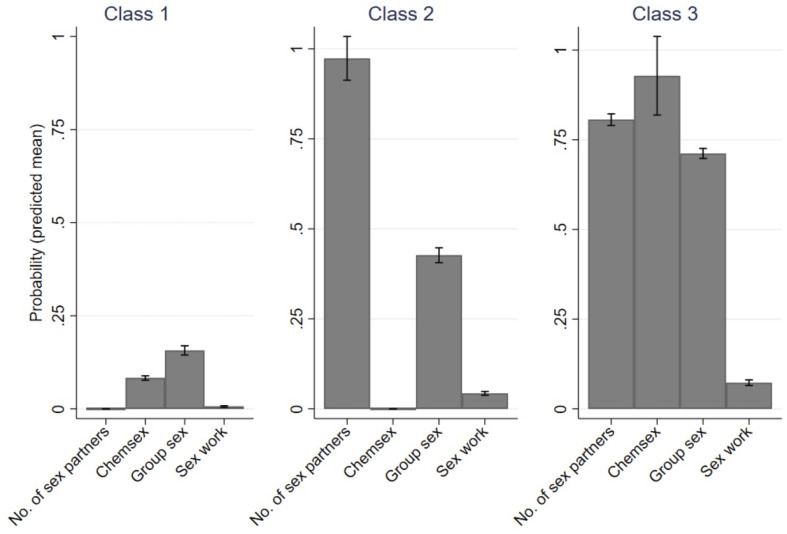
This study identified subgroups of sexual behaviors associated with increased STI/HIV risk among those eligible for but not using pre-exposure prophylaxis (PrEP) in order to improve PrEP uptake and prioritization in the context of restricted capacity. We used data from sexual health centers (SHCs) in the Netherlands, including all visits of eligible but non-PrEP using men who have sex with men (MSM), men who have sex with men and women (MSMW) and transgender persons between July 2019 (start of the Dutch national PrEP pilot (NPP)) and June 2021. Using latent class analysis (LCA), we identified classes of sexual behaviors (number of partners, chemsex, group sex and sex work) and explored whether these classes were associated with STI diagnosis and sociodemographics. Across 45,582 visits of 14,588 eligible non-PrEP using individuals, the best fitting LCA model contained three classes of sexual behaviors. Classes were distinguished by seldomly reported sexual behaviors (class 1; 53.5%, n = 24,383), the highest proportions of ≥6 partners and group sex (class 2; 29.8%, n = 13,596), and the highest proportions of chemsex and sex work (class 3; 16.7% of visits, n = 7,603). Visits in classes 2 and 3 (vs. class 1) were significantly more often with individuals who were diagnosed with an STI, older (≥36 vs. ≤35 years), MSMW (vs. MSM), and visiting an urban (vs. non-urban) SHC; while these visits were significantly less often with individuals from an STI/HIV endemic area. The percentage of visits at which an STI was diagnosed was 17.07% (n = 4,163) in class 1, 19.53% (n = 2,655) in class 2 and 25.25% (n = 1,920) in class 3. The highest risk of STI, and thereby HIV, was in those engaging in specific subgroups of sexual behavior characterized by frequently reporting multiple partners, group sex, sex work or chemsex. PrEP uptake should be encouraged and prioritized for these individuals.
本研究旨在确定与有资格但未使用暴露前预防(PrEP)的人群中增加性传播感染/艾滋病毒(STI/HIV)风险相关的性行为亚组,以便在能力有限的情况下提高 PrEP 的采用率和优先级。我们使用了荷兰性健康中心(SHC)的数据,包括 2019 年 7 月(荷兰国家 PrEP 试点项目(NPP)开始)至 2021 年 6 月期间有资格但未使用 PrEP 的男男性行为者(MSM)、男男性行为者和女性(MSMW)以及跨性别者的所有就诊情况。我们使用潜在类别分析(LCA)确定性行为类别(性伴侣数量、化学性行为、群交和性工作),并探讨这些类别是否与 STI 诊断和社会人口统计学有关。在 45582 次有资格但未使用 PrEP 的个人就诊中,最佳拟合的 LCA 模型包含三个性行为类别。这些类别通过很少报告的性行为来区分(类别 1;53.5%,n=24383)、≥6 个性伴侣和群交的比例最高(类别 2;29.8%,n=13596),以及化学性行为和性工作的比例最高(类别 3;占就诊的 16.7%,n=7603)。与类别 1 相比,类别 2 和 3 的就诊(类别 2 和 3)更常与诊断为 STI 的个体、年龄较大(≥36 岁 vs. ≤35 岁)、MSMW(vs. MSM)以及到城市(vs. 非城市)SHC 就诊有关;而这些就诊更常与来自 STI/HIV 流行地区的个体有关。在类别 1 中,诊断出 STI 的就诊比例为 17.07%(n=4163),在类别 2 中为 19.53%(n=2655),在类别 3 中为 25.25%(n=1920)。在报告有多个性伴侣、群交、性工作或化学性行为的特定性行为亚组中,性传播感染/艾滋病毒的风险最高。应鼓励这些人采用 PrEP,并优先考虑他们使用 PrEP。