Detti Beatrice, Carnevale Maria Grazia, Lucidi Sara, Burchini Luca, Caini Saverio, Orsatti Carolina, Bertini Niccolò, Roghi Manuele, di Cataldo Vanessa, Fondelli Simona, Ingrosso Gianluca, Francolini Giulio, Scartoni Daniele, Sardaro Angela, Pisani Antonio, Scoccianti Silvia, Aristei Cynthia, Livi Lorenzo
Radiation Oncology Unit, Azienda Ospedaliero-Universitaria Careggi, Florence, Italy.
Department of Experimental and Clinical Biomedical Sciences "M. Serio", University of Florence, Florence, Italy.
Front Oncol. 2023 Mar 21;13:1079808. doi: 10.3389/fonc.2023.1079808. eCollection 2023.
Biochemical recurrence (BR) occurs in up to 40% of patients with prostate cancer (PCa) treated with primary radical prostatectomy (RP). Choline PET/CT may show, in a single-step examination, the site of tumor recurrence earlier than traditional imaging methods, particularly at low prostate-specific antigen (PSA) levels, thus influencing subsequent treatment.
METHODS/PATIENTS: Patients with recurrent and non-metastatic prostate cancer (nmPCa), who were assessed with choline PET/CT, were included in the analysis. Based on imaging results, the following therapeutic strategies were chosen: radiotherapy to the prostatic bed, androgen deprivation therapy (ADT), and chemotherapy or stereotactic body radiotherapy (SBRT) to either the pelvic lymph nodes or distant metastases. We assessed the impact of age, PSA levels, Gleason score (GS), and adjuvant therapy on oncological outcomes.
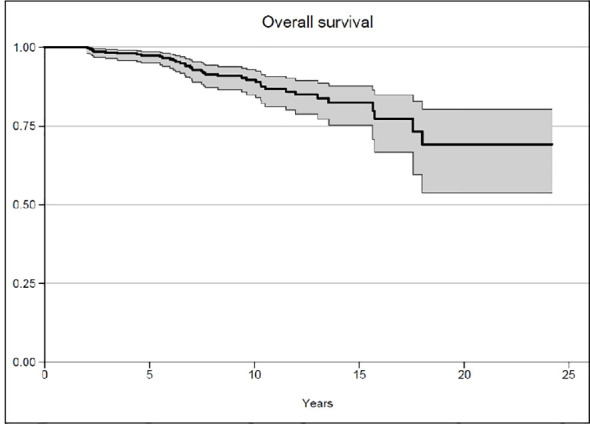
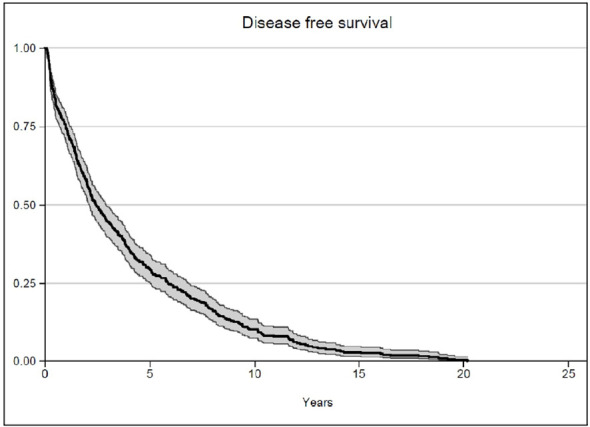
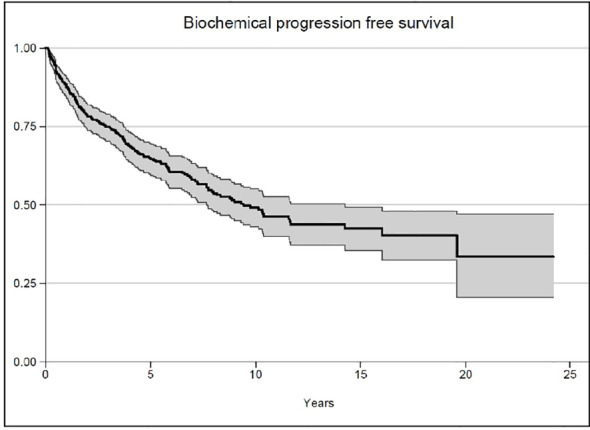
Data from 410 consecutive nmPCa patients with BR who underwent RP as primary treatment were analyzed. One hundred seventy-six (42.9%) patients had a negative choline PET/CT, and 234 (57.1%) patients resulted positive. In the multivariate analysis, only chemotherapy and PSA at recurrence were significant independent prognostic factors on overall survival (OS). In the PET-positive subgroup, the number of relapses, PSA post-prostatectomy, and chemotherapy impacted on OS. PSA (post-surgery and at recurrence) affected progression-free survival (PFS) in the univariate analysis. In the multivariate analysis, GS, the number of relapse sites, and PSA (post-surgery and at recurrence) were significant prognostic factors for disease-free survival (DFS).
Choline PET/CT provides better accuracy than conventional imaging for the assessment of nmPCa with BR after prostatectomy, thereby enabling salvage strategies and improving quality of life.
在接受根治性前列腺切除术(RP)的前列腺癌(PCa)患者中,高达40%会发生生化复发(BR)。胆碱PET/CT可能在单次检查中比传统成像方法更早显示肿瘤复发部位,尤其是在前列腺特异性抗原(PSA)水平较低时,从而影响后续治疗。
方法/患者:纳入接受胆碱PET/CT评估的复发性非转移性前列腺癌(nmPCa)患者进行分析。根据成像结果,选择以下治疗策略:对前列腺床进行放疗、雄激素剥夺治疗(ADT),以及对盆腔淋巴结或远处转移灶进行化疗或立体定向体部放疗(SBRT)。我们评估了年龄、PSA水平、 Gleason评分(GS)和辅助治疗对肿瘤学结局的影响。
分析了410例连续接受RP作为初始治疗的BR nmPCa患者的数据。176例(42.9%)患者胆碱PET/CT结果为阴性,234例(57.1%)患者结果为阳性。在多变量分析中,仅化疗和复发时的PSA是总生存期(OS)的显著独立预后因素。在PET阳性亚组中,复发次数、前列腺切除术后的PSA和化疗对OS有影响。在单变量分析中,PSA(术后和复发时)影响无进展生存期(PFS)。在多变量分析中,GS、复发部位数量和PSA(术后和复发时)是无病生存期(DFS)的显著预后因素。
胆碱PET/CT在评估前列腺切除术后BR的nmPCa方面比传统成像具有更高的准确性,从而能够实施挽救策略并改善生活质量。