Department of Musculoskeletal & Ageing Science, Faculty of Health & Life Sciences, University of Liverpool, Liverpool, UK.
School of Biomedical Sciences, Faculty of Biosciences, University of Leeds, Leeds, UK.
Exp Physiol. 2023 Jun;108(6):891-911. doi: 10.1113/EP091134. Epub 2023 Apr 7.
What is the central question of this study? Can we manipulate muscle recruitment to differentially enhance skeletal muscle fatigue resistance? What is the main finding and its importance? Through manipulation of muscle activation patterns, it is possible to promote distinct microvascular growth. Enhancement of fatigue resistance is closely associated with the distribution of the capillaries within the muscle, not necessarily with quantity. Additionally, at the acute stages of remodelling in response to indirect electrical stimulation, the improvement in fatigue resistance appears to be primarily driven by vascular remodelling, with metabolic adaptation of secondary importance.
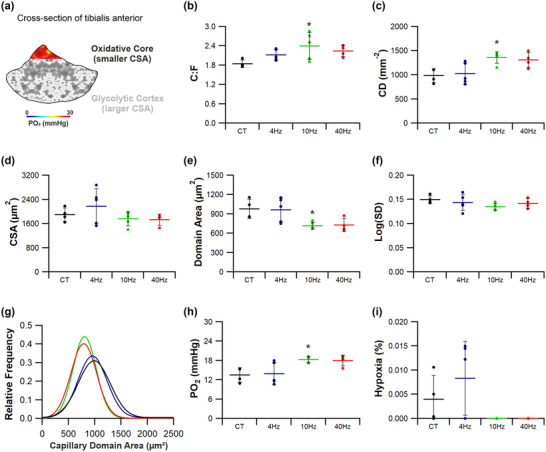
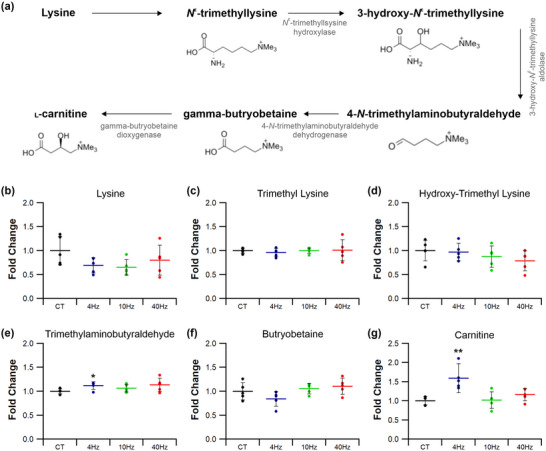
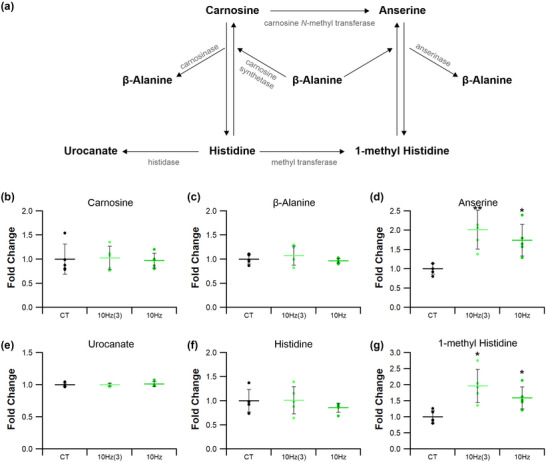
Exercise involves a complex interaction of factors influencing muscle performance, where variations in recruitment pattern (e.g., endurance vs. resistance training) may differentially modulate the local tissue environment (i.e., oxygenation, blood flow, fuel utilization). These exercise stimuli are potent drivers of vascular and metabolic change. However, their relative contribution to adaptive remodelling of skeletal muscle and subsequent performance is unclear. Using implantable devices, indirect electrical stimulation (ES) of locomotor muscles of rat at different pacing frequencies (4, 10 and 40 Hz) was used to differentially recruit hindlimb blood flow and modulate fuel utilization. After 7 days, ES promoted significant remodelling of microvascular composition, increasing capillary density in the cortex of the tibialis anterior by 73%, 110% and 55% for the 4 Hz, 10 and 40 Hz groups, respectively. Additionally, there was remodelling of the whole muscle metabolome, including significantly elevated amino acid turnover, with muscle kynurenic acid levels doubled by pacing at 10 Hz (P < 0.05). Interestingly, the fatigue index of skeletal muscle was only significantly elevated in 10 Hz (58% increase) and 40 Hz (73% increase) ES groups, apparently linked to improved capillary distribution. These data demonstrate that manipulation of muscle recruitment pattern may be used to differentially expand the capillary network prior to altering the metabolome, emphasising the importance of local capillary supply in promoting exercise tolerance.
本研究的核心问题是什么?我们能否通过控制肌肉募集来有区别地增强骨骼肌的抗疲劳能力?主要发现及其重要性是什么?通过控制肌肉激活模式,可以促进不同的微血管生长。抗疲劳能力的增强与肌肉内毛细血管的分布密切相关,而不一定与数量有关。此外,在间接电刺激引起的重塑的急性阶段,抗疲劳能力的提高似乎主要是由血管重塑驱动的,代谢适应的重要性次之。
运动涉及影响肌肉性能的多种因素的复杂相互作用,募集模式的变化(例如,耐力训练与阻力训练)可能会有区别地调节局部组织环境(即氧合、血流、燃料利用)。这些运动刺激是血管和代谢变化的有力驱动因素。然而,它们对骨骼肌适应性重塑及其后续性能的相对贡献尚不清楚。使用可植入装置,以不同的起搏频率(4、10 和 40 Hz)对大鼠运动肌肉进行间接电刺激(ES),以有区别地募集下肢血流并调节燃料利用。7 天后,ES 促进了微血管组成的显著重塑,使胫骨前肌皮质中的毛细血管密度分别增加了 73%、110%和 55%,分别对应于 4 Hz、10 Hz 和 40 Hz 组。此外,整个肌肉代谢组也发生了重塑,包括氨基酸周转率显著升高,10 Hz 起搏使肌肉犬尿氨酸水平增加一倍(P < 0.05)。有趣的是,只有在 10 Hz(增加 58%)和 40 Hz(增加 73%)ES 组中,骨骼肌的疲劳指数才显著升高,这显然与改善毛细血管分布有关。这些数据表明,控制肌肉募集模式可用于在改变代谢组之前有区别地扩展毛细血管网络,强调了局部毛细血管供应在促进运动耐量方面的重要性。