Department of Operating Room, Shengjing Hospital of China Medical University, Shenyang, Liaoning, P. R. China.
Department of Urology, Shengjing Hospital of China Medical University, Shenyang, Liaoning, P. R. China.
BMC Psychiatry. 2023 Apr 7;23(1):234. doi: 10.1186/s12888-023-04722-y.
Nurses were more likely to experience mental disorders due to long working hours and irregular schedules. However, studies addressing this issue are scarce; therefore, we aimed to investigate the association between long working hours and mental health in Chinese nurses during the coronavirus disease pandemic.
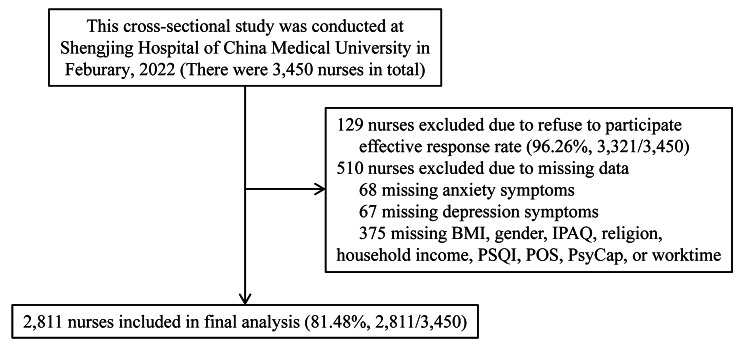
A cross-sectional study was conducted with 2,811 nurses at a tertiary hospital in China from March to April 2022. We collected data on demographic, psychological characteristics, dietary habits, life, and work-related factors using a self-reported questionnaire and measured mental health using Patient Health Questionnaire-9 and General Anxiety Disorder-7. Binary logistic regression to determine adjusted odds ratios and 95% confidence intervals.
The effective response rates were 81.48%, 7.80% (219), and 6.70% (189) of the respondents who reported depression and anxiety, respectively. We categorized the weekly working hours by quartiles. Compared with the lowest quartile, the odds ratios and 95% confidence intervals across the quartiles for depression after adjustment were 0.98 (0.69, 1.40), 10.58 (2.78, 40.32), and 1.79 (0.81, 3.97) respectively, the P for trend was 0.002. The odds ratios across the quartiles for anxiety after adjustment were 0.87 (0.59, 1.30), 8.69 (2.13, 35.46), and 2.67 (1.26, 5.62), respectively, and the P for trend was 0.008.
This study demonstrated that extended working hours increased the risk of mental disorders among nurses during the coronavirus disease pandemic, particularly in those who worked more than 60 h per week. These findings enrich the literature on mental disorders and demonstrate a critical need for additional studies investigating intervention strategies.
护士由于工作时间长和作息不规律,更容易出现精神障碍。然而,针对这一问题的研究很少;因此,我们旨在调查在冠状病毒病大流行期间,中国护士的工作时间长与心理健康之间的关系。
本研究于 2022 年 3 月至 4 月在中国一家三级医院进行了一项横断面研究,共纳入 2811 名护士。我们使用自报问卷收集人口统计学、心理特征、饮食习惯、生活和工作相关因素的数据,并使用患者健康问卷-9 和一般焦虑障碍-7 测量心理健康。采用二元逻辑回归确定调整后的优势比和 95%置信区间。
分别有 7.80%(219 人)和 6.70%(189 人)的受访者报告了抑郁和焦虑,有效应答率分别为 81.48%。我们将每周工作时间按四分位数进行分类。与最低四分位数相比,调整后抑郁的四分位数的比值比和 95%置信区间分别为 0.98(0.69,1.40)、10.58(2.78,40.32)和 1.79(0.81,3.97),趋势检验 P 值为 0.002。调整后焦虑的四分位数比值比分别为 0.87(0.59,1.30)、8.69(2.13,35.46)和 2.67(1.26,5.62),趋势检验 P 值为 0.008。
本研究表明,在冠状病毒病大流行期间,工作时间延长会增加护士出现精神障碍的风险,尤其是每周工作时间超过 60 小时的护士。这些发现丰富了关于精神障碍的文献,并表明迫切需要进一步研究干预策略。