
一种提高废水中 SARS-CoV-2 RNA 回收率和检测效率的有效方法。
An efficient method to enhance recovery and detection of SARS-CoV-2 RNA in wastewater.
机构信息
Division of Analytical and Environmental Toxicology, Department of Laboratory Medicine and Pathology, Faculty of Medicine and Dentistry, University of Alberta, Edmonton, Alberta, T6G 2G3, Canada.
Division of Diagnostic and Applied Microbiology, Department of Laboratory Medicine and Pathology, Faculty of Medicine and Dentistry, University of Alberta, Edmonton, T6G 2G3, Canada.
出版信息
J Environ Sci (China). 2023 Aug;130:139-148. doi: 10.1016/j.jes.2022.10.006. Epub 2022 Oct 12.
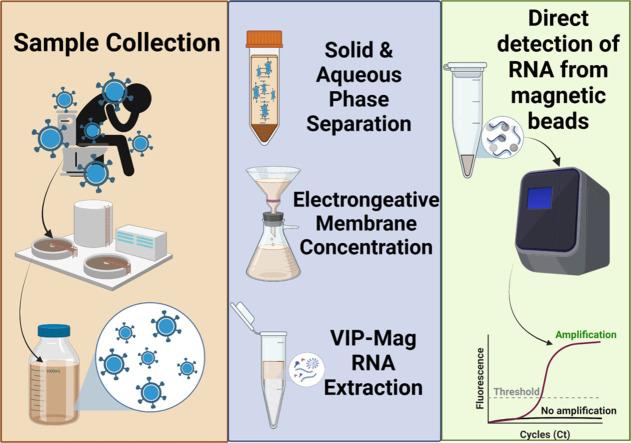
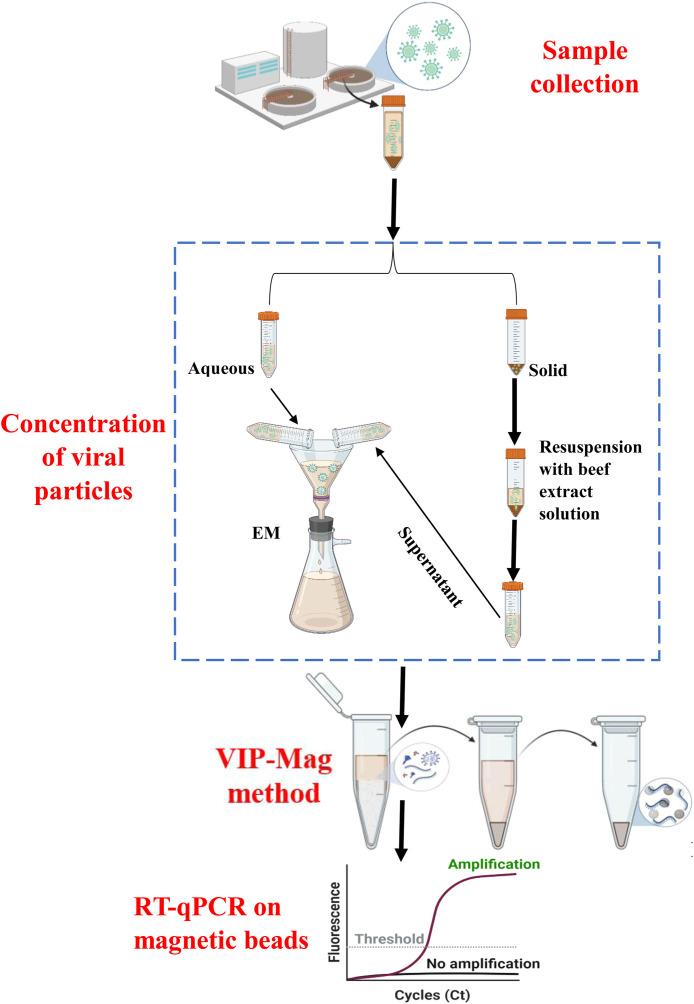
Wastewater surveillance (WS) of SARS-CoV-2 currently requires multiple steps and suffers low recoveries and poor sensitivity. Here, we report an improved analytical method with high sensitivity and recovery to quantify SARS-CoV-2 RNA in wastewater. To improve the recovery, we concentrated SARS-CoV-2 viral particles and RNA from both the solid and aqueous phases of wastewater using an electronegative membrane (EM). The captured viral particles and RNA on the EM were incubated in our newly developed viral inactivation and RNA preservation (VIP) buffer. Subsequently, the RNA was concentrated on magnetic beads and inhibitors removed by washing. Without eluting, the RNA on the magnetic beads was directly detected using reverse transcription quantitative polymerase chain reaction (RT-qPCR). Analysis of SARS-CoV-2 pseudovirus (SARS-CoV-2 RNA in a noninfectious viral coat) spiked to wastewater samples showed an improved recovery of 80%. Analysis of 120 wastewater samples collected twice weekly between May 2021 and February 2022 from two wastewater treatment plants showed 100% positive detection, which agreed with the results independently obtained by a provincial public health laboratory. The concentrations of SARS-CoV-2 RNA in these wastewater samples ranged from 2.4×10 to 2.9×10 copies per 100 mL of wastewater. Our method's capability of detecting trace and diverse concentrations of SARS-CoV-2 in complex wastewater samples is attributed to the enhanced recovery of SARS-CoV-2 RNA and efficient removal of PCR inhibitors. The improved method for the recovery and detection of viral RNA in wastewater is important for wastewater surveillance, complementing clinical diagnostic tests for public health protection.
污水监测(WS)目前需要多个步骤,且回收率低,灵敏度差。在此,我们报告了一种改进的分析方法,具有高灵敏度和高回收率,可定量污水中的 SARS-CoV-2 RNA。为了提高回收率,我们使用带负电荷的膜(EM)从污水的固相与水相集中 SARS-CoV-2 病毒颗粒和 RNA。将 EM 上捕获的病毒颗粒和 RNA 孵育在我们新开发的病毒失活和 RNA 保存(VIP)缓冲液中。随后,将 RNA 浓缩在磁性珠上,并通过洗涤去除抑制剂。无需洗脱,即可直接使用逆转录定量聚合酶链反应(RT-qPCR)检测磁性珠上的 RNA。将 SARS-CoV-2 假病毒(无传染性病毒外壳中的 SARS-CoV-2 RNA)掺入污水样品进行分析,结果显示回收率提高了 80%。对 2021 年 5 月至 2022 年 2 月期间从两个污水处理厂每周采集两次的 120 个污水样本进行分析,结果均为 100%阳性检测,与省级公共卫生实验室独立获得的结果一致。这些污水样本中 SARS-CoV-2 RNA 的浓度范围为每 100 毫升污水 2.4×10 至 2.9×10 拷贝。我们的方法能够在复杂的污水样本中检测到痕量和多样化浓度的 SARS-CoV-2,这归因于 SARS-CoV-2 RNA 的回收率提高和 PCR 抑制剂的有效去除。这种改进的污水中病毒 RNA 回收和检测方法对于污水监测很重要,可补充公共卫生保护的临床诊断测试。



 Zotero 插件