Department of Chemical Engineering, Texas Tech University, Lubbock 79409, TX, USA.
Department of Chemical Engineering, Texas Tech University, Lubbock 79409, TX, USA; Departamento de Ingenierías Química y Biomolecular, Universidad de Cantabria, Avda. Los Castros, s/n, 39005 Santander, Spain.
Sci Total Environ. 2023 Jun 20;878:162953. doi: 10.1016/j.scitotenv.2023.162953. Epub 2023 Mar 21.
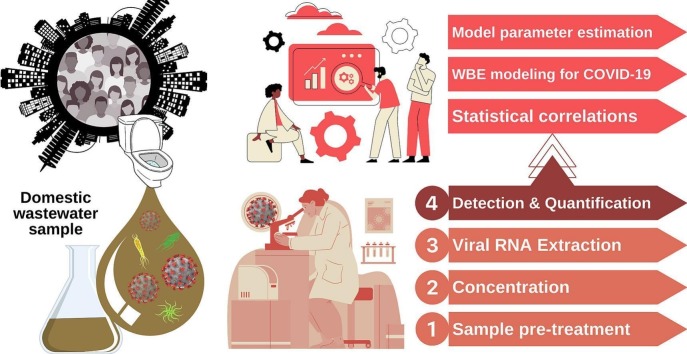
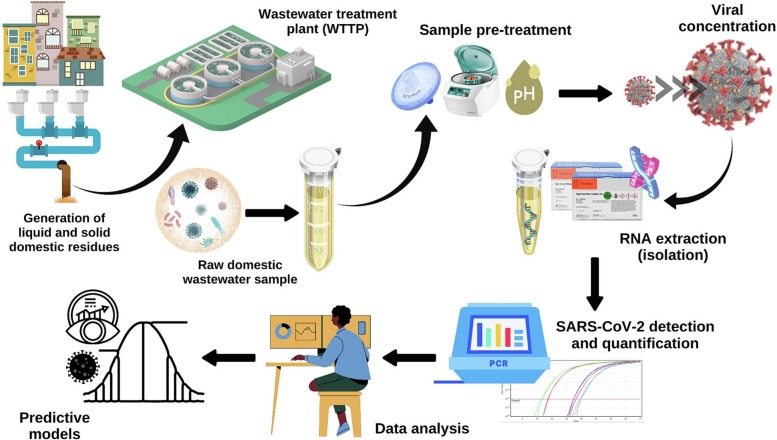
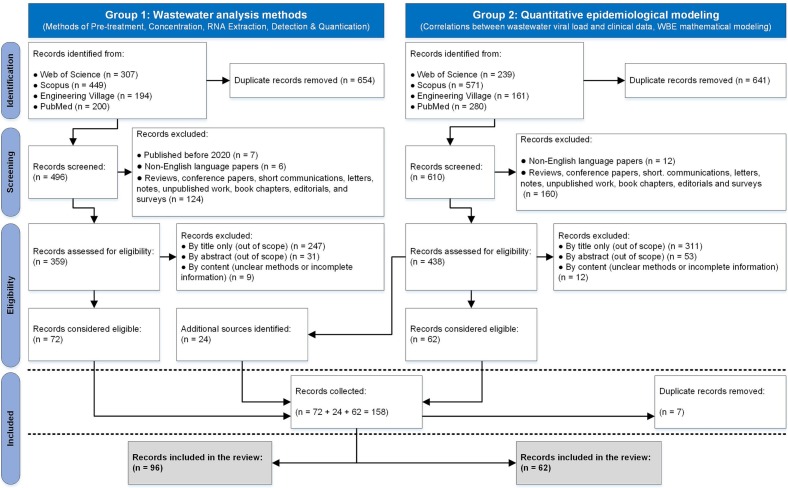
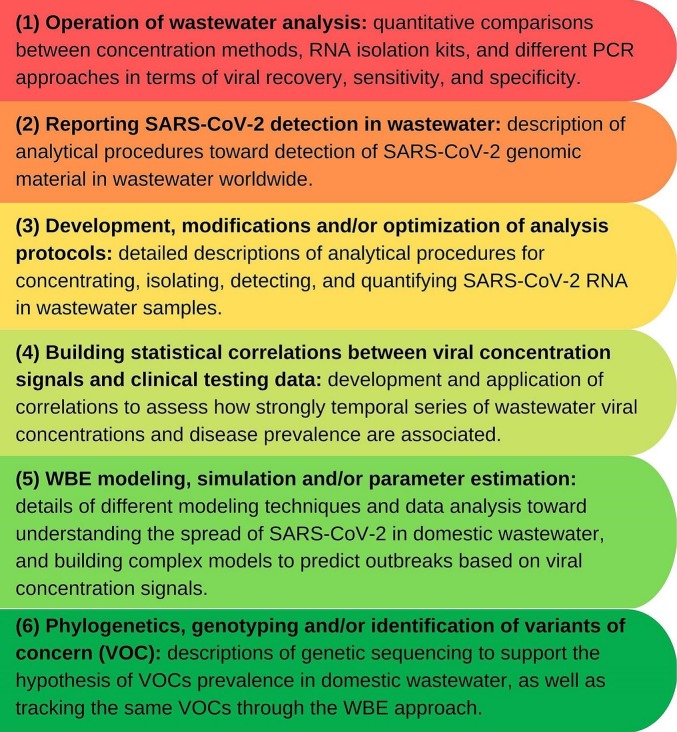
On March 11, 2020, the World Health Organization declared the coronavirus disease 2019 (COVID-19), whose causative agent is the Severe Acute Respiratory Syndrome Coronavirus 2 (SARS-CoV-2), a pandemic. This virus is predominantly transmitted via respiratory droplets and shed via sputum, saliva, urine, and stool. Wastewater-based epidemiology (WBE) has been able to monitor the circulation of viral pathogens in the population. This tool demands both in-lab and computational work to be meaningful for, among other purposes, the prediction of outbreaks. In this context, we present a systematic review that organizes and discusses laboratory procedures for SARS-CoV-2 RNA quantification from a wastewater matrix, along with modeling techniques applied to the development of WBE for COVID-19 surveillance. The goal of this review is to present the current panorama of WBE operational aspects as well as to identify current challenges related to it. Our review was conducted in a reproducible manner by following the Preferred Reporting Items for Systematic Reviews and Meta-Analyses (PRISMA) guidelines for systematic reviews. We identified a lack of standardization in wastewater analytical procedures. Regardless, the reverse transcription-quantitative polymerase chain reaction (RT-qPCR) approach was the most reported technique employed to detect and quantify viral RNA in wastewater samples. As a more convenient sample matrix, we suggest the solid portion of wastewater to be considered in future investigations due to its higher viral load compared to the liquid fraction. Regarding the epidemiological modeling, the data-driven approach was consistently used for the prediction of variables associated with outbreaks. Future efforts should also be directed toward the development of rapid, more economical, portable, and accurate detection devices.
2020 年 3 月 11 日,世界卫生组织宣布新型冠状病毒病 2019(COVID-19)大流行,其病原体是严重急性呼吸系统综合征冠状病毒 2(SARS-CoV-2)。该病毒主要通过呼吸道飞沫传播,并通过痰液、唾液、尿液和粪便排出。基于污水的流行病学(WBE)已能够监测人群中病毒病原体的循环。该工具需要实验室和计算工作才能有意义,除其他目的外,还可用于预测疫情爆发。在这种情况下,我们提出了一项系统评价,该评价从污水基质中组织和讨论了用于 SARS-CoV-2 RNA 定量的实验室程序,以及应用于 COVID-19 监测的 WBE 开发的建模技术。本综述的目的是介绍 WBE 操作方面的当前概况,并确定与之相关的当前挑战。我们的综述是按照系统评价的首选报告项目(PRISMA)指南以可重现的方式进行的。我们发现污水分析程序缺乏标准化。尽管如此,逆转录定量聚合酶链反应(RT-qPCR)方法仍然是在污水样本中检测和定量病毒 RNA 最常报道的技术。作为更方便的样本基质,我们建议在未来的研究中考虑污水的固体部分,因为其病毒载量高于液体部分。关于流行病学模型,数据驱动方法一直用于预测与疫情爆发相关的变量。未来的工作还应致力于开发快速、更经济、便携和准确的检测设备。