• 文献检索
  • 文档翻译
  • 深度研究
  • 学术资讯
  • Suppr Zotero 插件Zotero 插件
  • 邀请有礼
  • 套餐&价格
  • 历史记录
应用&插件
Suppr Zotero 插件Zotero 插件浏览器插件Mac 客户端Windows 客户端微信小程序
定价
高级版会员购买积分包购买API积分包
服务
文献检索文档翻译深度研究API 文档MCP 服务
关于我们
关于 Suppr公司介绍联系我们用户协议隐私条款
关注我们

Suppr 超能文献

核心技术专利:CN118964589B侵权必究
粤ICP备2023148730 号-1Suppr @ 2026

文献检索

告别复杂PubMed语法,用中文像聊天一样搜索,搜遍4000万医学文献。AI智能推荐,让科研检索更轻松。

立即免费搜索

文件翻译

保留排版,准确专业,支持PDF/Word/PPT等文件格式,支持 12+语言互译。

免费翻译文档

深度研究

AI帮你快速写综述,25分钟生成高质量综述,智能提取关键信息,辅助科研写作。

立即免费体验

多中心评估深度学习软件(LungQuant)在 COVID-19 肺炎肺实质特征中的应用。

A multicenter evaluation of a deep learning software (LungQuant) for lung parenchyma characterization in COVID-19 pneumonia.

机构信息

Physics Department, University of Pisa, Pisa, Italy.

Pisa Division, National Institute for Nuclear Physics, Pisa, Italy.

出版信息

Eur Radiol Exp. 2023 Apr 10;7(1):18. doi: 10.1186/s41747-023-00334-z.

DOI:
10.1186/s41747-023-00334-z
PMID:37032383
原文链接:https://pmc.ncbi.nlm.nih.gov/articles/PMC10083148/
Abstract

BACKGROUND

The role of computed tomography (CT) in the diagnosis and characterization of coronavirus disease 2019 (COVID-19) pneumonia has been widely recognized. We evaluated the performance of a software for quantitative analysis of chest CT, the LungQuant system, by comparing its results with independent visual evaluations by a group of 14 clinical experts. The aim of this work is to evaluate the ability of the automated tool to extract quantitative information from lung CT, relevant for the design of a diagnosis support model.

METHODS

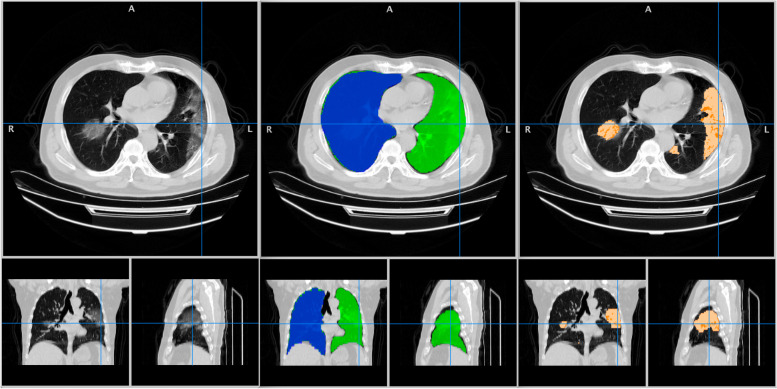
LungQuant segments both the lungs and lesions associated with COVID-19 pneumonia (ground-glass opacities and consolidations) and computes derived quantities corresponding to qualitative characteristics used to clinically assess COVID-19 lesions. The comparison was carried out on 120 publicly available CT scans of patients affected by COVID-19 pneumonia. Scans were scored for four qualitative metrics: percentage of lung involvement, type of lesion, and two disease distribution scores. We evaluated the agreement between the LungQuant output and the visual assessments through receiver operating characteristics area under the curve (AUC) analysis and by fitting a nonlinear regression model.

RESULTS

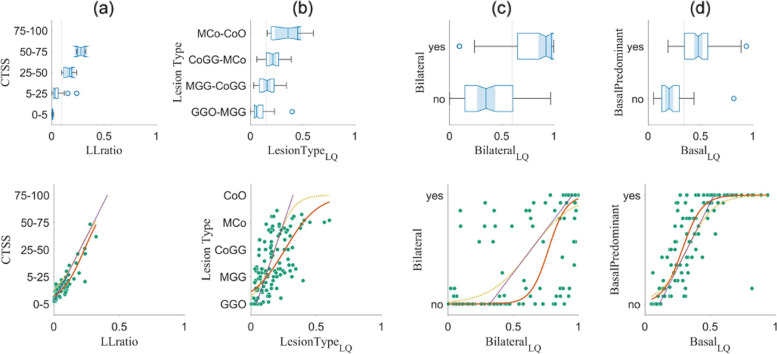
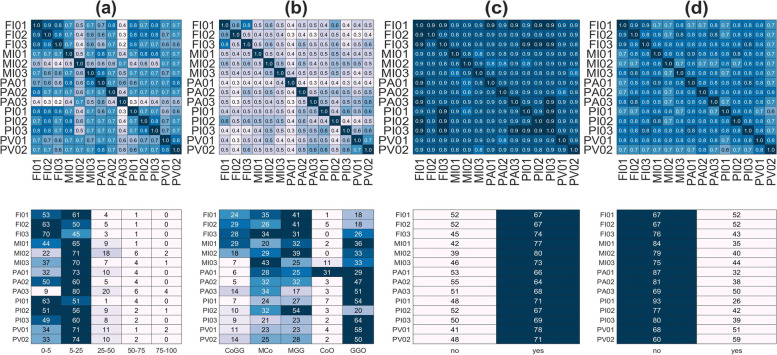
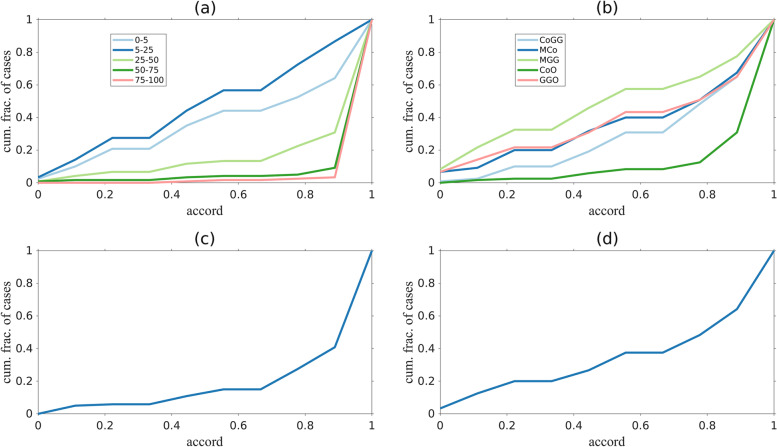
Despite the rather large heterogeneity in the qualitative labels assigned by the clinical experts for each metric, we found good agreement on the metrics compared to the LungQuant output. The AUC values obtained for the four qualitative metrics were 0.98, 0.85, 0.90, and 0.81.

CONCLUSIONS

Visual clinical evaluation could be complemented and supported by computer-aided quantification, whose values match the average evaluation of several independent clinical experts.

KEY POINTS

We conducted a multicenter evaluation of the deep learning-based LungQuant automated software. We translated qualitative assessments into quantifiable metrics to characterize coronavirus disease 2019 (COVID-19) pneumonia lesions. Comparing the software output to the clinical evaluations, results were satisfactory despite heterogeneity of the clinical evaluations. An automatic quantification tool may contribute to improve the clinical workflow of COVID-19 pneumonia.

摘要

背景

计算机断层扫描(CT)在 2019 年冠状病毒病(COVID-19)肺炎的诊断和特征中的作用已得到广泛认可。我们通过将其结果与一组 14 位临床专家的独立视觉评估进行比较,评估了一种用于定量分析胸部 CT 的软件(LungQuant 系统)的性能。这项工作的目的是评估该自动工具从肺部 CT 中提取定量信息的能力,这对于设计诊断支持模型非常重要。

方法

LungQuant 对 COVID-19 肺炎相关的肺部和病变(磨玻璃影和实变)进行分割,并计算与用于临床评估 COVID-19 病变的定性特征相对应的衍生量。比较是在 120 例公开的 COVID-19 肺炎患者 CT 扫描上进行的。对 4 种定性指标进行评分:肺受累百分比、病变类型和两种疾病分布评分。我们通过接受者操作特征曲线(AUC)分析和拟合非线性回归模型来评估 LungQuant 输出与视觉评估之间的一致性。

结果

尽管临床专家为每个指标分配的定性标签存在较大差异,但与 LungQuant 输出相比,我们发现指标之间的一致性很好。四个定性指标的 AUC 值分别为 0.98、0.85、0.90 和 0.81。

结论

视觉临床评估可以通过计算机辅助定量来补充和支持,其值与几个独立临床专家的平均评估相匹配。

重点

我们对基于深度学习的 LungQuant 自动软件进行了多中心评估。我们将定性评估转化为可量化的指标,以对 COVID-19 肺炎病变进行特征描述。将软件输出与临床评估进行比较,结果令人满意,尽管临床评估存在异质性。自动定量工具可能有助于改善 COVID-19 肺炎的临床工作流程。
https://cdn.ncbi.nlm.nih.gov/pmc/blobs/5360/10083148/bd80d4d2caf2/41747_2023_334_Fig7_HTML.jpg
https://cdn.ncbi.nlm.nih.gov/pmc/blobs/5360/10083148/d30f2186b309/41747_2023_334_Fig1_HTML.jpg
https://cdn.ncbi.nlm.nih.gov/pmc/blobs/5360/10083148/791ce27c5ec4/41747_2023_334_Fig2_HTML.jpg
https://cdn.ncbi.nlm.nih.gov/pmc/blobs/5360/10083148/d256e2f6b390/41747_2023_334_Fig3_HTML.jpg
https://cdn.ncbi.nlm.nih.gov/pmc/blobs/5360/10083148/6dcd7b0cd000/41747_2023_334_Fig4_HTML.jpg
https://cdn.ncbi.nlm.nih.gov/pmc/blobs/5360/10083148/7336731c3b85/41747_2023_334_Fig5_HTML.jpg
https://cdn.ncbi.nlm.nih.gov/pmc/blobs/5360/10083148/9044cd975830/41747_2023_334_Fig6_HTML.jpg
https://cdn.ncbi.nlm.nih.gov/pmc/blobs/5360/10083148/bd80d4d2caf2/41747_2023_334_Fig7_HTML.jpg
https://cdn.ncbi.nlm.nih.gov/pmc/blobs/5360/10083148/d30f2186b309/41747_2023_334_Fig1_HTML.jpg
https://cdn.ncbi.nlm.nih.gov/pmc/blobs/5360/10083148/791ce27c5ec4/41747_2023_334_Fig2_HTML.jpg
https://cdn.ncbi.nlm.nih.gov/pmc/blobs/5360/10083148/d256e2f6b390/41747_2023_334_Fig3_HTML.jpg
https://cdn.ncbi.nlm.nih.gov/pmc/blobs/5360/10083148/6dcd7b0cd000/41747_2023_334_Fig4_HTML.jpg
https://cdn.ncbi.nlm.nih.gov/pmc/blobs/5360/10083148/7336731c3b85/41747_2023_334_Fig5_HTML.jpg
https://cdn.ncbi.nlm.nih.gov/pmc/blobs/5360/10083148/9044cd975830/41747_2023_334_Fig6_HTML.jpg
https://cdn.ncbi.nlm.nih.gov/pmc/blobs/5360/10083148/bd80d4d2caf2/41747_2023_334_Fig7_HTML.jpg

相似文献

1
A multicenter evaluation of a deep learning software (LungQuant) for lung parenchyma characterization in COVID-19 pneumonia.多中心评估深度学习软件(LungQuant)在 COVID-19 肺炎肺实质特征中的应用。
Eur Radiol Exp. 2023 Apr 10;7(1):18. doi: 10.1186/s41747-023-00334-z.
2
Quantification of pulmonary involvement in COVID-19 pneumonia: an upgrade of the software for lung CT segmentation.新型冠状病毒肺炎肺部受累情况的量化:肺CT分割软件的升级
Eur Phys J Plus. 2023;138(4):326. doi: 10.1140/epjp/s13360-023-03896-4. Epub 2023 Apr 11.
3
Automated detection and quantification of COVID-19 pneumonia: CT imaging analysis by a deep learning-based software.基于深度学习的软件对 COVID-19 肺炎的自动检测和定量:CT 成像分析。
Eur J Nucl Med Mol Imaging. 2020 Oct;47(11):2525-2532. doi: 10.1007/s00259-020-04953-1. Epub 2020 Jul 14.
4
Quantification of pulmonary involvement in COVID-19 pneumonia by means of a cascade of two U-nets: training and assessment on multiple datasets using different annotation criteria.通过两个 U-Net 级联对 COVID-19 肺炎肺部受累进行量化:使用不同标注标准在多个数据集上进行训练和评估。
Int J Comput Assist Radiol Surg. 2022 Feb;17(2):229-237. doi: 10.1007/s11548-021-02501-2. Epub 2021 Oct 26.
5
From community-acquired pneumonia to COVID-19: a deep learning-based method for quantitative analysis of COVID-19 on thick-section CT scans.从社区获得性肺炎到 COVID-19:一种基于深度学习的 CT 厚层扫描 COVID-19 定量分析方法。
Eur Radiol. 2020 Dec;30(12):6828-6837. doi: 10.1007/s00330-020-07042-x. Epub 2020 Jul 18.
6
Analysis of clinical features and imaging signs of COVID-19 with the assistance of artificial intelligence.人工智能辅助分析 COVID-19 的临床特征和影像征象。
Eur Rev Med Pharmacol Sci. 2020 Aug;24(15):8210-8218. doi: 10.26355/eurrev_202008_22510.
7
Six artificial intelligence paradigms for tissue characterisation and classification of non-COVID-19 pneumonia against COVID-19 pneumonia in computed tomography lungs.用于在计算机断层扫描肺部中对非新冠肺炎肺炎与新冠肺炎肺炎进行组织特征描述和分类的六种人工智能范式。
Int J Comput Assist Radiol Surg. 2021 Mar;16(3):423-434. doi: 10.1007/s11548-021-02317-0. Epub 2021 Feb 3.
8
Automated quantification of COVID-19 severity and progression using chest CT images.利用胸部 CT 图像对 COVID-19 严重程度和进展进行自动量化。
Eur Radiol. 2021 Jan;31(1):436-446. doi: 10.1007/s00330-020-07156-2. Epub 2020 Aug 13.
9
Deep-Learning-Based Whole-Lung and Lung-Lesion Quantification Despite Inconsistent Ground Truth: Application to Computerized Tomography in SARS-CoV-2 Nonhuman Primate Models.基于深度学习的全肺和肺病变定量分析,即使存在不一致的真实数据:在 SARS-CoV-2 非人类灵长类动物模型的计算机断层扫描中的应用。
Acad Radiol. 2023 Sep;30(9):2037-2045. doi: 10.1016/j.acra.2023.02.027. Epub 2023 Feb 27.
10
Quantitative Chest CT analysis in discriminating COVID-19 from non-COVID-19 patients.定量胸部 CT 分析在鉴别 COVID-19 与非 COVID-19 患者中的应用。
Radiol Med. 2021 Feb;126(2):243-249. doi: 10.1007/s11547-020-01291-y. Epub 2020 Oct 12.

引用本文的文献

1
CompositIA: an open-source automated quantification tool for body composition scores from thoraco-abdominal CT scans.CompositIA:一种用于从胸腹CT扫描中获取身体成分评分的开源自动量化工具。
Eur Radiol Exp. 2025 Jan 29;9(1):12. doi: 10.1186/s41747-025-00552-7.
2
Quantitative Chest CT Analysis: Three Different Approaches to Quantify the Burden of Viral Interstitial Pneumonia Using COVID-19 as a Paradigm.胸部CT定量分析:以COVID-19为范例的三种不同方法量化病毒性间质性肺炎的负担
J Clin Med. 2024 Dec 1;13(23):7308. doi: 10.3390/jcm13237308.
3
Quantitative CT Texture Analysis of COVID-19 Hospitalized Patients during 3-24-Month Follow-Up and Correlation with Functional Parameters.

本文引用的文献

1
Assessment of COVID-19 lung involvement on computed tomography by deep-learning-, threshold-, and human reader-based approaches-an international, multi-center comparative study.基于深度学习、阈值和人工阅片方法的计算机断层扫描对新型冠状病毒肺炎肺部受累情况的评估——一项国际多中心比较研究
Quant Imaging Med Surg. 2022 Nov;12(11):5156-5170. doi: 10.21037/qims-22-175.
2
Quantification of pulmonary involvement in COVID-19 pneumonia by means of a cascade of two U-nets: training and assessment on multiple datasets using different annotation criteria.通过两个 U-Net 级联对 COVID-19 肺炎肺部受累进行量化:使用不同标注标准在多个数据集上进行训练和评估。
Int J Comput Assist Radiol Surg. 2022 Feb;17(2):229-237. doi: 10.1007/s11548-021-02501-2. Epub 2021 Oct 26.
3
COVID-19住院患者3至24个月随访期间的定量CT纹理分析及其与功能参数的相关性
Diagnostics (Basel). 2024 Mar 5;14(5):550. doi: 10.3390/diagnostics14050550.
4
Accuracy of artificial intelligence CT quantification in predicting COVID-19 subjects' prognosis.人工智能 CT 定量分析在预测 COVID-19 患者预后中的准确性。
PLoS One. 2023 Dec 8;18(12):e0294899. doi: 10.1371/journal.pone.0294899. eCollection 2023.
5
Doubts and concerns about COVID-19 uncertainties on imaging data, clinical score, and outcomes.对 COVID-19 影像学数据、临床评分和结果的不确定性的疑虑和担忧。
BMC Pulm Med. 2023 Nov 25;23(1):472. doi: 10.1186/s12890-023-02763-3.
6
Radiomics Applications in Spleen Imaging: A Systematic Review and Methodological Quality Assessment.放射组学在脾脏成像中的应用:系统评价与方法学质量评估
Diagnostics (Basel). 2023 Aug 8;13(16):2623. doi: 10.3390/diagnostics13162623.
7
Quantification of pulmonary involvement in COVID-19 pneumonia: an upgrade of the software for lung CT segmentation.新型冠状病毒肺炎肺部受累情况的量化:肺CT分割软件的升级
Eur Phys J Plus. 2023;138(4):326. doi: 10.1140/epjp/s13360-023-03896-4. Epub 2023 Apr 11.
Chest CT abnormalities in COVID-19: a systematic review.新型冠状病毒肺炎胸部CT异常表现:一项系统评价
Int J Med Sci. 2021 Aug 1;18(15):3395-3402. doi: 10.7150/ijms.50568. eCollection 2021.
4
The role of chest CT in deciphering interstitial lung involvement: systemic sclerosis versus COVID-19.胸部 CT 在解读肺间质受累中的作用:系统性硬化症与 COVID-19。
Rheumatology (Oxford). 2022 Apr 11;61(4):1600-1609. doi: 10.1093/rheumatology/keab615.
5
Screening for Lung Cancer: CHEST Guideline and Expert Panel Report.肺癌筛查:CHEST 指南和专家小组报告。
Chest. 2021 Nov;160(5):e427-e494. doi: 10.1016/j.chest.2021.06.063. Epub 2021 Jul 13.
6
Automatic lung segmentation in COVID-19 patients: Impact on quantitative computed tomography analysis.新冠病毒患者的自动肺分割:对定量计算机断层扫描分析的影响。
Phys Med. 2021 Jul;87:115-122. doi: 10.1016/j.ejmp.2021.06.001. Epub 2021 Jun 7.
7
Lung segmentation and automatic detection of COVID-19 using radiomic features from chest CT images.利用胸部CT图像的放射组学特征进行肺部分割及新冠病毒肺炎的自动检测
Pattern Recognit. 2021 Nov;119:108071. doi: 10.1016/j.patcog.2021.108071. Epub 2021 Jun 2.
8
Checklist for Artificial Intelligence in Medical Imaging (CLAIM): A Guide for Authors and Reviewers.医学影像人工智能清单(CLAIM):作者和审稿人指南
Radiol Artif Intell. 2020 Mar 25;2(2):e200029. doi: 10.1148/ryai.2020200029. eCollection 2020 Mar.
9
Correlation between lung ultrasound and chest CT patterns with estimation of pulmonary burden in COVID-19 patients.新型冠状病毒肺炎患者肺部超声与胸部 CT 模式的相关性及其对肺部受累程度的评估。
Eur J Radiol. 2021 May;138:109650. doi: 10.1016/j.ejrad.2021.109650. Epub 2021 Mar 11.
10
A patient-specific approach for quantitative and automatic analysis of computed tomography images in lung disease: Application to COVID-19 patients.一种针对肺部疾病的 CT 图像进行定量和自动分析的个体化方法:在 COVID-19 患者中的应用。
Phys Med. 2021 Feb;82:28-39. doi: 10.1016/j.ejmp.2021.01.004. Epub 2021 Jan 28.