Nguyen Tu Huu, Ta Nguyet Thi, Dang Anh Kim, Nguyen Tham Thi, Dam Vu Anh Trong, Latkin Carl A, Ho Cyrus S H, Ho Roger C M
Faculty of Nursing and Midwifery, Hanoi Medical University, Hanoi, Vietnam.
Institute for Preventive Medicine and Public Health, Hanoi Medical University, Hanoi, Vietnam.
Front Nutr. 2023 Mar 23;10:1008636. doi: 10.3389/fnut.2023.1008636. eCollection 2023.
Post-operative appetite loss is an important complication affecting surgical outcomes. It has been estimated that nearly 60% of patients having gastrointestinal or major elective surgeries suffer from malnutrition. Appetite refers to the physical desire for food appetite, and losing appetite after surgery may result in a decrease in body weight, impairment of intestinal absorption and eventually, malnutrition among postoperative patients. This study aims to assess appetite status and other relevant factors among abdominal postoperative patients in Vietnam.
A cross-sectional study was conducted on 169 abdominal postoperative patients from June 1st to August 30th, 2016 at Hanoi Medical University Hospital, Hanoi, Vietnam. Appetite score was computed by using the Council on Nutrition Appetite Questionnaire (CNAQ). This study used GEE to account for the potential correlation of outcomes of the longitudinal assessment, assuming an independent correlation structure.
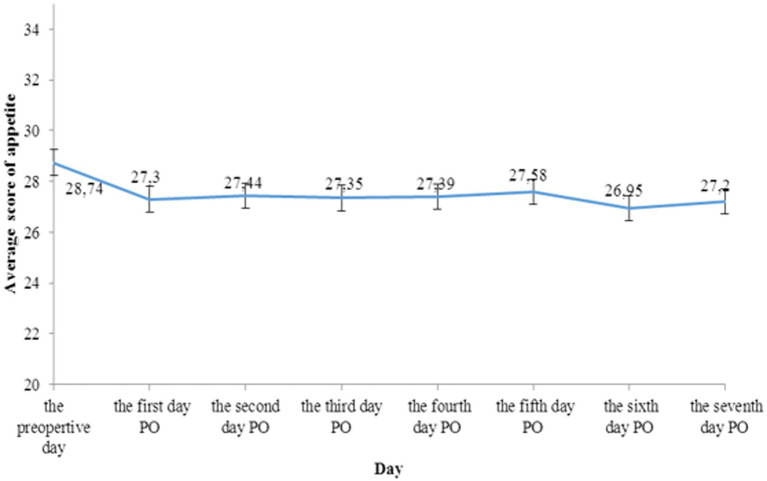
The primary and secondary outcome measures: highest average appetite score was recorded in the preoperative day and the score declined throughout seven-day duration. Patients who were female, under general anesthetics and being under open surgery tended to get lower appetite scores. The majority of patients had moderate to good appetite in both the preoperative day and seven days post-operation.
Women should receive more care and help in regaining their appetite after surgery. Treatment for appetite loss through non-pharmaceutical measures should be prioritized. Interventions that increase the appetite of patients after abdominal surgery should be targeted on patients being under general anesthetic as well as open surgery and be undertaken with caution.
术后食欲减退是影响手术效果的重要并发症。据估计,近60%接受胃肠道或大型择期手术的患者会出现营养不良。食欲是指对食物的生理欲望,术后食欲不振可能导致体重下降、肠道吸收受损,最终导致术后患者营养不良。本研究旨在评估越南腹部手术后患者的食欲状况及其他相关因素。
2016年6月1日至8月30日,在越南河内医科大学附属医院对169例腹部手术后患者进行了一项横断面研究。食欲评分采用营养食欲问卷委员会(CNAQ)计算。本研究使用广义估计方程(GEE)来考虑纵向评估结果的潜在相关性,假设为独立相关结构。
主要和次要结局指标:术前日平均食欲评分最高,且在七天内评分逐渐下降。女性、接受全身麻醉和接受开放手术的患者食欲评分往往较低。大多数患者在术前日和术后七天的食欲为中度至良好。
女性在术后恢复食欲方面应得到更多的护理和帮助。应优先采用非药物措施治疗食欲减退。增加腹部手术后患者食欲的干预措施应针对接受全身麻醉以及开放手术的患者,并谨慎进行。