Seidi Samani Hassan, Niasari-Naslaji Amir, Vojgani Mahdi, Ganjkhanlou Mahdi, Baninajjar Mohammad, Alijani Amir
Department of Theriogenology, Faculty of Veterinary Medicine, University of Tehran, Tehran, Iran.
Veterinary Research Institute, Faculty of Veterinary Medicine, University of Tehran, Tehran, Iran.
Vet Res Forum. 2023;14(3):145-151. doi: 10.30466/vrf.2022.542734.3311. Epub 2023 Mar 15.
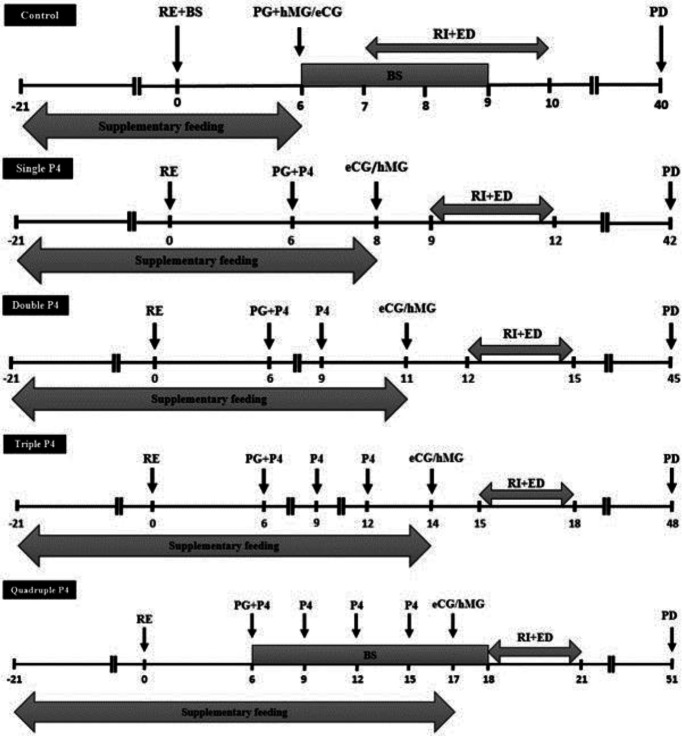
Serial progesterone injections followed by human menopausal gonadotropin (hMG), instead of equine chorionic gonadotropin (eCG), were used to synchronize estrus in ewes. Shal ewes (n = 189) were assigned into five groups and each group was divided into two sub-groups to receive gonadotropins including eCG (300 IU; intra-muscular) or hMG (one ampoule; subcutaneously, SC). All ewes received prostaglandin (PG) Fα six days after introducing ram (day 0). Ewes received 0 (control), one, two, three or four injections of progesterone (50.00 mg; SC), 72 hr apart. The first progesterone was injected at the time of PG injection. Ewes in treatment groups received gonadotropins 48 hr after the last progesterone injection. Control group ewes received gonadotropins, at the time of PG injection. Mating was recorded after introducing fertile rams. Data were analyzed using GLM and GENMOD procedures in SAS. The incidence of estrus was less in control and ewes received a single progesterone (34.20%) compared to ewes received two (64.10%), three (81.10%) and four injections (68.40%) of progesterone. Time to estrus was earlier in control (45.70 ± 4.41 hr) than progesterone-treated groups (63.60 ± 1.79 hr). Fertility (51.30%) and fecundity (78.40%) of ewes received three progesterone injections were significantly greater than other progesterone-treated groups. There was no significant difference in reproductive indices between eCG and hMG sub-groups. In conclusion, during the non-breeding season, three injections of progesterone, three days apart, starting six days after ram exposure, in association with hMG, 48 hr after the last progesterone injection, could provide a sound reproductive performance in Shal ewes.
采用连续注射孕酮后再注射人绝经期促性腺激素(hMG)而非马绒毛膜促性腺激素(eCG)的方法来使母羊发情同步。将189只沙勒母羊分为五组,每组再分为两个亚组,分别接受促性腺激素,包括eCG(300国际单位;肌肉注射)或hMG(一支安瓿;皮下注射,SC)。所有母羊在引入公羊后第6天(第0天)接受前列腺素(PG)Fα。母羊每隔72小时接受0次(对照组)、1次、2次、3次或4次孕酮(50.00毫克;皮下注射)注射。第一次孕酮在注射PG时注射。治疗组母羊在最后一次孕酮注射后48小时接受促性腺激素。对照组母羊在注射PG时接受促性腺激素。引入可育公羊后记录配种情况。使用SAS中的GLM和GENMOD程序分析数据。与接受2次(64.10%)、3次(81.10%)和4次孕酮注射(68.40%)的母羊相比,对照组和接受单次孕酮注射的母羊发情发生率较低(34.20%)。对照组母羊发情时间(45.70±4.41小时)早于接受孕酮治疗的组(63.60±1.79小时)。接受3次孕酮注射的母羊的繁殖力(51.30%)和产仔率(78.40%)显著高于其他接受孕酮治疗的组。eCG和hMG亚组之间的生殖指标没有显著差异。总之,在非繁殖季节,从公羊暴露后第6天开始,每隔3天注射3次孕酮,最后一次孕酮注射后48小时联合hMG,可使沙勒母羊获得良好的繁殖性能。