Bergström Max, Rosvold Malene, Sæther Stig Arve
Department of Sociology and Political Science, Norwegian University of Science and Technology, NTNU, Trondheim, Norway.
Front Sports Act Living. 2023 Mar 23;5:1127207. doi: 10.3389/fspor.2023.1127207. eCollection 2023.
Symptoms related to the menstrual cycle (MC) affect the performance level and health of female athletes in various ways. Previous research has reported MC symptoms such as pain, mood disturbance, reduced coordination and competition distraction as well as diminished performance levels and an increased injury risk among female elite athletes. Despite this, the coach-athlete communication related to the female hormonal cycle is limited. The aim of the present study was to explore the perceptions of MC communication in a group of junior elite football players and their male coaches in a case study of one youth football team in a specific club in Norway.
The study used a qualitative approach with semi-structured interviews. In total, 8 female junior elite players (aged 16-20) from a Norwegian football team and 2 of their male coaches participated in the study.
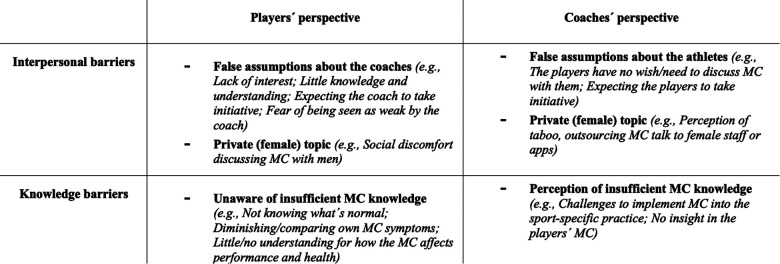
The data analysis revealed two main communication barriers: 1. interpersonal barriers (e.g., false assumptions about the coach/athletes and social discomfort) and 2. knowledge barriers (e.g., unaware/perceptions of insufficient knowledge levels).
As the players seemed to be unaware of their insufficient MC knowledge (e.g., failed to see a connection between the MC and their health and performance level), the coaches perceived their knowledge as insufficient and coped mainly by outsourcing MC communication to female staff and apps. Hence, the MC communication was hindered by both the athletes and the coaches (e.g., mutual avoidance). In line with previous research, this study supports that there is a need for developing effective strategies to overcome the interpersonal barriers and knowledge gaps.
与月经周期(MC)相关的症状会以多种方式影响女运动员的表现水平和健康状况。先前的研究报告了月经周期症状,如疼痛、情绪波动、协调性下降、比赛分心,以及精英女运动员的表现水平下降和受伤风险增加。尽管如此,与女性荷尔蒙周期相关的教练与运动员之间的沟通却很有限。本研究的目的是通过对挪威一个特定俱乐部的一支青年足球队进行案例研究,探讨一组青年精英足球运动员及其男教练对月经周期沟通的看法。
本研究采用定性方法,进行半结构化访谈。共有8名来自挪威足球队的16 - 20岁的青年精英女球员及其2名男教练参与了研究。
数据分析揭示了两个主要的沟通障碍:1. 人际障碍(例如,对教练/运动员的错误假设和社交不适)和2. 知识障碍(例如,未意识到/认为知识水平不足)。
由于球员似乎没有意识到自己的月经周期知识不足(例如,未能看出月经周期与她们的健康和表现水平之间的联系),教练们认为自己的知识也不足,主要通过将月经周期沟通外包给女员工和应用程序来应对。因此,月经周期沟通受到运动员和教练双方的阻碍(例如,相互回避)。与先前的研究一致,本研究支持有必要制定有效的策略来克服人际障碍和知识差距。