Mehta Yatin, Paul Rajib, Ansari Abdul Samad, Banerjee Tanmay, Gunaydin Serdar, Nassiri Amir Ahmad, Pappalardo Federico, Premužić Vedran, Sathe Prachee, Singh Vinod, Vela Emilio Rey
Institute of Critical Care and Anesthesiology, Medanta the Medicity, Gurugram 12201, India.
Department of Internal Medicine, Apollo Hospitals, Jubilee Hills, Hyderabad 500033, India.
World J Crit Care Med. 2023 Mar 9;12(2):71-88. doi: 10.5492/wjccm.v12.i2.71.
Despite various therapies to treat sepsis, it is one of the leading causes of mortality in the intensive care unit patients globally. Knowledge about the pathophysiology of sepsis has sparked interest in extracorporeal therapies (ECT) which are intended to balance the dysregulation of the immune system by removing excessive levels of inflammatory mediators.
To review recent data on the use of ECT in sepsis and to assess their effects on various inflammatory and clinical outcomes.
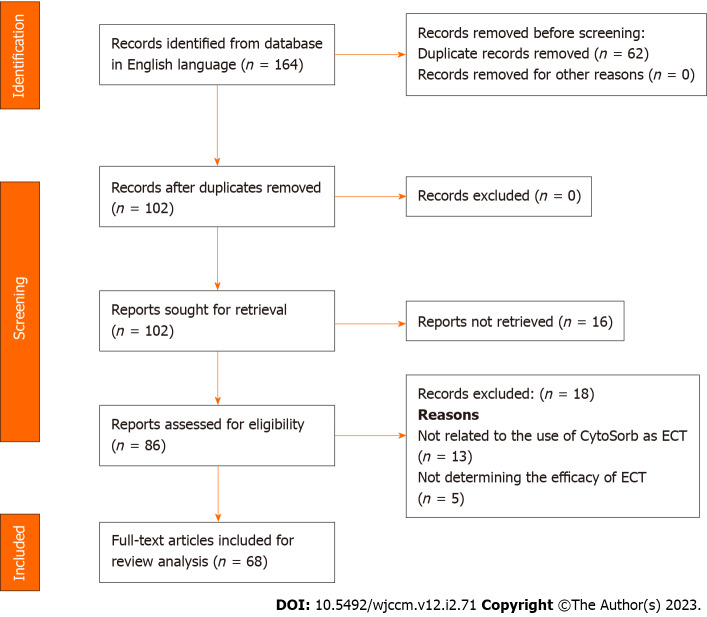
In this review, an extensive English literature search was conducted from the last two decades to identify the use of ECT in sepsis. A total of 68 articles from peer-reviewed and indexed journals were selected excluding publications with only abstracts.
Results showed that ECT techniques such as high-volume hemofiltration, coupled plasma adsorption/filtration, resin or polymer adsorbers, and CytoSorb are emerging as adjunct therapies to improve hemodynamic stability in sepsis. CytoSorb has the most published data in regard to the use in the field of septic shock with reports on improved survival rates and lowered sequential organ failure assessment scores, lactate levels, total leucocyte count, platelet count, interleukin- IL-6, IL-10, and TNF levels.
Clinical acceptance of ECT in sepsis and septic shock is currently still limited due to a lack of large random clinical trials. In addition to patient-tailored therapies, future research developments with therapies targeting the cellular level of the immune response are expected.
尽管有多种治疗脓毒症的方法,但它仍是全球重症监护病房患者死亡的主要原因之一。对脓毒症病理生理学的了解引发了人们对体外治疗(ECT)的兴趣,这种治疗旨在通过清除过量的炎症介质来平衡免疫系统的失调。
回顾近期关于ECT在脓毒症中应用的数据,并评估其对各种炎症和临床结局的影响。
在本综述中,对过去二十年的英文文献进行了广泛检索,以确定ECT在脓毒症中的应用。从同行评审和索引期刊中总共选择了68篇文章,不包括仅有摘要的出版物。
结果表明,诸如高容量血液滤过、耦合血浆吸附/滤过、树脂或聚合物吸附器以及CytoSorb等ECT技术正在成为改善脓毒症血流动力学稳定性的辅助治疗方法。CytoSorb在脓毒性休克领域的应用方面发表的数据最多,有报告称其可提高生存率,并降低序贯器官衰竭评估评分、乳酸水平、白细胞总数、血小板计数、白细胞介素 - IL - 6、IL - 10和TNF水平。
由于缺乏大型随机临床试验,目前ECT在脓毒症和脓毒性休克中的临床接受度仍然有限。除了针对患者的个性化治疗外,预计未来还会有针对免疫反应细胞水平的治疗研究进展。