Liu Guizhen, Riemer Esther, Schneider Robin, Cabuzu Daniela, Bonny Olivier, Wagner Carsten A, Qiu Danye, Saiardi Adolfo, Strauss Annett, Lahaye Thomas, Schaaf Gabriel, Knoll Thomas, Jessen Jan P, Jessen Henning J
Institute of Organic Chemistry & CIBSS-Centre for Integrative Biological Signalling Studies, University of Freiburg Germany
Institute of Crop Science and Resource Conservation, Department of Plant Nutrition, University of Bonn Germany.
RSC Chem Biol. 2023 Jan 27;4(4):300-309. doi: 10.1039/d2cb00235c. eCollection 2023 Apr 5.
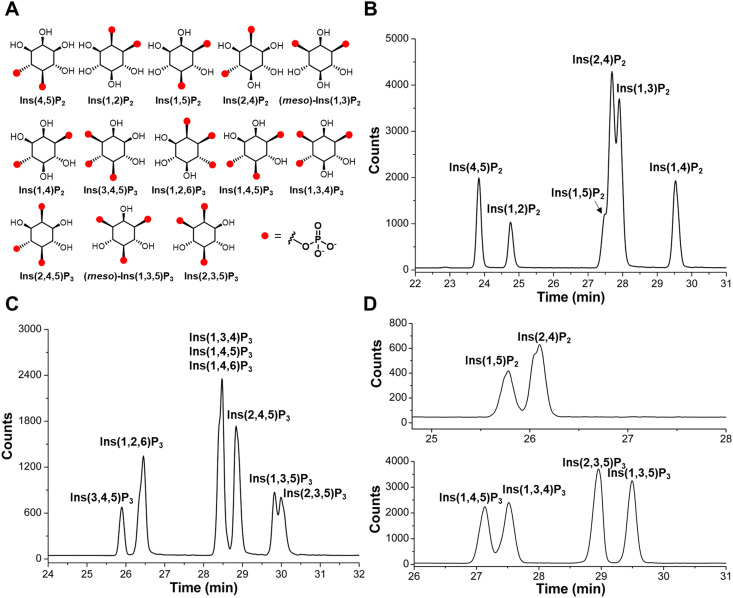
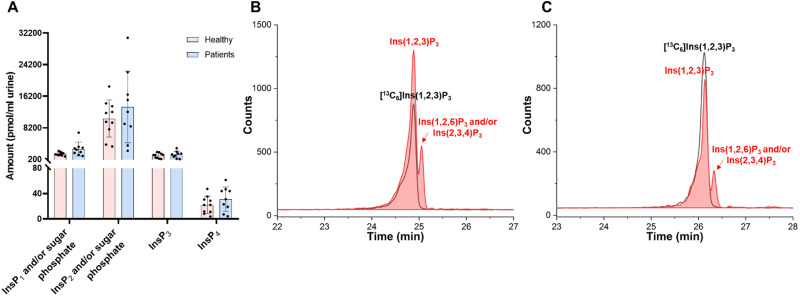
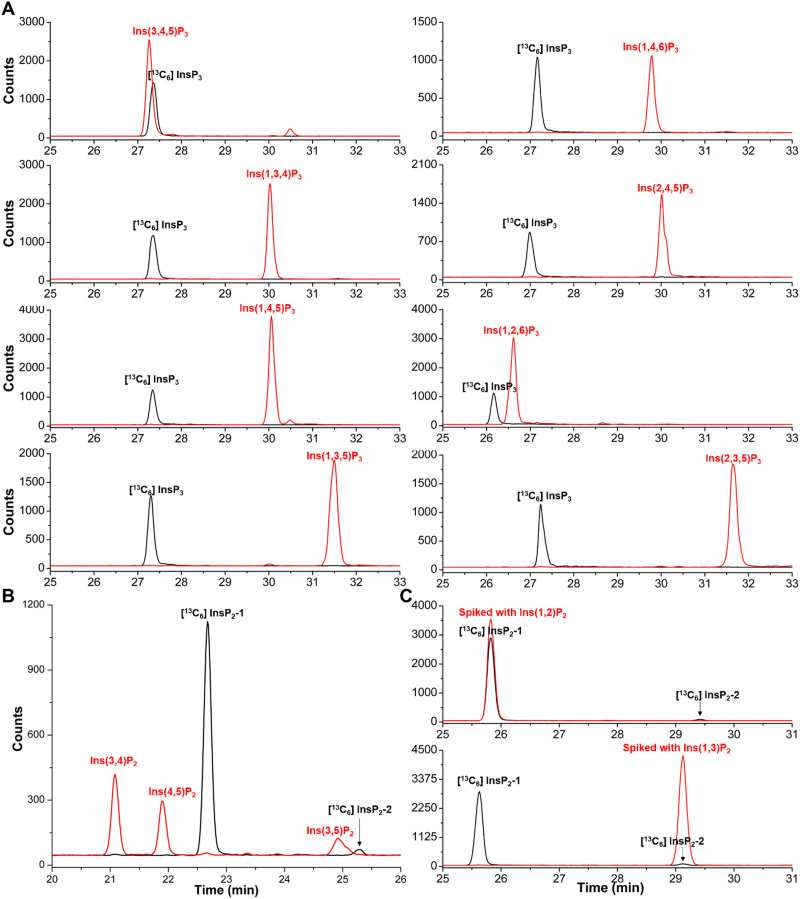
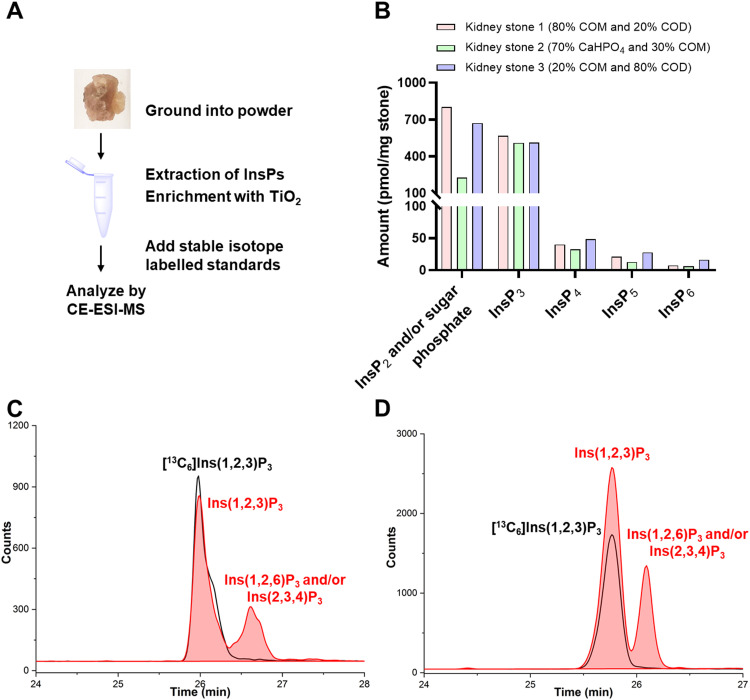
Inositol phosphates (InsPs) are ubiquitous in all eukaryotes. However, since there are 63 possible different phosphate ester isomers, the analysis of InsPs is challenging. In particular, InsP, InsP and InsP already amass 41 different isomers, of which some occur as enantiomers. Profiling of these "lower" inositol phosphates in mammalian tissues requires powerful analytical methods and reference compounds. Here, we report an analysis of InsP and InsP with capillary electrophoresis coupled to electrospray ionization mass spectrometry (CE-ESI-MS). Using this method, the bacterial effector RipBL1 was analyzed and found to degrade InsP to Ins(1,2,3)P, an understudied InsP isomer. This new reference molecule then aided us in the assignment of the isomeric identity of an InsP while profiling human samples: in urine and kidney stones, we describe for the first time the presence of defined and abundant InsP isomers, namely Ins(1,2,3)P, Ins(1,2,6)P and/or Ins(2,3,4)P.
肌醇磷酸酯(InsPs)在所有真核生物中普遍存在。然而,由于存在63种可能不同的磷酸酯异构体,对肌醇磷酸酯的分析具有挑战性。特别是,InsP、InsP和InsP已经累积了41种不同的异构体,其中一些以对映体形式出现。在哺乳动物组织中对这些“低级”肌醇磷酸酯进行分析需要强大的分析方法和参考化合物。在此,我们报告了一种采用毛细管电泳与电喷雾电离质谱联用(CE-ESI-MS)对InsP和InsP进行分析的方法。利用该方法,对细菌效应蛋白RipBL1进行了分析,发现它能将InsP降解为Ins(1,2,3)P,这是一种研究较少的肌醇磷酸酯异构体。这种新的参考分子随后帮助我们在分析人类样本时确定了一种肌醇磷酸酯异构体的身份:在尿液和肾结石中,我们首次描述了特定且丰富的肌醇磷酸酯异构体的存在,即Ins(1,2,3)P、Ins(1,2,6)P和/或Ins(2,3,4)P。