Yang Fuhan, Servadio Joseph L, Le Thanh Nguyen Thi, Lam Ha Minh, Choisy Marc, Thai Pham Quang, Nhu Thao Tran Thi, Thao Vy Nguyen Ha, Phuong Huynh Thi, Nguyen Tran Dang, Hoai Tam Dong Thi, Hanks Ephraim M, Vinh Ha, Bjornstad Ottar N, Van Vinh Chau Nguyen, Boni Maciej F
Department of Biology and Center for Infectious Disease Dynamics, Pennsylvania State University, University Park, PA, 16802, United States.
Wellcome Trust Major Overseas Programme, Oxford University Clinical Research Unit, Ho Chi Minh City, Vietnam.
medRxiv. 2023 Mar 29:2023.03.28.23287862. doi: 10.1101/2023.03.28.23287862.
It is well known that influenza and other respiratory viruses are wintertime-seasonal in temperate regions. However, respiratory disease seasonality in the tropics remains elusive. In this study, we aimed to characterize the seasonality of influenza-like illness (ILI) and influenza virus in Ho Chi Minh City (HCMC), Vietnam.
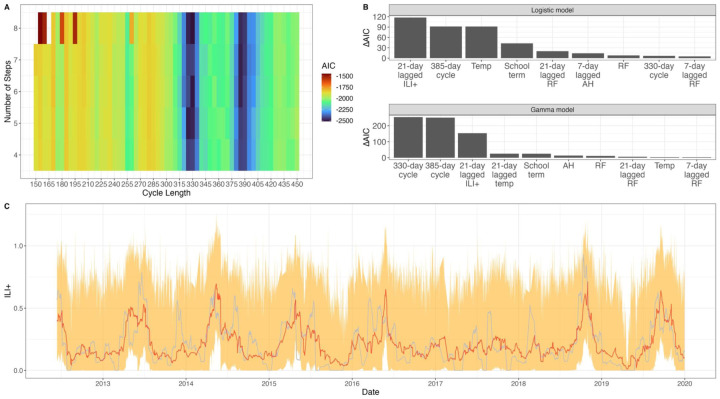
We monitored the daily number of ILI patients in 89 outpatient clinics from January 2010 to December 2019. We collected nasal swabs and tested for influenza from a subset of clinics from May 2012 to December 2019. We used spectral analysis to describe the periodicities in the system. We evaluated the contribution of these periodicities to predicting ILI and influenza patterns through lognormal and gamma hurdle models.
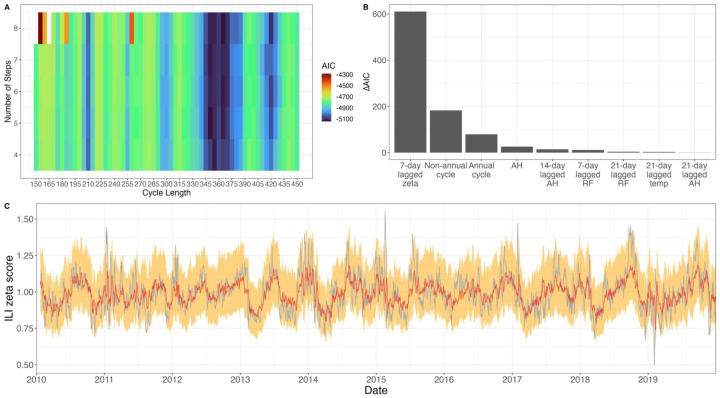
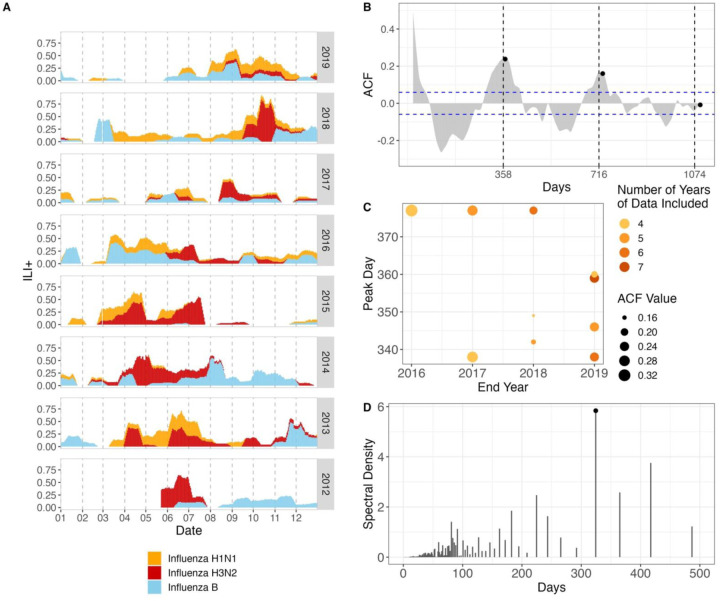
During ten years of community surveillance, 66,799 ILI reports were collected covering 2.9 million patient visits; 2604 nasal swabs were collected 559 of which were PCR-positive for influenza virus. Both annual and nonannual cycles were detected in the ILI time series, with the annual cycle showing 8.9% lower ILI activity (95% CI: 8.8%-9.0%) from February 24 to May 15. Nonannual cycles had substantial explanatory power for ILI trends (ΔAIC = 183) compared to all annual covariates (ΔAIC = 263). Near-annual signals were observed for PCR-confirmed influenza but were not consistent along in time or across influenza (sub)types.
Our study reveals a unique pattern of respiratory disease dynamics in a tropical setting influenced by both annual and nonannual drivers. Timing of vaccination campaigns and hospital capacity planning may require a complex forecasting approach.
众所周知,在温带地区,流感和其他呼吸道病毒具有冬季季节性。然而,热带地区呼吸道疾病的季节性仍不明确。在本研究中,我们旨在描述越南胡志明市流感样疾病(ILI)和流感病毒的季节性特征。
我们监测了2010年1月至2019年12月期间89家门诊诊所的ILI患者每日数量。我们从2012年5月至2019年12月的部分诊所收集了鼻拭子并进行流感检测。我们使用频谱分析来描述系统中的周期性。我们通过对数正态和伽马障碍模型评估这些周期性对预测ILI和流感模式的贡献。
在十年的社区监测中,共收集到66799份ILI报告,涵盖290万次患者就诊;收集了2604份鼻拭子,其中559份流感病毒PCR检测呈阳性。在ILI时间序列中检测到年度和非年度周期,年度周期显示从2月24日至5月15日ILI活动降低8.9%(95%CI:8.8%-9.0%)。与所有年度协变量相比,非年度周期对ILI趋势具有显著的解释力(ΔAIC = 183)(ΔAIC = 263)。PCR确诊的流感观察到接近年度的信号,但在时间上或流感(亚)型之间不一致。
我们的研究揭示了热带地区受年度和非年度驱动因素影响的呼吸道疾病动态的独特模式。疫苗接种运动的时间安排和医院容量规划可能需要复杂的预测方法。