Wellcome Trust Major Overseas Programme, Oxford University Clinical Research Unit, Ho Chi Minh City, Vietnam.
Centre for Tropical Medicine, Nuffield Department of Clinical, Medicine, University of Oxford, Oxford, United Kingdom.
Sci Rep. 2017 Jul 20;7(1):6060. doi: 10.1038/s41598-017-06177-0.
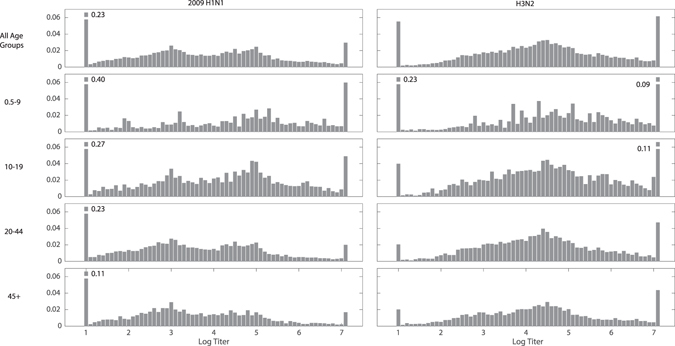
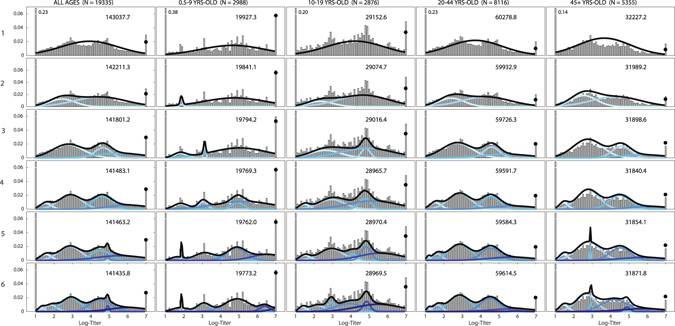
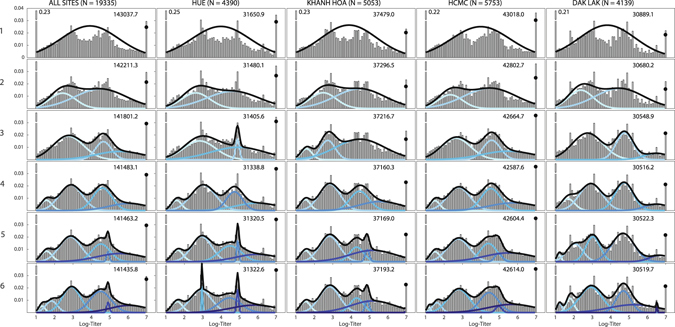
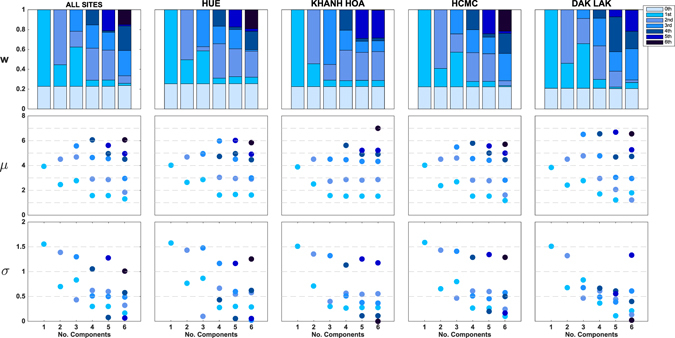
Seroepidemiological studies aim to understand population-level exposure and immunity to infectious diseases. Their results are normally presented as binary outcomes describing the presence or absence of pathogen-specific antibody, despite the fact that many assays measure continuous quantities. A population's natural distribution of antibody titers to an endemic infectious disease may include information on multiple serological states - naiveté, recent infection, non-recent infection, childhood infection - depending on the disease in question and the acquisition and waning patterns of immunity. In this study, we investigate 20,152 general-population serum samples from southern Vietnam collected between 2009 and 2013 from which we report antibody titers to the influenza virus HA1 protein using a continuous titer measurement from a protein microarray assay. We describe the distributions of antibody titers to subtypes 2009 H1N1 and H3N2. Using a model selection approach to fit mixture distributions, we show that 2009 H1N1 antibody titers fall into four titer subgroups and that H3N2 titers fall into three subgroups. For H1N1, our interpretation is that the two highest-titer subgroups correspond to recent and historical infection, which is consistent with 2009 pandemic attack rates. Similar interpretations are available for H3N2, but right-censoring of titers makes these interpretations difficult to validate.
血清流行病学研究旨在了解传染病在人群中的暴露和免疫情况。其结果通常以描述病原体特异性抗体存在或不存在的二项结果呈现,尽管许多检测方法测量的是连续数量。一个人群对地方性传染病的抗体滴度的自然分布可能包括多种血清学状态的信息——幼稚、近期感染、非近期感染、儿童感染——这取决于所研究的疾病以及免疫力的获得和衰减模式。在这项研究中,我们调查了 2013 年期间在越南南部采集的 20152 份普通人群血清样本,使用蛋白质微阵列检测方法从连续滴度测量中报告了对流感病毒 HA1 蛋白的抗体滴度。我们描述了亚型 2009 H1N1 和 H3N2 的抗体滴度分布。通过模型选择方法拟合混合分布,我们发现 2009 H1N1 抗体滴度分为四个滴度亚组,而 H3N2 滴度分为三个亚组。对于 H1N1,我们的解释是两个最高滴度亚组对应于近期和历史感染,这与 2009 年大流行的发病率一致。对于 H3N2 也可以进行类似的解释,但由于存在右删失,这些解释难以验证。