Klosowski Marika, Haines Laurel, Alfino Lauren, McMellen Alexandra, Leibowitz Michael, Regan Daniel
Flint Animal Cancer Center, College of Veterinary Medicine and Biomedical Sciences, Colorado State University, Fort Collins, CO, United States.
Department of Microbiology, Immunology, and Pathology, College of Veterinary Medicine and Biomedical Sciences, Colorado State University, Fort Collins, CO, United States.
Front Oncol. 2023 Mar 23;13:1130215. doi: 10.3389/fonc.2023.1130215. eCollection 2023.
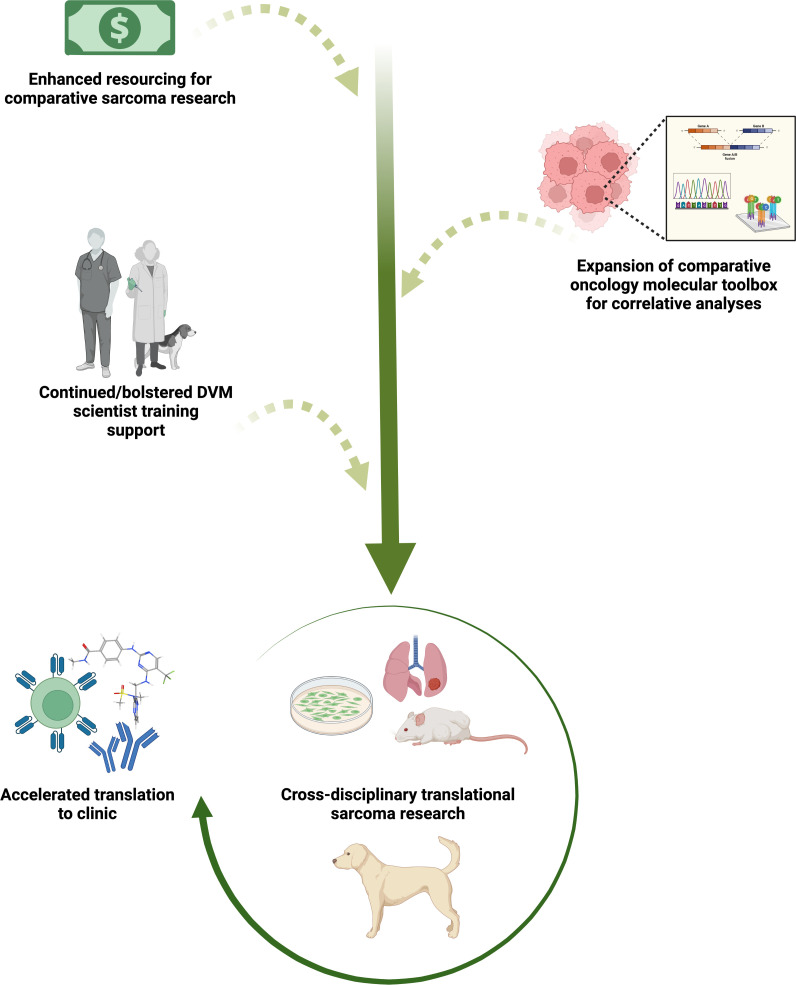
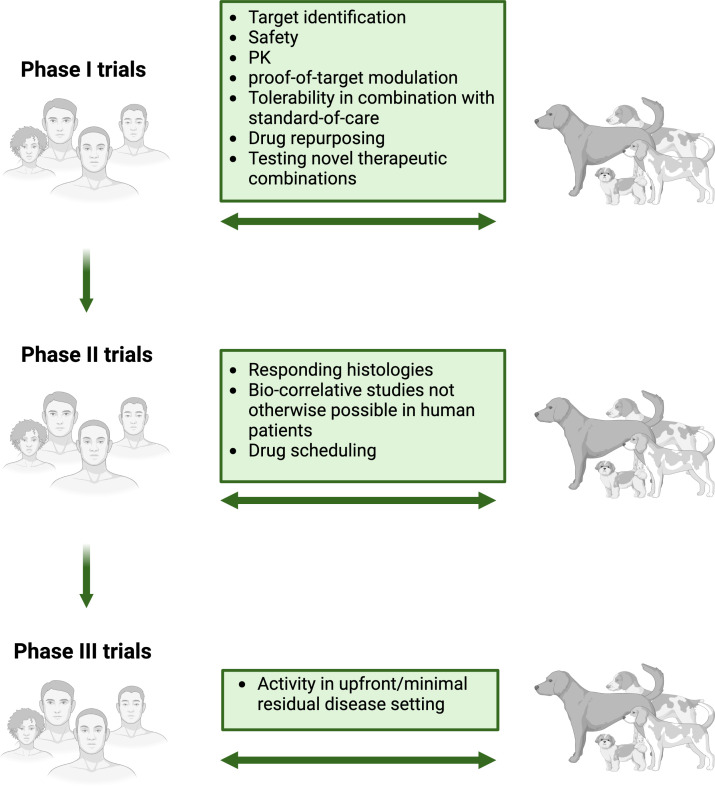
Fueled by support from the National Cancer Institute's "Cancer Moonshot" program, the past few years have witnessed a renewed interest in the canine spontaneous cancer model as an invaluable resource in translational oncology research. Increasingly, there is awareness that pet dogs with cancer provide an accessible bridge to improving the efficiency of cancer drug discovery and clinical therapeutic development. Canine tumors share many biological, genetic, and histologic features with their human tumor counterparts, and most importantly, retain the complexities of naturally occurring drug resistance, metastasis, and tumor-host immune interactions, all of which are difficult to recapitulate in induced or genetically engineered murine tumor models. The utility of canine models has been particularly apparent in sarcoma research, where the increased incidence of sarcomas in dogs as compared to people has facilitated comparative research resulting in treatment advances benefitting both species. Although there is an increasing awareness of the advantages in using spontaneous canine sarcoma models for research, these models remain underutilized, in part due to a lack of more permanent institutional and cross-institutional infrastructure to support partnerships between veterinary and human clinician-scientists. In this review, we provide an updated overview of historical and current applications of spontaneously occurring canine tumor models in sarcoma research, with particular attention to knowledge gaps, limitations, and growth opportunities within these applications. Furthermore, we propose considerations for working within existing veterinary translational and comparative oncology research infrastructures to maximize the benefit of partnerships between veterinary and human biomedical researchers within and across institutions to improve the utility and application of spontaneous canine sarcomas in translational oncology research.
在美国国立癌症研究所“癌症登月计划”的支持下,过去几年见证了人们对犬自发性癌症模型重新产生兴趣,它是转化肿瘤学研究中一种宝贵的资源。人们越来越意识到,患癌宠物狗为提高癌症药物研发和临床治疗开发的效率提供了一座可及的桥梁。犬类肿瘤与其人类肿瘤对应物具有许多生物学、遗传学和组织学特征,最重要的是,保留了天然产生的耐药性、转移以及肿瘤与宿主免疫相互作用的复杂性,而所有这些在诱导或基因工程小鼠肿瘤模型中都难以重现。犬模型的实用性在肉瘤研究中尤为明显,与人类相比,犬类肉瘤发病率的增加促进了比较研究,从而带来了使两个物种都受益的治疗进展。尽管越来越多的人意识到使用自发性犬肉瘤模型进行研究的优势,但这些模型仍未得到充分利用,部分原因是缺乏更永久性的机构和跨机构基础设施来支持兽医和人类临床科学家之间的合作。在这篇综述中,我们提供了自发性犬肿瘤模型在肉瘤研究中的历史和当前应用的最新概述,特别关注这些应用中的知识空白、局限性和发展机会。此外,我们提出了在现有兽医转化和比较肿瘤学研究基础设施内开展工作的考虑因素,以最大限度地发挥兽医和人类生物医学研究人员在机构内部和跨机构之间合作的益处,从而提高自发性犬肉瘤在转化肿瘤学研究中的实用性和应用价值。