Jia Lingmei, Chen Yali, Liu Chang, Luan Yinyin, Jia Min
Cardiovascular Medicine Department, The Second Hospital of Hebei Medical University, Shijiazhuang, China.
Front Med (Lausanne). 2023 Mar 22;10:1156254. doi: 10.3389/fmed.2023.1156254. eCollection 2023.
In previous observational studies, green tea intake has been demonstrated to protect against arterial embolism and thrombosis. However, whether there is a causative connection between green tea intake and arterial embolism and thrombosis is currently unclear.
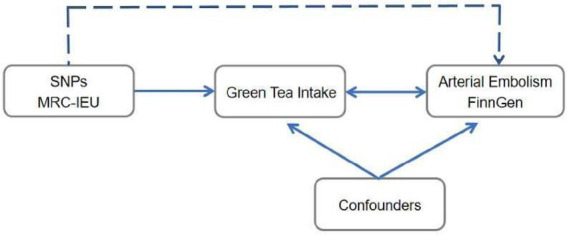
A two-sample Mendelian randomization (MR) study has been designed to explore whether there is a causal association between green tea intake and arterial embolism and thrombosis by acquiring exposure and outcome data from previously published research. Data from the MRC-IEU (data on green tea intake, 64,949 participants) consortium and the FinnGen project (data on arterial embolism and thrombosis, 278 cases of arterial thrombosis and 92,349 control participants) has been utilized to determine the causal impact of green tea intake on arterial embolism and thrombosis.
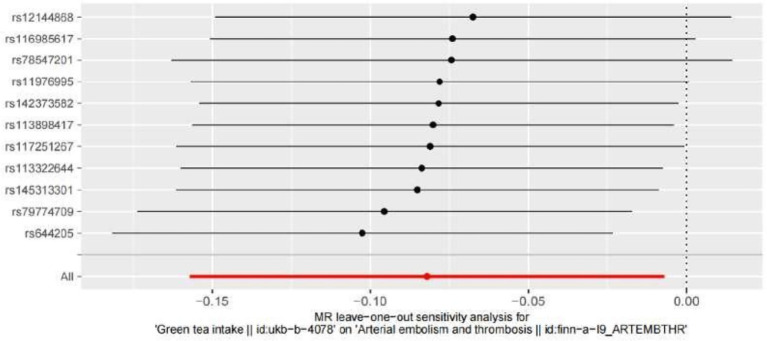
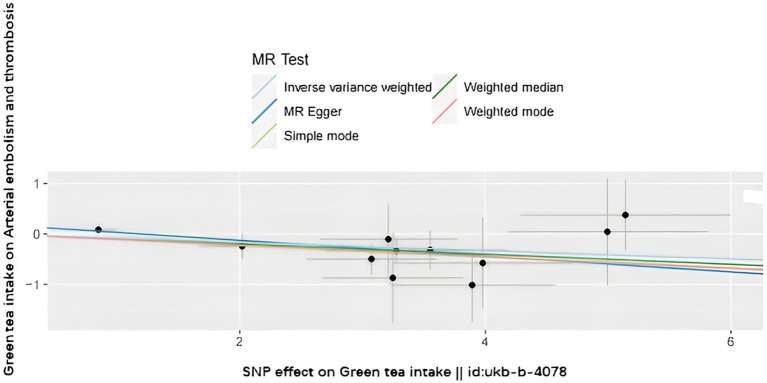
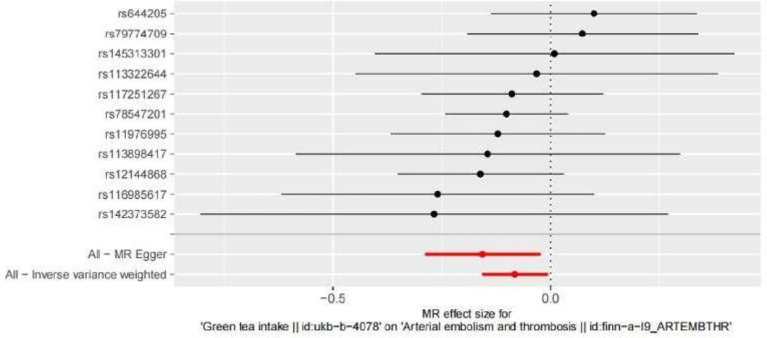
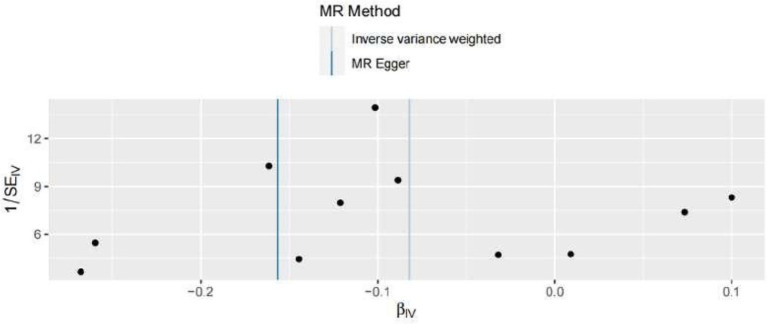
We found that genetically predicted green tea intake was causally associated with a lower risk of arterial embolism and thrombosis (IVW odds ratio [OR] per SD decrease in green tea intake = 0.92 [95% confidence interval, 0.85-0.99]; = 0.032). Moreover, the sensitivity analysis (both MR Egger regression and weighted median) yielded comparable estimates but with low precision. No directional pleiotropic effect between green tea intake and arterial embolism and thrombosis was observed in both funnel plots and MR-Egger intercepts.
Our study provided causal evidence that genetically predicted green tea intake may be a protective factor against arterial embolism and thrombosis.
在先前的观察性研究中,已证明摄入绿茶可预防动脉栓塞和血栓形成。然而,目前尚不清楚绿茶摄入与动脉栓塞和血栓形成之间是否存在因果关系。
设计了一项两样本孟德尔随机化(MR)研究,通过从先前发表的研究中获取暴露和结局数据,探讨绿茶摄入与动脉栓塞和血栓形成之间是否存在因果关联。利用医学研究委员会-国际流行病学联合会(MRC-IEU,关于绿茶摄入的数据,64949名参与者)联盟和芬兰基因组计划(FinnGen project,关于动脉栓塞和血栓形成的数据,278例动脉血栓形成患者和92349名对照参与者)的数据,来确定绿茶摄入对动脉栓塞和血栓形成的因果影响。
我们发现,基因预测的绿茶摄入量与较低的动脉栓塞和血栓形成风险存在因果关联(每标准差绿茶摄入量降低的逆方差加权比值比[OR]=0.92[95%置信区间,0.85-0.99]; =0.032)。此外,敏感性分析(MR-Egger回归和加权中位数)得出了可比的估计值,但精度较低。在漏斗图和MR-Egger截距中均未观察到绿茶摄入与动脉栓塞和血栓形成之间的定向多效性效应。
我们的研究提供了因果证据,表明基因预测的绿茶摄入量可能是预防动脉栓塞和血栓形成的保护因素。