Department of Economics, Princeton University, Princeton, NJ 08544.
Network Systems Science and Advanced Computing Division, Biocomplexity Institute, University of Virginia, Charlottesville, VA 22904.
Proc Natl Acad Sci U S A. 2023 Apr 18;120(16):e2216948120. doi: 10.1073/pnas.2216948120. Epub 2023 Apr 10.
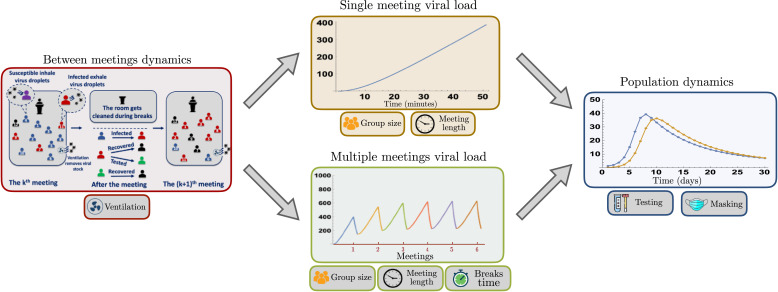
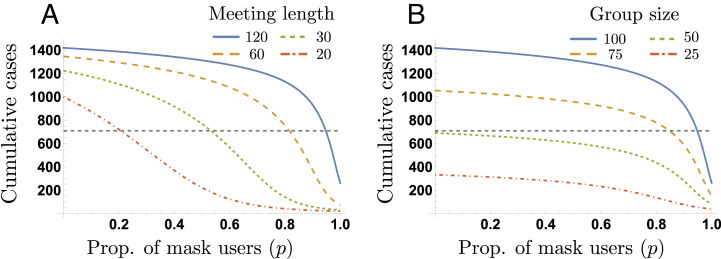
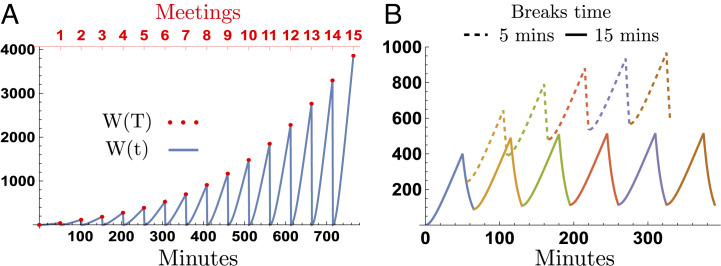
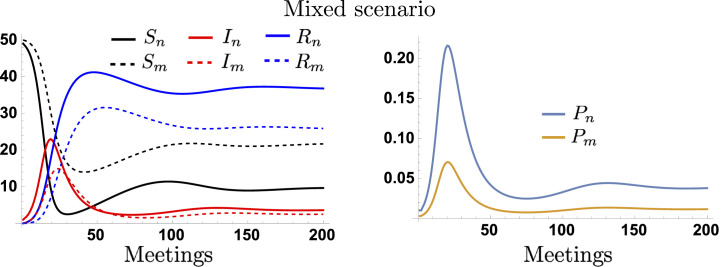
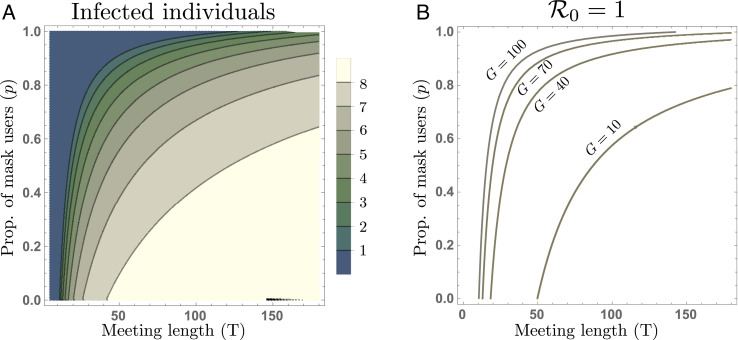
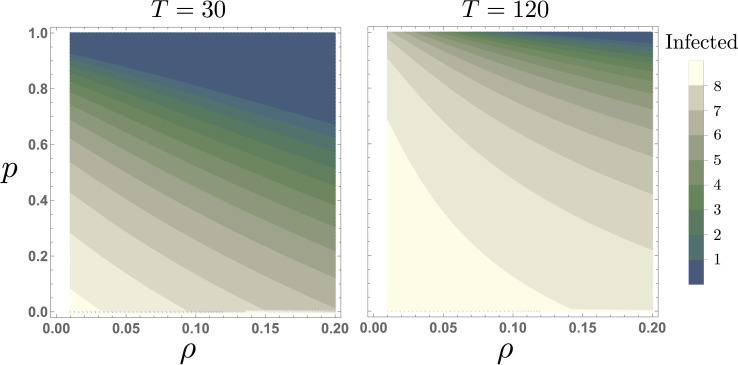
Indoor superspreading events are significant drivers of transmission of respiratory diseases. In this work, we study the dynamics of airborne transmission in consecutive meetings of individuals in enclosed spaces. In contrast to the usual pairwise-interaction models of infection where effective contacts transmit the disease, we focus on group interactions where individuals with distinct health states meet simultaneously. Specifically, the disease is transmitted by infected individuals exhaling droplets (contributing to the viral load in the closed space) and susceptible ones inhaling the contaminated air. We propose a modeling framework that couples the fast dynamics of the viral load attained over meetings in enclosed spaces and the slow dynamics of disease progression at the population level. Our modeling framework incorporates the multiple time scales involved in different setups in which indoor events may happen, from single-time events to events hosting multiple meetings per day, over many days. We present theoretical and numerical results of trade-offs between the room characteristics (ventilation system efficiency and air mass) and the group's behavioral and composition characteristics (group size, mask compliance, testing, meeting time, and break times), that inform indoor policies to achieve disease control in closed environments through different pathways. Our results emphasize the impact of break times, mask-wearing, and testing on facilitating the conditions to achieve disease control. We study scenarios of different break times, mask compliance, and testing. We also derive policy guidelines to contain the infection rate under a certain threshold.
室内超级传播事件是呼吸道疾病传播的重要驱动因素。在这项工作中,我们研究了在封闭空间中连续进行的个人会议中空气传播的动力学。与通常的感染的成对相互作用模型不同,在该模型中,有效接触者传播疾病,我们关注的是同时具有不同健康状态的个体进行群体相互作用的情况。具体来说,疾病通过感染个体呼出飞沫(导致封闭空间中的病毒载量增加)和易感个体吸入受污染的空气传播。我们提出了一个建模框架,该框架将封闭空间中会议期间获得的病毒载量的快速动力学与群体水平上疾病进展的缓慢动力学耦合在一起。我们的建模框架包含了不同设置中涉及的多个时间尺度,这些设置包括从单次事件到每天举办多次会议的事件,以及持续多天的事件。我们提出了理论和数值结果,展示了房间特征(通风系统效率和空气质量)和群体的行为和组成特征(群体规模、口罩佩戴率、检测、会议时间和休息时间)之间的权衡,这些结果为通过不同途径在封闭环境中实现疾病控制的室内政策提供了信息。我们的结果强调了休息时间、戴口罩和检测对促进实现疾病控制条件的影响。我们研究了不同休息时间、口罩佩戴率和检测的情况。我们还推导出了在一定阈值下控制感染率的政策指导方针。