School of Health Sciences, Faculty of Medicine and Health, The University of Sydney, Camperdown, New South Wales, Australia.
John Walsh Centre for Rehabilitation Research, New South Wales, Australia, Kolling Institute, Northern Sydney Local Health District and Faculty of Medicine and Health, The University of Sydney, St Leonards, New South Wales, Australia.
BMJ Open. 2021 Dec 30;11(12):e057705. doi: 10.1136/bmjopen-2021-057705.
Musculoskeletal (MSK) conditions constitute the highest burden of disease globally, with healthcare services often utilised inappropriately and overburdened. The aim of this trial is to evaluate the effectiveness of a novel clinical PAthway of CarE programme (PACE programme), where care is provided based on people's risk of poor outcome.
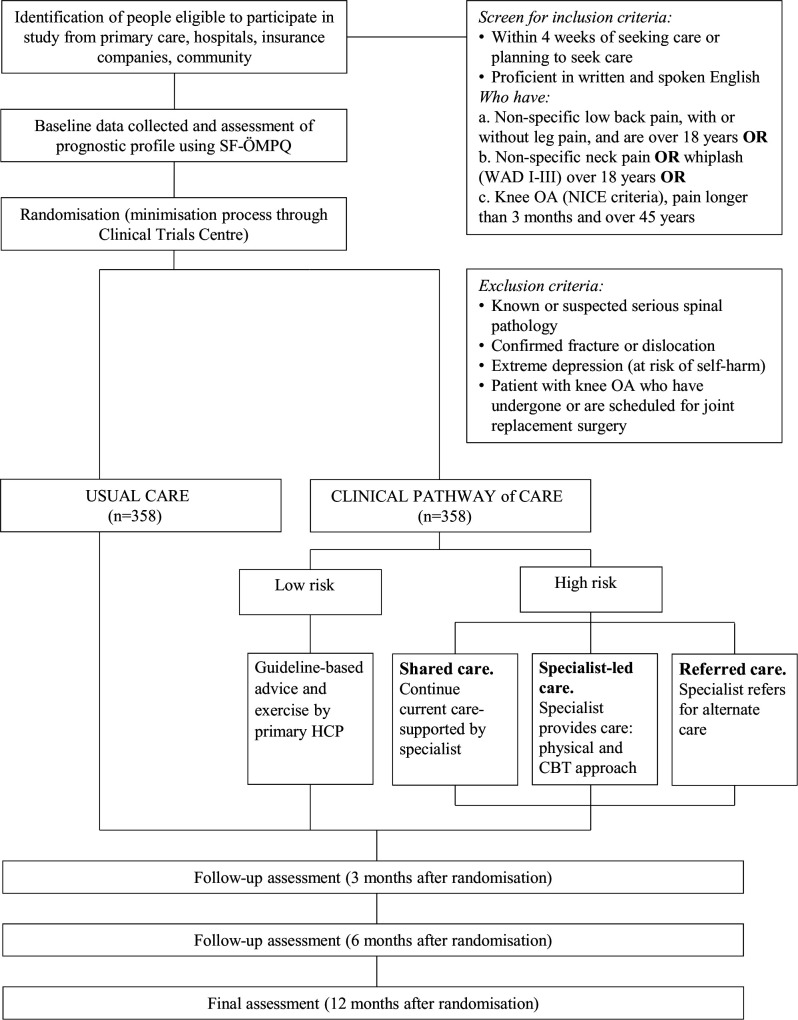
Multicentre randomised controlled trial. 716 people with MSK conditions (low back pain, neck pain or knee osteoarthritis) will be recruited in primary care. They will be stratified for risk of a poor outcome (low risk/high risk) using the Short Form Örebro Musculoskeletal Pain Screening Questionnaire (SF-ÖMSPQ) then randomised to usual care (n=358) or the PACE programme (n=358). Participants at low risk in the PACE programme will receive up to 3 sessions of guideline based care from their primary healthcare professional (HCP) supported by a custom designed website (mypainhub.com). Those at high risk will be referred to an allied health MSK specialist who will conduct a comprehensive patient-centred assessment then liaise with the primary HCP to determine further care. Primary outcome (SF 12-item PCS) and secondary outcomes (eg, pain self-efficacy, psychological health) will be collected at baseline, 3, 6 and 12 months. Cost-effectiveness will be measured as cost per quality-adjusted life-year gained. Health economic analysis will include direct and indirect costs. Analyses will be conducted on an intention-to-treat basis. Primary and secondary outcomes will be analysed independently, using generalised linear models. Qualitative and mixed-methods studies embedded within the trial will evaluate patient experience, health professional practice and interprofessional collaboration.
Ethics approval has been received from the following Human Research Ethics Committees: The University of Sydney (2018/926), The University of Queensland (2019000700/2018/926), University of Melbourne (1954239), Curtin University (HRE2019-0263) and Northern Sydney Local Health District (2019/ETH03632). Dissemination of findings will occur via peer-reviewed publications, conference presentations and social media.
ACTRN12619000871145.
肌肉骨骼(MSK)疾病是全球疾病负担最高的疾病,医疗服务往往使用不当且负担过重。本试验的目的是评估一种新的临床 PAthway of CarE 方案(PACE 方案)的有效性,该方案根据人们不良预后的风险提供护理。
多中心随机对照试验。将在初级保健中招募 716 名 MSK 疾病(下腰痛、颈痛或膝骨关节炎)患者。他们将使用 Short Form Örebro Musculoskeletal Pain Screening Questionnaire(SF-ÖMSPQ)进行不良预后风险分层(低风险/高风险),然后随机分为常规护理组(n=358)或 PACE 方案组(n=358)。在 PACE 方案中处于低风险的参与者将接受最多 3 次基于指南的护理,由他们的初级保健医生(HCP)提供支持,并通过定制设计的网站(mypainhub.com)提供支持。高风险的参与者将被转介给一名联合健康 MSK 专家,该专家将进行全面的以患者为中心的评估,然后与初级 HCP 联系,以确定进一步的护理。主要结局(SF 12 项 PCS)和次要结局(例如,疼痛自我效能,心理健康)将在基线、3、6 和 12 个月时收集。成本效益将作为每获得一个质量调整生命年的成本来衡量。健康经济学分析将包括直接和间接成本。分析将基于意向治疗进行。主要和次要结局将独立分析,使用广义线性模型。嵌入试验中的定性和混合方法研究将评估患者体验、卫生专业人员实践和跨专业合作。
以下人类研究伦理委员会已批准伦理:悉尼大学(2018/926)、昆士兰大学(2019000700/2018/926)、墨尔本大学(1954239)、科廷大学(HRE2019-0263)和北悉尼地方卫生区(2019/ETH03632)。研究结果将通过同行评议的出版物、会议演讲和社交媒体进行传播。
ACTRN12619000871145。