Universidade Federal da Fronteira Sul, Chapecó, SC, Brazil.
Universidade Estadual do Centro-Oeste, Guarapuava, PR, Brazil.
Rev Paul Pediatr. 2023 Apr 7;41:e2021342. doi: 10.1590/1984-0462/2023/41/2021342. eCollection 2023.
To identify and summarize the possible associations between screen time and low back pain in children and adolescents.
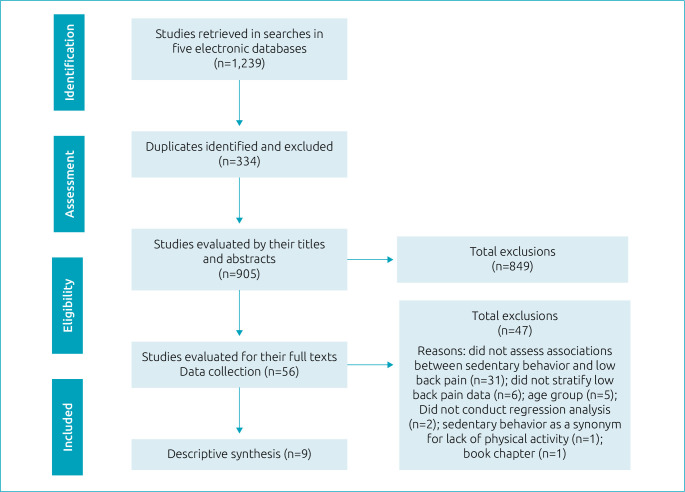
Systematic searches were performed in five electronic databases (Lilacs, Scielo, Scopus, PubMed and Web of Science) on 01/25/2021, complemented by manual searches in reference lists and on Google Scholar, looking for original scientific articles that included Brazilian observational studies; whose samples had children and/or adolescents aged between 6 and 19 years, without specific clinical conditions, and that presented analyses of associations between indicators of screen time and nonspecific low back pain, based on regression models.
Nine cross-sectional studies whose samples had adolescents were included. Of the 18 analyses identified, nine reported risk relationships between the variables of interest. More specifically, risk associations were found in two studies that evaluated adolescents exposed to at least three hours using cell phone or tablet, and watching television per day. Also, instruments, cut-off points adopted, and screen equipment evaluated were diverse.
Even though most of the risk associations were borderline from the statistical point of view, we found a higher frequency of risk associations between screen time and non-specific low back pain in adolescents exposed to screen time for at least three hours a day. In addition, further longitudinal studies with samples composed of children should be conducted across the country.
确定并总结儿童和青少年屏幕时间与下背痛之间可能存在的关联。
2021 年 1 月 25 日,在五个电子数据库(Lilacs、Scielo、Scopus、PubMed 和 Web of Science)中进行了系统检索,同时在参考文献列表和 Google Scholar 上进行了手动检索,以寻找包含巴西观察性研究的原始科学文章;其样本包括年龄在 6 至 19 岁之间、无特定临床条件的儿童和/或青少年,并根据回归模型分析了屏幕时间指标与非特异性下背痛之间的关联。
纳入了九项横断面研究,其样本均为青少年。在确定的 18 项分析中,有 9 项报告了这些变量之间的风险关系。更具体地说,在两项评估每天至少使用手机或平板电脑 3 小时以及每天看电视的青少年的研究中发现了风险关联。此外,所使用的仪器、采用的截止点和评估的屏幕设备也各不相同。
尽管从统计学角度来看,大多数风险关联都处于边缘状态,但我们发现每天至少暴露于 3 小时屏幕时间的青少年与非特异性下背痛之间的风险关联频率更高。此外,还应在全国范围内对由儿童组成的样本进行进一步的纵向研究。