From the University of Texas Medical Branch, Galveston (L.D.P., G.R.S., A.S.), the University of Texas Health Science Center at Houston, Children's Memorial Hermann Hospital, Houston (S.P.C.), and the University of Texas at Austin, Austin (G.A.M.) - all in Texas; the George Washington University Biostatistics Center, Washington, DC (R.G.C., S.J.W.); the University of Pennsylvania, Philadelphia (S.P.); the University of North Carolina at Chapel Hill, Chapel Hill (J.M.T.); the Eunice Kennedy Shriver National Institute of Child Health and Human Development, Bethesda, MD (M.L.); MetroHealth Medical Center, Case Western Reserve University, Cleveland (W.D., J.L.B.), and the Ohio State University, Columbus (K.R.) - both in Ohio; the University of Alabama at Birmingham, Birmingham (A.T.N.T.); Columbia University, New York (C.G.-B.); the University of Utah Health Sciences Center, Salt Lake City (T.D.M.); Brown University, Providence, RI (D.J.R.); Northwestern University, Chicago (W.A.G.); and the University of Pittsburgh, Pittsburgh (H.N.S.).
N Engl J Med. 2023 Apr 13;388(15):1365-1375. doi: 10.1056/NEJMoa2207419.
Prophylactic use of tranexamic acid at the time of cesarean delivery has been shown to decrease the calculated blood loss, but the effect on the need for blood transfusions is unclear.
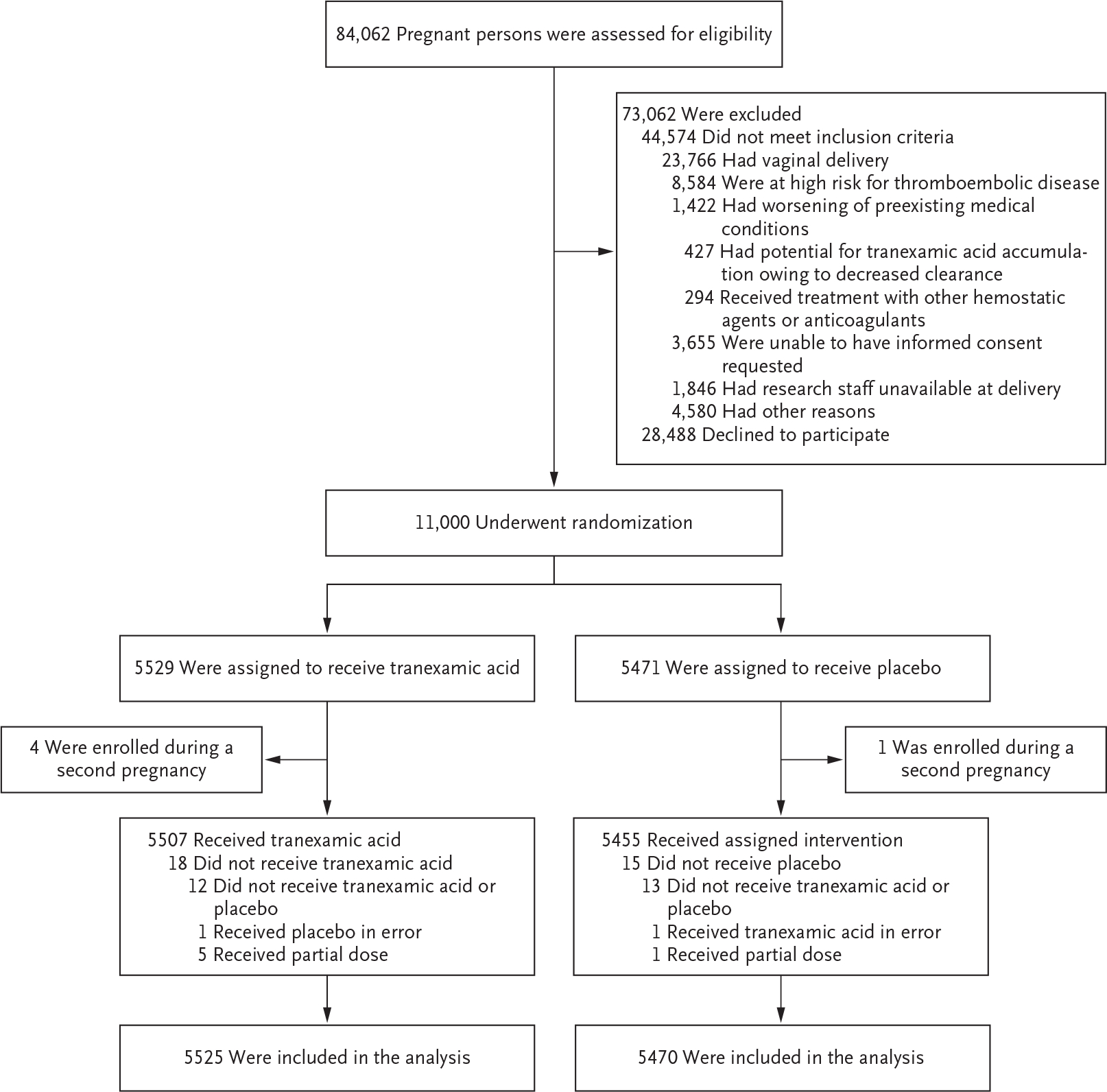
We randomly assigned patients undergoing cesarean delivery at 31 U.S. hospitals to receive either tranexamic acid or placebo after umbilical-cord clamping. The primary outcome was a composite of maternal death or blood transfusion by hospital discharge or 7 days post partum, whichever came first. Key secondary outcomes were estimated intraoperative blood loss of more than 1 liter (prespecified as a major secondary outcome), interventions for bleeding and related complications, the preoperative-to-postoperative change in the hemoglobin level, and postpartum infectious complications. Adverse events were assessed.
A total of 11,000 participants underwent randomization (5529 to the tranexamic acid group and 5471 to the placebo group); scheduled cesarean delivery accounted for 50.1% and 49.2% of the deliveries in the respective groups. A primary-outcome event occurred in 201 of 5525 participants (3.6%) in the tranexamic acid group and in 233 of 5470 (4.3%) in the placebo group (adjusted relative risk, 0.89; 95.26% confidence interval [CI], 0.74 to 1.07; P = 0.19). Estimated intraoperative blood loss of more than 1 liter occurred in 7.3% of the participants in the tranexamic acid group and in 8.0% of those in the placebo group (relative risk, 0.91; 95% CI, 0.79 to 1.05). Interventions for bleeding complications occurred in 16.1% of the participants in the tranexamic acid group and in 18.0% of those in the placebo group (relative risk, 0.90; 95% CI, 0.82 to 0.97); the change in the hemoglobin level was -1.8 g per deciliter and -1.9 g per deciliter, respectively (mean difference, -0.1 g per deciliter; 95% CI, -0.2 to -0.1); and postpartum infectious complications occurred in 3.2% and 2.5% of the participants, respectively (relative risk, 1.28; 95% CI, 1.02 to 1.61). The frequencies of thromboembolic events and other adverse events were similar in the two groups.
Prophylactic use of tranexamic acid during cesarean delivery did not lead to a significantly lower risk of a composite outcome of maternal death or blood transfusion than placebo. (Funded by the Eunice Kennedy Shriver National Institute of Child Health and Human Development; ClinicalTrials.gov number, NCT03364491.).
剖宫产术中预防性使用氨甲环酸已被证明可减少计算出的失血量,但对输血需求的影响尚不清楚。
我们在 31 家美国医院随机分配接受剖宫产的患者,在脐带夹闭后接受氨甲环酸或安慰剂。主要结局是产妇死亡或出院或产后 7 天内输血的复合结局。主要次要结局是术中失血量超过 1 升(预先指定为主要次要结局)、出血和相关并发症的干预措施、血红蛋白水平术前到术后的变化以及产后感染性并发症。评估不良事件。
共有 11000 名参与者被随机分组(氨甲环酸组 5529 名,安慰剂组 5471 名);计划剖宫产分别占各自组别的 50.1%和 49.2%。在氨甲环酸组中,5525 名参与者中有 201 名(3.6%)发生主要结局事件,安慰剂组中 5470 名参与者中有 233 名(4.3%)(调整后的相对风险,0.89;95%置信区间[CI],0.74 至 1.07;P=0.19)。氨甲环酸组中有 7.3%的参与者术中失血量超过 1 升,安慰剂组中有 8.0%(相对风险,0.91;95%CI,0.79 至 1.05)。氨甲环酸组中有 16.1%的参与者发生出血并发症干预措施,安慰剂组中有 18.0%(相对风险,0.90;95%CI,0.82 至 0.97);血红蛋白水平分别下降 1.8 克/分升和 1.9 克/分升(平均差值,-0.1 克/分升;95%CI,-0.2 至-0.1);产后感染性并发症分别发生在 3.2%和 2.5%的参与者中(相对风险,1.28;95%CI,1.02 至 1.61)。两组血栓栓塞事件和其他不良事件的发生率相似。
剖宫产术中预防性使用氨甲环酸与安慰剂相比,并未显著降低产妇死亡或输血的复合结局风险。(由 Eunice Kennedy Shriver 国家儿童健康与人类发展研究所资助;临床试验.gov 编号,NCT03364491。)