Yoon Uzung, Beausang David, Elia Elia, Torjman Marc, Mojica Jeffrey, Purtill James, Nazarian David, Courtney P Maxwell, Kang Yoogoo
Department of Anesthesiology, Sidney Kimmel Medical College, Thomas Jefferson University Hospital, Philadelphia, PA, USA.
Department of Anesthesiology, Tampa General Hospital, Tampa, FL, USA.
EClinicalMedicine. 2025 Jul 21;86:103374. doi: 10.1016/j.eclinm.2025.103374. eCollection 2025 Aug.
Tranexamic acid (TXA), is commonly administered prophylactically to reduce blood loss in patients undergoing total hip arthroplasty (THA). However, its effect has never been studied. We hypothesized that no difference exists in the degree of fibrinolysis and blood loss between patients receiving prophylactic TXA and placebo.
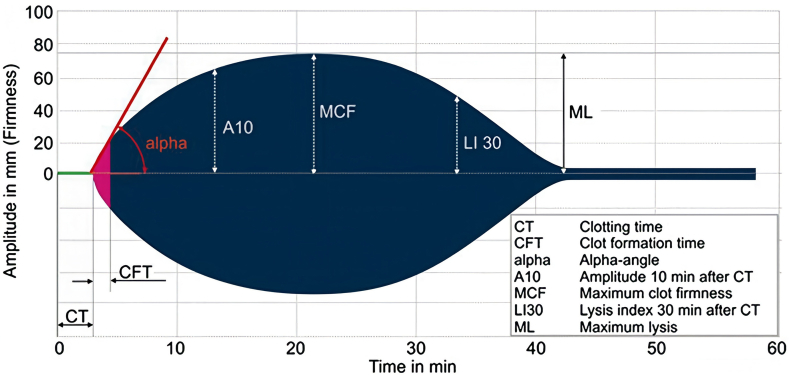
This double-blinded randomized-controlled trial included 50 patients undergoing primary THA in 2021-2023. Clinicaltrials.gov (NCT03897621). Rotational-thromboelastometry (ROTEM) were performed to test blood coagulability using non citrated whole blood (NATEM) and blood treated with TXA (T-APTEM). The intervention group received TXA intravenously. The placebo group received 0.9% sodium chloride solution. The primary outcome measure was to quantitate the degree of fibrinolysis measured by maximum lysis (ML) demonstrated by ROTEM variables. Fibrinolysis was defined as ML (maximum lysis) > 15% within 1 h of testing.
Blood coagulability tested by ROTEM was within the normal range in all patients, and no difference was found between the TXA group and placebo group.NATEM and T-APTEM variables were similar in both groups and no patient developed fibrinolysis during the entire perioperative phases. At baseline, T-APTEM, compared with NATEM, showed shorter CT (746 ± 265 vs. 991 ± 237 p < 0.05) and greater ML (1.9 ± 2.2 vs. 0.8 ± 1, p < 0.05), suggesting some degree of acceleration of coagulation. Postoperatively, blood coagulability showed a tendency of acceleration with shorter CT (689 ± 188 vs. 828 ± 163, p < 0.05) and CFT (258 ± 101 vs. 293 ± 87 p < 0.05) and increased A10 (41 ± 9 vs. 38 ± 8, p < 0.05). Clinical outcomes, including blood loss, hematologic variables, and coagulation profile were similar between the two groups.
Normal range of blood coagulability in all patients, no significant differences between NATEM and T-APTEM variables, and similar clinical outcome between the two groups suggest that there is no definitive medical indication for TXA administration in patients undergoing THA without a preexisting fibrinolytic condition. Monitoring blood coagulability using ROTEM may be useful in guiding selective administration of TXA in high-risk patients.
Department of Anesthesiology funding, Thomas Jefferson University Hospital. Support was provided solely from institutional and/or departmental sources.
氨甲环酸(TXA)通常用于全髋关节置换术(THA)患者的预防性给药,以减少失血。然而,其效果从未被研究过。我们假设接受预防性TXA和安慰剂的患者在纤维蛋白溶解程度和失血量方面没有差异。
这项双盲随机对照试验纳入了2021年至2023年期间接受初次THA的50例患者。Clinicaltrials.gov(NCT03897621)。使用非枸橼酸化全血(NATEM)和用TXA处理的血液(T-APTEM)进行旋转血栓弹力图(ROTEM)检测血液凝固性。干预组静脉注射TXA。安慰剂组接受0.9%氯化钠溶液。主要结局指标是通过ROTEM变量显示的最大溶解(ML)来定量纤维蛋白溶解程度。纤维蛋白溶解定义为检测后1小时内ML(最大溶解)>15%。
所有患者通过ROTEM检测的血液凝固性均在正常范围内,TXA组和安慰剂组之间未发现差异。两组的NATEM和T-APTEM变量相似,在整个围手术期没有患者发生纤维蛋白溶解。在基线时,与NATEM相比,T-APTEM显示CT更短(746±265对991±237,p<0.05)和ML更大(1.9±2.2对0.8±1,p<0.05),表明有一定程度的凝血加速。术后,血液凝固性呈加速趋势,CT更短(689±188对828±163,p<0.05)和CFT更短(258±101对293±87,p<0.05),A10增加(41±9对38±8,p<0.05)。两组的临床结局,包括失血量、血液学变量和凝血指标相似。
所有患者的血液凝固性在正常范围内,NATEM和T-APTEM变量之间无显著差异,两组的临床结局相似,这表明对于没有预先存在纤维蛋白溶解情况的THA患者,没有明确的医学指征使用TXA。使用ROTEM监测血液凝固性可能有助于指导高危患者选择性使用TXA。
托马斯·杰斐逊大学医院麻醉科资助。支持仅来自机构和/或部门来源。