Infectious Diseases Department, Université Côte d'Azur, CHU Nice, Nice, France.
Université Côte d'Azur, Inserm, U1065, C3M, Nice, France; Department of Bacteriology, Université Côte d'Azur, CHU Nice, 06202 Nice, France.
Infect Dis Now. 2023 Aug;53(5):104709. doi: 10.1016/j.idnow.2023.104709. Epub 2023 Apr 11.
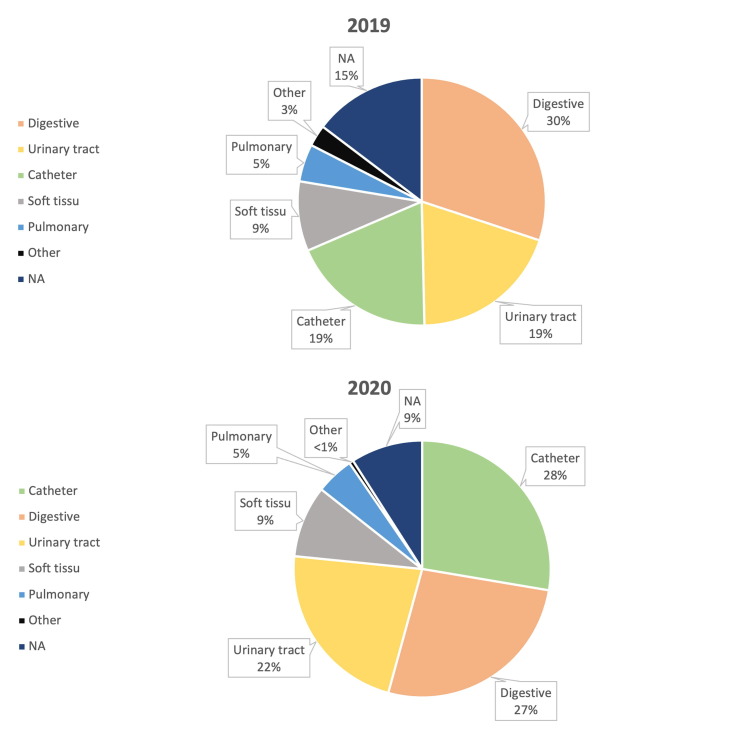
When the COVID-19 pandemic reached France early in 2020, the enforced nationwide lockdown deeply altered lifestyle as well as hospital processes and modalities of care. The aim of the study was to evaluate the impact during the lockdown of the first epidemic wave on the epidemiology of bacteremia in one French University Hospital.
Retrospective cohort study including adult patients with positive blood culture between 23 March to 24 May 2020. The clinical-microbiological characteristics were compared with those of the period from 25 March to 26 May 2019. The data were adjusted to the number of hospitalizations (h).
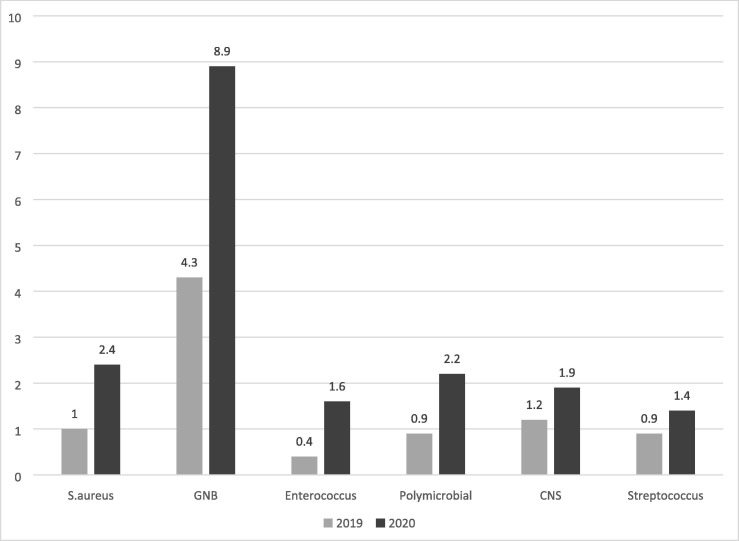
In 2020, 189 bacteremia were diagnosed from 1939 vials (9658 hospitalizations, 10911 emergency room consultations) compared to 143 from 1976 vials (14797 hospitalizations, 16493 emergency room consultations) recorded in 2019. The incidence of bacteremia increased up to 19.7 per 1000h in 2020 vs 9.7 in 2019 (p < 0.001). The main differences (2020 vs 2019) were: Staphylococcus aureus bacteremia (2.4 vs 1.0/1000h, p = 0.012), polymicrobial bacteremia (2.2 vs 0.9/1000h p = 0.013) and Gram-negative bacteremia (8.9 vs 4.3/1000h, p < 0.01). Conversely, Streptococcus pneumoniae incidence decreased (0 vs 0.47/1000h, p = 0.047). The standardized incidence ratio calculation confirmed these results.
The lockdown and the impact of the first wave of the Covid-19 pandemic on the health system resulted in increased hospital-diagnosed bacteremia and decreased pneumococcal bacteremia. Disruption and overload of ICUs, lockdown with preventive control measures, and decrease in human-to-human interaction may have been the main reasons.
2020 年初,新冠疫情在法国爆发,全国性的强制封锁深刻改变了人们的生活方式以及医院的流程和护理模式。本研究旨在评估第一波疫情封锁期间对一家法国大学医院菌血症流行病学的影响。
这是一项回顾性队列研究,纳入 2020 年 3 月 23 日至 5 月 24 日期间血培养阳性的成年患者。将临床微生物学特征与 2019 年 3 月 25 日至 5 月 26 日期间的特征进行比较。数据按住院(h)数量进行调整。
2020 年共诊断出 189 例菌血症,来自 1939 个培养瓶(9658 例住院患者,10911 例急诊就诊),而 2019 年共诊断出 143 例菌血症,来自 1976 个培养瓶(14797 例住院患者,16493 例急诊就诊)。2020 年菌血症的发病率上升至 19.7/1000h,而 2019 年为 9.7/1000h(p<0.001)。主要差异(2020 年与 2019 年)为:金黄色葡萄球菌菌血症(2.4/1000h 比 1.0/1000h,p=0.012),混合菌血症(2.2/1000h 比 0.9/1000h,p=0.013)和革兰氏阴性菌血症(8.9/1000h 比 4.3/1000h,p<0.01)。相反,肺炎链球菌的发病率下降(0/1000h 比 0.47/1000h,p=0.047)。标准化发病率比的计算证实了这些结果。
封锁以及第一波新冠疫情对卫生系统的影响导致医院诊断菌血症增加,肺炎球菌菌血症减少。重症监护病房的中断和过载、预防控制措施的封锁以及人际互动的减少可能是主要原因。