Jubyda Fatema Tuz, Nahar Kazi Sumaita, Barman Indrajeet, Johura Fatema-Tuz, Islam Mohammad Tarequl, Sultana Marzia, Ullah Wali, Tasnim Jarin, Biswas Sahitya Ranjan, Monir Md Mamun, George Christine Marie, Camilli Andrew, Ahmed Niyaz, Ross Allen G, Clemens John D, Alam Munirul
icddr,b (International Centre for Diarrhoeal Disease Research, Bangladesh), 68, Shaheed Tajuddin Ahmed Sharani, Mohakhali, Dhaka, 1212, Bangladesh.
Department of Microbiology, Jahangirnagar University, Dhaka, Bangladesh.
Gut Pathog. 2023 Apr 12;15(1):17. doi: 10.1186/s13099-023-00537-0.
Despite the advancement in our understanding of cholera and its etiological agent, Vibrio cholerae, the prevention and treatment of the disease are often hindered due to rapid changes in drug response pattern, serotype, and the major genomic islands namely, the CTX-prophage, and related genetic characteristics. In the present study, V. cholerae (n = 172) associated with endemic cholera in Dhaka during the years 2015-2021 were analyzed for major phenotypic and genetic characteristics, including drug resistance patterns.
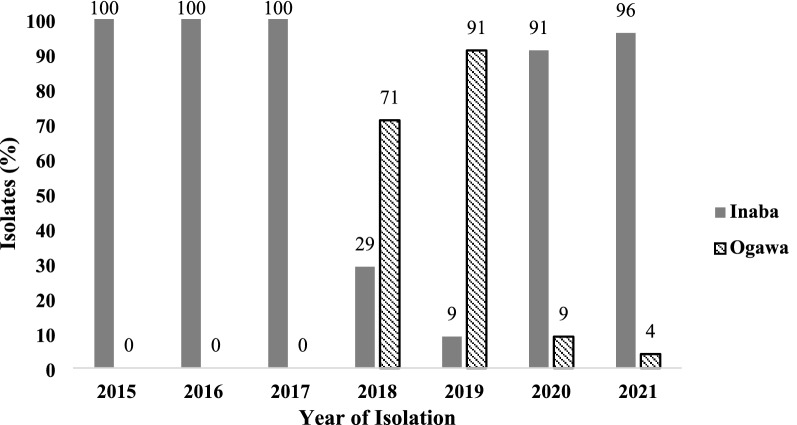
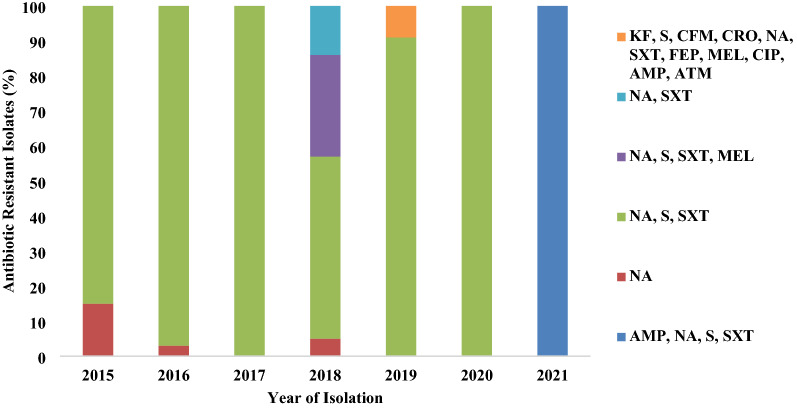
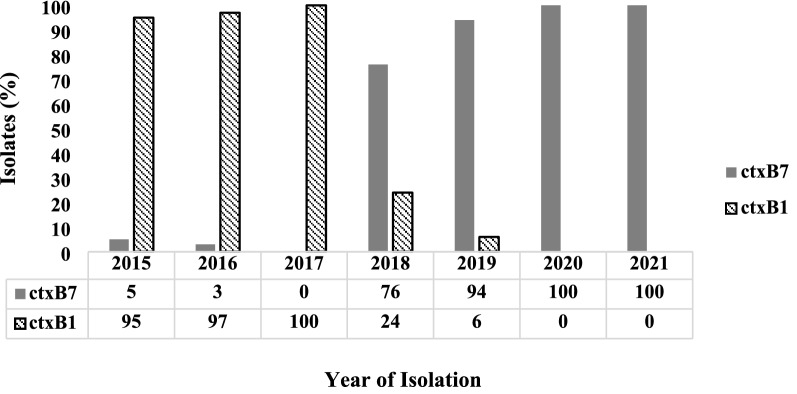
Results revealed that the V. cholerae strains belonged to serogroup O1 biotype El Tor carrying El Tor -specific genes rtxC, tcpA El Tor, and hlyA El Tor, but possessed classical-biotype cholera toxin. Serotypes of V. cholerae strains differed temporally in predominance with Inaba during 2015-2017, and again in 2020-2021, while Ogawa was the predominant serotype in 2018-2019. Also, ctxB1 was predominant in V. cholerae associated with cholera during 2015-2017, while ctxB7 was predominant in 2018, and in the subsequent years, as observed until 2021. V. cholerae strains differed in their antibiotic resistance pattern with a majority (97%) being multi-drug resistant (MDR) and belonging to six sub-groups. Notably, one of these MDR strains was resistant to eleven of the eighteen antibiotics tested, with resistance to fourth-generation cephalosporin (cefepime), and aztreonam. This extreme drug resistant (XDR) strain carried resistance-related genes namely, extended-spectrum β-lactamases (ESBL), blaOXA-1 and blaPER-3.
The observed temporal switching of serotypes, as well as the ctxB genotype, and the emergence of MDR/XDR V. cholerae and their association with endemic cholera in Dhaka underscore the need for routine monitoring of the pathogen for proper patient management.
尽管我们对霍乱及其病原体霍乱弧菌的认识有所进步,但由于药物反应模式、血清型以及主要基因组岛(即CTX噬菌体)和相关遗传特征的快速变化,该疾病的预防和治疗常常受到阻碍。在本研究中,对2015年至2021年期间在达卡与地方性霍乱相关的霍乱弧菌(n = 172)进行了主要表型和遗传特征分析,包括耐药模式。
结果显示,霍乱弧菌菌株属于O1血清群生物型埃尔托型,携带埃尔托型特异性基因rtxC、tcpA埃尔托型和hlyA埃尔托型,但拥有经典生物型霍乱毒素。霍乱弧菌菌株的血清型在优势地位上随时间变化,2015 - 2017年以及2020 - 2021年以稻叶型为主,而小川型在2018 - 2019年是主要血清型。此外,ctxB1在2015 - 2017年与霍乱相关的霍乱弧菌中占主导地位,而ctxB7在2018年及随后几年(直至2021年)占主导地位。霍乱弧菌菌株的抗生素耐药模式不同,大多数(97%)为多重耐药(MDR),并属于六个亚组。值得注意的是,这些MDR菌株之一对所测试的18种抗生素中的11种耐药,包括对第四代头孢菌素(头孢吡肟)和氨曲南耐药。这种极端耐药(XDR)菌株携带与耐药相关的基因,即超广谱β-内酰胺酶(ESBL)、blaOXA - 1和blaPER - 3。
观察到的血清型以及ctxB基因型的时间性转换,以及MDR/XDR霍乱弧菌的出现及其与达卡地方性霍乱的关联,强调了对病原体进行常规监测以妥善管理患者的必要性。